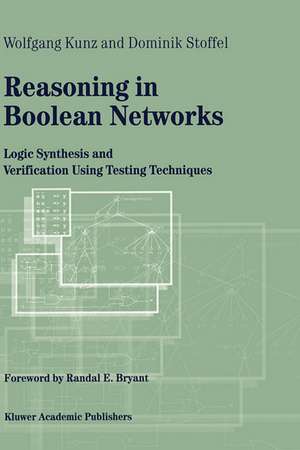
Reasoning in Boolean Networks
Autor Wolfgang Kunz, Dominik Stoffelen Limba Engleză Hardback – 30 iun 1997
While Boolean reasoning techniques have been a central element of two-level circuit theory for many decades Reasoning in Boolean Networks describes a basic reasoning methodology for multi-level circuits. This leads to a unified view on two-level and multi-level logic synthesis. The presented reasoning techniques are applied to various CAD-problems to demonstrate their usefulness for today's industrially relevant problems.
Reasoning in Boolean Networks provides lucid descriptions of basic algorithmic concepts in automatic test pattern generation, logic synthesis and verification and elaborates their intimate relationship to provide further intuition and insight into the subject. Numerous examples are provide for ease in understanding the material.
Reasoning in Boolean Networks is intended for researchers in logic synthesis, VLSI testing and formal verification as well as for integrated circuit designers who want to enhance their understanding of basic CAD methodologies.
Preț: 993.96 lei
Preț vechi: 1242.45 lei
-20%
Puncte Express: 1491
Carte tipărită la comandă
Livrare economică 18 noiembrie-02 decembrie
Livrare prin curier în România Termenul estimat este afișat lângă disponibilitate.
Transport gratuit pentru acest produs Plată online sau ramburs, în funcție de opțiunile comenzii.
Retur gratuit în 14 zile Comandă securizată și suport în română.
Specificații
ISBN-13: 9780792399216
ISBN-10: 0792399218
Pagini: 248
Ilustrații: XVI, 230 p.
Dimensiuni: 156 x 234 x 16 mm
Greutate: 0.53 kg
Ediția:1997 edition
Editura: Springer Nature B.V.
Locul publicării:New York, NY, United States
ISBN-10: 0792399218
Pagini: 248
Ilustrații: XVI, 230 p.
Dimensiuni: 156 x 234 x 16 mm
Greutate: 0.53 kg
Ediția:1997 edition
Editura: Springer Nature B.V.
Locul publicării:New York, NY, United States
V-ar putea interesa
-
 Preț: 69.77 lei
 -
 Fundamentals of Digital Logic with Verilog DesignStephen Brown-18%Preț: 1491.35 lei1818.72 lei
 -
 -20%Preț: 341.77 lei427.21 lei
 -
 Essential Logic for Computer ScienceRex PagePreț: 413.13 lei
 -
 Computer Architecture: A Quantitative ApproachJohn L. Hennessy-40%Preț: 530.11 lei881.24 lei
 -
 -20%Preț: 774.84 lei968.54 lei
 -
 Notes on the Synthesis of FormChristopher AlexanderPreț: 234.11 lei
 -
 How to Pass Diagrammatic Reasoning TestsMike BryonPreț: 83.23 lei
 -
 Preț: 204.99 lei
 -
 Digital Fundamentals, Global EditionThomas Floyd-11%Preț: 708.50 lei796.07 lei
 -
 Digital Design, Global EditionM. Morris Mano-15%Preț: 624.44 lei734.64 lei
 -
 Foundations of Analog and Digital Electronic CircuitsAnant Agarwal-28%Preț: 533.50 lei741.17 lei
 -
 Deep Learning Crash CourseGiovanni Volpe-35%Preț: 288.69 lei445.22 lei
 -
 Structural Decision Diagrams in Digital TestRaimund Ubar-20%Preț: 1417.40 lei1771.75 lei
 -
 Digital ElectronicsGareth MonkmanPreț: 364.65 lei
 -
 Preț: 286.75 lei
 -
 Modeling Complex Processes Through Nature-Analogous MethodsChristina Klüver-15%Preț: 511.58 lei601.85 lei
Public țintă
ResearchCuprins
1 Preliminaries.- 2 Combinational Atpg.- 3 Recursive Learning.- 4 AND/OR Reasoning Graphs.- 5 Logic Optimization.- 6 Logic Verification.- 7 Conclusions and Future Work.- References.