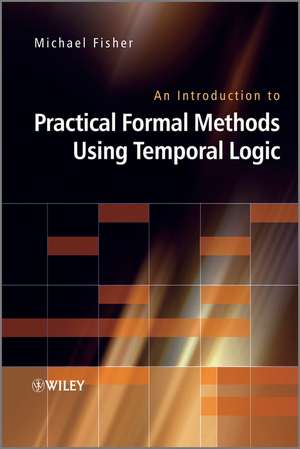
An Introduction to Practical Formal Methods Using Temporal Logic
Autor Michael Fisheren Limba Engleză Hardback – 15 iun 2011
Adresată studenților din anii terminali, masteranzilor și cercetătorilor în inginerie sau inteligență artificială, această lucrare semnată de Michael Fisher demistifică utilizarea logicii temporale în dezvoltarea sistemelor informatice complexe. Ne-a atras atenția modul în care autorul reușește să transforme un subiect aparent abstract într-un set de instrumente practice, esențiale pentru verificarea și specificația software-ului de tip safety-critical. Structura volumului publicat de Wiley este riguroasă, pornind de la conceptele de bază ale logicii temporale și avansând către tehnici de analiză sofisticate, precum verificarea algoritmică (model checking) și execuția directă. Subliniem importanța capitolului final, care ancorează teoria în realitatea inginerească prin studii de caz din domenii precum robotica, semnalizarea feroviară și designul hardware. Dacă Temporal Logic and State Systems de Fred Kröger v-a oferit cadrul teoretic fundamental și o privire de ansamblu asupra logicii de stare, An Introduction to Practical Formal Methods Using Temporal Logic oferă instrumentele practice și accesul la resurse software concrete pentru implementare. În contextul operei sale, deși Michael Fisher a explorat anterior metodologii educaționale în Hacking Instructional Design, această lucrare reprezintă o incursiune tehnică profundă în rigoarea matematică aplicată sistemelor reactive. Ritmul este alert, axat pe rezolvarea problemelor de concurență și comunicare, fiind susținut de numeroase exerciții și resurse online care facilitează învățarea activă.
Preț: 700.84 lei
Preț vechi: 910.19 lei
-23%
Carte disponibilă
Livrare economică 03-17 august
Livrare express 17-23 iulie pentru 43.84 lei
Specificații
ISBN-10: 0470027886
Pagini: 360
Dimensiuni: 177 x 251 x 29 mm
Greutate: 0.78 kg
Editura: Wiley
Locul publicării:Chichester, United Kingdom
V-ar putea interesa
-
 Introduction to Formal LogicRussell Marcus-23%Preț: 573.56 lei744.88 lei
 -
 Logic: A Very Short IntroductionGraham Priest-20%Preț: 56.12 lei70.36 lei
 -
 Principles of Model CheckingChristel Baier-22%Preț: 709.58 lei914.23 lei
 -
 Essential Logic for Computer ScienceRex PagePreț: 407.35 lei
 -
 Formal Methods for Multi-Agent Feedback Control SystemsDimos V. Dimarogonas-20%Preț: 600.65 lei750.82 lei
 -
 -20%Preț: 574.25 lei717.80 lei
 -
 Programming Language PragmaticsMichael Scott-40%Preț: 474.35 lei795.46 lei
 -
 Concurrent and Distributed Computing in JavaVijay K Garg-20%Preț: 730.97 lei913.71 lei
 -
 -20%Preț: 378.55 lei473.19 lei
 -
 From Chaos to ClarityJames Eagle-20%Preț: 129.23 lei161.53 lei
 -
 Logic For DummiesMark ZegarelliPreț: 114.46 lei
 -
 Liars and OutliersBruce SchneierPreț: 123.35 lei
 -
 Modal Logic for Open MindsJohan van BenthemPreț: 195.85 lei
 -
 Networked SystemsSalem Lahlou-20%Preț: 982.68 lei1228.35 lei
 -
 -20%Preț: 391.93 lei489.91 lei
 -
 Handbook of Model CheckingRoderick Bloem-20%Preț: 1011.72 lei1264.65 lei
 -
 -20%Preț: 318.67 lei398.33 lei
 -
 Formal Methods for Safety and SecurityManju Nanda-18%Preț: 745.12 lei908.69 lei
 -
 Logical Foundations of Computer Science (in 2 Volumes)Peter A Fejer-14%Preț: 2469.31 lei2871.28 lei
 -
 Logic in Computer ScienceHantao ZhangPreț: 460.47 lei
Public țintă
Senior undergraduate and graduate students taking courses on formal methods in the fields of Engineering, Computer Science, Artificial Intelligence and Information Systems, practitioners and researchers working on verification, specification and development of advanced safety–critical software systems.De ce să citești această carte
Recomandăm această carte profesioniștilor care lucrează la sisteme critice unde eroarea nu este o opțiune. Cititorul câștigă o înțelegere clară a modului în care logica temporală poate fi aplicată pentru a garanta acuratețea și fiabilitatea software-ului. Este un ghid esențial pentru a trece de la specificații ambigue la sisteme verificate riguros prin metode formale moderne.
Despre autor
Michael Fisher este un cercetător și autor cu o activitate diversificată, deținând poziția de profesor Robert S. Danforth la Oberlin College. Expertiza sa se extinde dincolo de metodele formale în informatică, acoperind domenii precum istoria și designul instrucțional. Această polivalență îi permite să abordeze subiecte tehnice complexe, precum logica temporală, dintr-o perspectivă structurată și pedagogică. În lucrările sale, Fisher pune accent pe aplicabilitatea practică a conceptelor, fie că este vorba de securitatea sistemelor computaționale sau de optimizarea proceselor de învățare.
Descriere scurtă
- Models temporal notions and uses them to analyze computational systems
- Provides a broad approach to temporal logic across many formal methods - including specification, verification and implementation
- Introduces and explains freely available tools based on temporal logics and shows how these can be applied
- Presents exercises and pointers to further study in each chapter, as well as an accompanying website providing links to additional systems based upon temporal logic as well as additional material related to the book.
Notă biografică
Michael Fisher is currently Professor of Computer Science at the University of Liverpool. He also heads the Logic and Computation research group and is Director of the Liverpool Verification Laboratory. Having been an active member of the research community for over 20 years, Professor Fisher is internationally recognised for his research into logic and computer science, particularly temporal verification, automated reasoning, high-level programming languages and formal methods for multi-agent systems. This has also led him to be programme chair of the International Symposium on Temporal Representation and Reasoning in 2004, and a member of the steering committee for this event. He has co-edited several books, including Advances in Temporal Logic (Kluwer, 2000), Foundations and Applications of Multi-Agent Systems (Springer-Verlag, 2002), Temporal Representation and Reasoning (IEEE Computer Society Press, 2002) and Handbook of Temporal Reasoning in Artificial Intelligence (Elsevier, 2005).