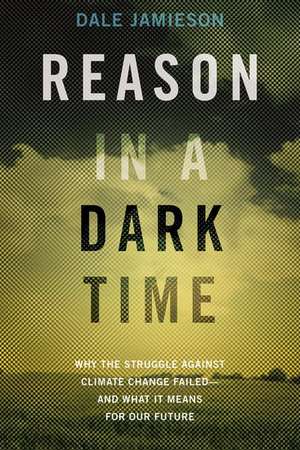
Reason in a Dark Time: Why the Struggle Against Climate Change Failed -- and What It Means for Our Future
Autor Dale Jamiesonen Limba Engleză Hardback – 24 apr 2014
Preț: 402.70 lei
Preț vechi: 473.76 lei
-15%
Puncte Express: 604
Carte disponibilă
Livrare economică 22 octombrie-05 noiembrie
Livrare prin curier în România Termenul estimat este afișat lângă disponibilitate.
Transport gratuit pentru acest produs Plată online sau ramburs, în funcție de opțiunile comenzii.
Retur gratuit în 14 zile Comandă securizată și suport în română.
Specificații
ISBN-13: 9780199337668
ISBN-10: 0199337667
Pagini: 288
Ilustrații: 10 illus.
Dimensiuni: 157 x 234 x 25 mm
Greutate: 0.5 kg
Editura: Oxford University Press
Colecția OUP USA
Locul publicării:New York, United States
ISBN-10: 0199337667
Pagini: 288
Ilustrații: 10 illus.
Dimensiuni: 157 x 234 x 25 mm
Greutate: 0.5 kg
Editura: Oxford University Press
Colecția OUP USA
Locul publicării:New York, United States
V-ar putea interesa
-
 -35%Preț: 570.17 lei872.58 lei
 -
 Preț: 278.27 lei
 -
 -24%Preț: 377.48 lei497.17 lei
 -
 -24%Preț: 571.05 lei755.13 lei
 -
 Consciousness and Moral ResponsibilityNeil Levy-29%Preț: 390.70 lei546.55 lei
 -
 Utilitarianism: A Very Short IntroductionKatarzyna de Lazari-Radek-20%Preț: 55.78 lei70.14 lei
 -
 -31%Preț: 590.64 lei855.00 lei
 -
 Virtue and Law in Plato and BeyondJulia Annas-29%Preț: 536.74 lei751.61 lei
 -
 Neuroethics: Anticipating the futureJudy Illes-30%Preț: 805.06 lei1156.13 lei
 -
 -31%Preț: 556.48 lei807.13 lei
 -
 -28%Preț: 374.87 lei522.91 lei
 -
 -22%Preț: 285.24 lei366.19 lei
 -
 -18%Preț: 251.78 lei306.80 lei
 -
 Philosophical Progress: In Defence of a Reasonable OptimismDaniel Stoljar-30%Preț: 404.73 lei578.24 lei
 -
 Oxford Studies in Metaethics 12Russ Shafer-Landau-19%Preț: 300.26 lei368.76 lei
 -
 -31%Preț: 628.03 lei910.27 lei
 -
 Doing and Allowing HarmFiona Woollard-31%Preț: 608.80 lei882.31 lei
 -
 Thinking about BriberyPhilip Nichols-27%Preț: 280.60 lei383.39 lei
 -
 Moral and Political Conceptions of Human RightsReidar Maliks-14%Preț: 746.46 lei867.98 lei
 -
 The Cambridge Handbook of Evolutionary EthicsMichael RusePreț: 252.58 lei
 -
 -15%Preț: 444.14 lei522.52 lei
 -
 The Blackwell Guide to Kant's EthicsThomas E. HillPreț: 347.75 lei
 -
 Preț: 249.03 lei
Recenzii
[I]t's the first book to be fully honest about climate change, it's the one book on the subject that stands a chance of not depressing you. It may even change your life.
Jamieson's book is a compelling, sophisticated, and highly learned contribution to climate scholarship written for an interdisciplinary and more general audience. In style, it is characteristically clear, well organized, and incisive yet suffused with a warm, humane sensibility and good humor. It is not afraid to make suggestive comments and signal broad programmatic change. In content, the book contains magisterial overviews of the history of the climate problem, climate economics, and obstacles to action.
A book that does justice to the full tragedy and weird comedy of climate change is Reason in a Dark Time, by the philosopher Dale Jamieson. Ordinarily, I avoid books on the subject, but a friend recommended it to me last summer, and I was intrigued by its subtitle, "Why the Struggle Against Climate Change Failed-And What It Means for Our Future"; by the word "failed" in particular, the past tense of it. I started reading and couldn't stop...I'd expected to be depressed by Reason in a Dark Time but I wasn't. Part of what's mesmerizing about climate change is its vastness across both space and time. Jamieson, by elucidating our past failures and casting doubt on whether we'll ever do any better, situates it within a humanely scaled context.
He has a gift for translating complexities into simple, often arresting terms, and is able to make even familiar material seem fresh ...The result is a book that is uncommonly accessible to nonspecialists, and will resonate even among those working in the trenches of climate policy, for whom works of pure philosophy often seem somewhat beside the point ... This is sound advice not only for economists but for anyone writing about climate change. Reason in a Dark Time succeeds so well because Jamieson, with very few exceptions, practices what he preaches.
An invaluable contribution to the dialogue about how to minimize the inevitable social and environmental devastation that looms large in our future.
Jamieson's ethical approach deserves serious consideration, especially since it manages to take our relationship with nature seriously while avoiding the debate about whether the value in nature is intrinsic or instrumental ... wide-ranging and ambitious ...
This book is a must read by all who wish to bring reason to the challenges [of climate change] we are going to face very soon, whether we want to or not...
Jamieson provides a wide-ranging account, looking at the lack of political incentives to act and at the influence of organised climate denial ... Jamieson concludes with some observations about things we can definitely do for the better right away (abandon coal), and with shrewd reflections on living with the knowledge that we flunked the climate test.
Part requiem for our failed hopes and part vision for our uncertain future, this remarkably far-ranging work by the philosopher who has thought longest and hardest about climate change could inspire fruitfully radical reassessment of our attitudes toward the most far-reaching challenge of our lifetimes. The climate is changing -- can we?
A highly informative, wise, and thought-provoking discussion of some of the greatest problems that humanity faces, and of some possible solutions.
Dale Jamieson is a philosopher and a realist. He was been working on climate change for a quarter of a century, alongside both scientists and policy makers. He argues that we are heading down a dangerous road and will likely have to face a much more difficult world. But he also argues that there is so much we can do individually and collectively to make a difference, and warns that the best must not be the enemy of the good. This is a very thoughtful and valuable book and should be read by all those who would wish to bring reason to a defining challenge of our century.
No one but Dale Jamieson could write an eminently readable book about climate change that ranges over the full sweep of the problem from the historical to the ethical, the scientific to the political. By placing this vexing issue into the broader context of the human condition, Jamieson guides the reader's mood from pessimism to optimism, and finally realism about our prospects.
Jamieson's book is a compelling, sophisticated, and highly learned contribution to climate scholarship written for an interdisciplinary and more general audience. In style, it is characteristically clear, well organized, and incisive yet suffused with a warm, humane sensibility and good humor. It is not afraid to make suggestive comments and signal broad programmatic change. In content, the book contains magisterial overviews of the history of the climate problem, climate economics, and obstacles to action.
A book that does justice to the full tragedy and weird comedy of climate change is Reason in a Dark Time, by the philosopher Dale Jamieson. Ordinarily, I avoid books on the subject, but a friend recommended it to me last summer, and I was intrigued by its subtitle, "Why the Struggle Against Climate Change Failed-And What It Means for Our Future"; by the word "failed" in particular, the past tense of it. I started reading and couldn't stop...I'd expected to be depressed by Reason in a Dark Time but I wasn't. Part of what's mesmerizing about climate change is its vastness across both space and time. Jamieson, by elucidating our past failures and casting doubt on whether we'll ever do any better, situates it within a humanely scaled context.
He has a gift for translating complexities into simple, often arresting terms, and is able to make even familiar material seem fresh ...The result is a book that is uncommonly accessible to nonspecialists, and will resonate even among those working in the trenches of climate policy, for whom works of pure philosophy often seem somewhat beside the point ... This is sound advice not only for economists but for anyone writing about climate change. Reason in a Dark Time succeeds so well because Jamieson, with very few exceptions, practices what he preaches.
An invaluable contribution to the dialogue about how to minimize the inevitable social and environmental devastation that looms large in our future.
Jamieson's ethical approach deserves serious consideration, especially since it manages to take our relationship with nature seriously while avoiding the debate about whether the value in nature is intrinsic or instrumental ... wide-ranging and ambitious ...
This book is a must read by all who wish to bring reason to the challenges [of climate change] we are going to face very soon, whether we want to or not...
Jamieson provides a wide-ranging account, looking at the lack of political incentives to act and at the influence of organised climate denial ... Jamieson concludes with some observations about things we can definitely do for the better right away (abandon coal), and with shrewd reflections on living with the knowledge that we flunked the climate test.
Part requiem for our failed hopes and part vision for our uncertain future, this remarkably far-ranging work by the philosopher who has thought longest and hardest about climate change could inspire fruitfully radical reassessment of our attitudes toward the most far-reaching challenge of our lifetimes. The climate is changing -- can we?
A highly informative, wise, and thought-provoking discussion of some of the greatest problems that humanity faces, and of some possible solutions.
Dale Jamieson is a philosopher and a realist. He was been working on climate change for a quarter of a century, alongside both scientists and policy makers. He argues that we are heading down a dangerous road and will likely have to face a much more difficult world. But he also argues that there is so much we can do individually and collectively to make a difference, and warns that the best must not be the enemy of the good. This is a very thoughtful and valuable book and should be read by all those who would wish to bring reason to a defining challenge of our century.
No one but Dale Jamieson could write an eminently readable book about climate change that ranges over the full sweep of the problem from the historical to the ethical, the scientific to the political. By placing this vexing issue into the broader context of the human condition, Jamieson guides the reader's mood from pessimism to optimism, and finally realism about our prospects.
Notă biografică
Dale Jamieson teaches Environmental Studies, Philosophy, and Law at New York University, and was formerly affiliated with the National Center for Atmospheric Research. He is the author of Ethics and the Environment: An Introduction, and Morality's Progress: Essays on Humans, Other Animals, and the Rest of Nature.
Cuprins
- 1. Introduction
- 2. The Nature of the Problem
- 2.1 The Development of Climate Science
- 2.2 Climate Change as a Public Issue
- 2.3 The Age of Climate Diplomacy
- 2.4 Concluding Remarks
- 3. Obstacles to Action
- 3.1 Scientific Ignorance
- 3.2 Politicizing Science
- 3.3 Facts and Values
- 3.4 The Science/Policy Interface
- 3.5 Organized Denial
- 3.6 Partisanship
- 3.7 Political Institutions
- 3.8 The Hardest Problem
- 3.9 Concluding Remarks
- 4. The Limits of Economics
- 4.1 Economics and Climate Change
- 4.2 The Stern Review and Its Critics
- 4.3 Discounting
- 4.4 Further Problems
- 4.5 State of the Discussion
- 4.6 Concluding Remarks
- 5. The Frontiers of Ethics
- 5.1 The Domain of Concern
- 5.2 Responsibility and Harm
- 5.3 Fault Liability
- 5.4 Human Rights and Domination
- 5.5 Differences That Matter
- 5.6 Revising Morality
- 5.7 Concluding Remarks
- 6. Living With Climate Change
- 6.1 Life in the Anthropocene
- 6.2 It Doesn't Matter What I Do
- 6.3 It's Not the Meat It's the Motion
- 6.4 Ethics for the Anthropocene
- 6.5 Respect For Nature
- 6.6 Global Justice
- 6.7 Concluding Remarks
- 7. Politics, Policy, and the Road Ahead
- 7.1 The Rectification of Names
- 7.2 Adaptation: The Neglected Option?
- 7.3 Why Abatement and Mitigation Still Matter
- 7.4 The Category Formerly Known as Geoengineering
- 7.5 The Way Forward
- 7.6 Concluding Remarks