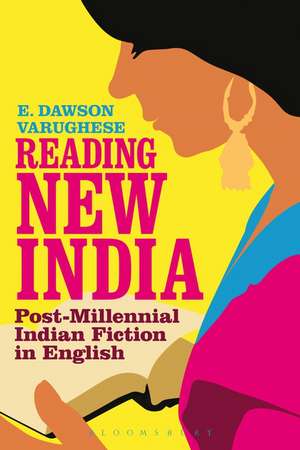
Reading New India: Post-Millennial Indian Fiction in English
Autor Dr E. Dawson Varugheseen Limba Engleză Paperback – 14 feb 2013
Reading New India covers such topics as:
- Representation of the city: Mumbai and Bangalore
- Chick Lit to Crick Lit - Call centre dramas and corporate lives
- Crime novels and Bharati narratives
- Graphic novels
Including a chronological time-line of major social, cultural and political reforms, biographies of the major authors covered, further reading and a glossary of Hindi terms, this book is an essential guide for students of contemporary world literature and postcolonial writing.
Preț: 255.87 lei
Preț vechi: 304.40 lei
-16%
Puncte Express: 384
Carte tipărită la comandă
Livrare economică 13-27 noiembrie
Livrare prin curier în România Termenul estimat este afișat lângă disponibilitate.
Transport gratuit de la 400.00 lei Plată online sau ramburs, în funcție de opțiunile comenzii.
Retur gratuit în 14 zile Comandă securizată și suport în română.
Specificații
ISBN-13: 9781441181749
ISBN-10: 1441181741
Pagini: 200
Dimensiuni: 156 x 234 x 15 mm
Greutate: 0.32 kg
Editura: Bloomsbury Publishing
Colecția Bloomsbury Academic
Locul publicării:London, United Kingdom
ISBN-10: 1441181741
Pagini: 200
Dimensiuni: 156 x 234 x 15 mm
Greutate: 0.32 kg
Editura: Bloomsbury Publishing
Colecția Bloomsbury Academic
Locul publicării:London, United Kingdom
V-ar putea interesa
-
 -31%Preț: 819.42 lei1192.00 lei
 -
 Abyssinia's Samuel Johnson: Ethiopian Thought in the Making of an English AuthorWendy Laura Belcher-31%Preț: 696.39 lei1008.77 lei
 -
 After AtheismMark VernonPreț: 384.52 lei
 -
 A Poetics of RelationO. FerlyPreț: 389.10 lei
 -
 Preț: 303.95 lei
 -
 Preț: 391.00 lei
 -
 Postcolonial TheoriesDr Jenni Ramone-22%Preț: 212.70 lei271.73 lei
 -
 Preț: 394.85 lei
 -
 Spivak and PostcolonialismT. SakhkhanePreț: 387.50 lei
 -
 Beyond the PostcolonialKenneth A LoparoPreț: 392.00 lei
 -
 Postcolonial Fiction and DisabilityC. Barker-15%Preț: 701.12 lei824.85 lei
 -
 Preț: 392.31 lei
 -
 Postcolonialism and Science FictionJ. Langer-18%Preț: 729.20 lei889.28 lei
 -
 Preț: 391.93 lei
 -
 The City of TranslationKenneth A LoparoPreț: 389.80 lei
 -
 Colonialism, Modernity, and LiteratureS. MohantyPreț: 371.93 lei
 -
 -18%Preț: 1251.34 lei1526.02 lei
 -
 -18%Preț: 1257.26 lei1533.24 lei
 -
 -18%Preț: 1255.17 lei1530.69 lei
 -
 -18%Preț: 1254.12 lei1529.41 lei
 -
 English Heart, Hindi HeartlandRashmi SadanaPreț: 412.74 lei
 -
 Flesh and Fish BloodSubramanian ShankarPreț: 308.79 lei
 -
 Urdu Literary CultureM. FarooqiPreț: 392.00 lei
 -
 -25%Preț: 276.77 lei368.86 lei
 -
 Citizenship Under PressureRachel L MordecaiPreț: 310.39 lei
Cuprins
Introduction: From Postcolonial India to New India
1.1 'Indianness' since Independence
1.2 Literary 'Indianness'
1.3 New India, a New Canon
2. Urban Scapes
2.1 Mumbai
2.2 Bangalore
3. Chick Lit - Crick Lit
3.1 Chick Lit
3.2 Crick Lit
4. Young India
4.1 Call Centres and Corporate Lives
4.2 MSMs
5. Crime Writing
5.1 Female Detectives
5.2 Difference and Death
6. Fantasy and Epic Myth
6.1 New [Fantastical] India
6.2 Bharat Fantasy
7. Graphic Novels
7.1 The Harappa Files (2011)
7.2 Kashmir Pending (2007)
Conclusion: New/Old Stories in Old/New Ways
Further Reading
Index
1.1 'Indianness' since Independence
1.2 Literary 'Indianness'
1.3 New India, a New Canon
2. Urban Scapes
2.1 Mumbai
2.2 Bangalore
3. Chick Lit - Crick Lit
3.1 Chick Lit
3.2 Crick Lit
4. Young India
4.1 Call Centres and Corporate Lives
4.2 MSMs
5. Crime Writing
5.1 Female Detectives
5.2 Difference and Death
6. Fantasy and Epic Myth
6.1 New [Fantastical] India
6.2 Bharat Fantasy
7. Graphic Novels
7.1 The Harappa Files (2011)
7.2 Kashmir Pending (2007)
Conclusion: New/Old Stories in Old/New Ways
Further Reading
Index
Recenzii
A thoughtful book, laden with insight, at the ways in which a new India is being written and read.
Reading New India provides a much needed and timely introduction to postmillennial India and Indian English literature within India as they move beyond the postcolonial past and forward into 'Newness'.
The splendor and the misery of Reading New India is that it whets the appetite for the fiction it introduces but necessarily fails to satiate the appetite thus awakened.
Varughese's book is a gift for academics teaching Indian writing in English. And perhaps it will outshine all other books in the 'academic' library with its lively and pulpy, Karan Joharesque cover of bright yellow and pink.
This is an ambitious and novel project, strenuous though, considering the vast body of literature to be considered. And [Dawson] has done it with a sense of academic objectivity. Reading New India: Post-Millennial Fiction in English - "the first book to focus on fiction at the millennium, the crossroad for India's globalisation" - is not a critique or a collection of reviews of individual novels or a generalised assessment of the oeuvre of individual writers, but a representation of various trends, themes, motifs, lineaments, zeitgeist, dynamic & conflicting cultural mores & values informing the fiction in hand, and an analysis of the core themes of some of the individual typical novels written in different voices.
The book is racy, giving you a smooth ride peppered with Indian exotica. You can't stop once you hold it in hands. It is a thorough work in itself. And who says, you get to know a place by reading its history and sociology only. Varughese fulfills it through her literary sojourn as well in an impeccable manner. Besides literary archives, you could place it in tourism section also to show the new rising India, in a big stroke.
Occasionally there's a book that catches the eye and this exposé of post-millennial Indian fiction in English is no exception . An experienced field researcher of world literature in English, Emma Dawson Varughese has put some painstaking work into her research describing how Indian fiction has moved beyond notions of 'postcolonial' writing to reveal progressively self-assured and varied cultures.
[T]his book marks important new interventions into the classification of contemporary Indian literature as moving away from a postcolonial paradigm that axiomatically centralizes the impact of British colonization as the defining Indian legacy. The strengths of the work undoubtedly lie in its ability to identify and delineate new and evolving trends in literature backed up by detailed close readings of selected novels. Furthermore, though the preface envisions the readership as predominantly Indian, a glossary of terms, a timeline, and author biographies open it up to a wider readership, and it will undoubtedly prove to be a useful resource for countless students of contemporary Indian literature.
Reading New India provides a much needed and timely introduction to postmillennial India and Indian English literature within India as they move beyond the postcolonial past and forward into 'Newness'.
The splendor and the misery of Reading New India is that it whets the appetite for the fiction it introduces but necessarily fails to satiate the appetite thus awakened.
Varughese's book is a gift for academics teaching Indian writing in English. And perhaps it will outshine all other books in the 'academic' library with its lively and pulpy, Karan Joharesque cover of bright yellow and pink.
This is an ambitious and novel project, strenuous though, considering the vast body of literature to be considered. And [Dawson] has done it with a sense of academic objectivity. Reading New India: Post-Millennial Fiction in English - "the first book to focus on fiction at the millennium, the crossroad for India's globalisation" - is not a critique or a collection of reviews of individual novels or a generalised assessment of the oeuvre of individual writers, but a representation of various trends, themes, motifs, lineaments, zeitgeist, dynamic & conflicting cultural mores & values informing the fiction in hand, and an analysis of the core themes of some of the individual typical novels written in different voices.
The book is racy, giving you a smooth ride peppered with Indian exotica. You can't stop once you hold it in hands. It is a thorough work in itself. And who says, you get to know a place by reading its history and sociology only. Varughese fulfills it through her literary sojourn as well in an impeccable manner. Besides literary archives, you could place it in tourism section also to show the new rising India, in a big stroke.
Occasionally there's a book that catches the eye and this exposé of post-millennial Indian fiction in English is no exception . An experienced field researcher of world literature in English, Emma Dawson Varughese has put some painstaking work into her research describing how Indian fiction has moved beyond notions of 'postcolonial' writing to reveal progressively self-assured and varied cultures.
[T]his book marks important new interventions into the classification of contemporary Indian literature as moving away from a postcolonial paradigm that axiomatically centralizes the impact of British colonization as the defining Indian legacy. The strengths of the work undoubtedly lie in its ability to identify and delineate new and evolving trends in literature backed up by detailed close readings of selected novels. Furthermore, though the preface envisions the readership as predominantly Indian, a glossary of terms, a timeline, and author biographies open it up to a wider readership, and it will undoubtedly prove to be a useful resource for countless students of contemporary Indian literature.
Notă biografică
E. Dawson Varughese is a Professor at Manipal Academy of Higher Education, India. She is author of Beyond The Postcolonial (2012) and is an experienced field researcher of world literature in English. She is the editor of numerous anthologies of short stories from such countries as Cameroon, Uganda and Malaysia. See her work at: www.beyondthepostcolonial.com.