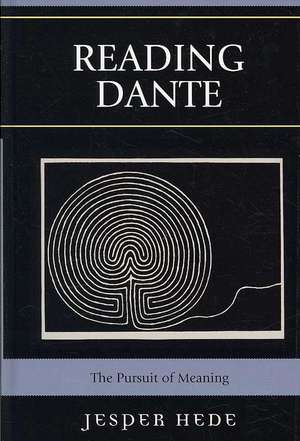
Reading Dante
Autor Jesper Hedeen Limba Engleză Hardback – sep 2007
Preț: 775.04 lei
Preț vechi: 1061.69 lei
-27%
Puncte Express: 1163
Carte tipărită la comandă
Livrare economică 10-24 august
Livrare prin curier în România Termenul estimat este afișat lângă disponibilitate.
Transport gratuit pentru acest produs Plată online sau ramburs, în funcție de opțiunile comenzii.
Retur gratuit în 14 zile Comandă securizată și suport în română.
Specificații
ISBN-13: 9780739121962
ISBN-10: 0739121960
Pagini: 304
Dimensiuni: 157 x 235 x 22 mm
Greutate: 0.65 kg
Editura: Bloomsbury Publishing
ISBN-10: 0739121960
Pagini: 304
Dimensiuni: 157 x 235 x 22 mm
Greutate: 0.65 kg
Editura: Bloomsbury Publishing
V-ar putea interesa
-
 Ancient Greek LiteratureK. J. Dover-18%Preț: 329.35 lei402.34 lei
 -
 Song of the Distant Dove: Judah Halevi's PilgrimageRaymond P. Scheindlin-38%Preț: 417.02 lei667.39 lei
 -
 Iliad IXHomer-18%Preț: 244.77 lei297.02 lei
 -
 -19%Preț: 514.15 lei638.53 lei
 -
 A Commentary on Horace: Odes: Book IR. G. M. Nisbet-20%Preț: 534.05 lei666.04 lei
 -
 -27%Preț: 802.49 lei1093.55 lei
 -
 Eudemian Ethics Books I, II, and VIIIAristotle-11%Preț: 359.47 lei403.91 lei
 -
 Beowulf: A Student EditionGeorge Jack-10%Preț: 297.76 lei330.13 lei
 -
 Oxford Readings in Greek TragedyErich Segal-34%Preț: 638.31 lei960.57 lei
 -
 -31%Preț: 380.49 lei550.99 lei
 -
 A Companion to PetroniusEdward Courtney-31%Preț: 508.16 lei739.95 lei
 -
 Greek Oratory: Tradition and OriginalityStephen Usher-30%Preț: 599.79 lei852.36 lei
 -
 Plutarch's Lives: Exploring Virtue and ViceTimothy E. Duff-19%Preț: 501.17 lei620.32 lei
 -
 Apuleius: A Latin SophistS. J. Harrison-19%Preț: 368.04 lei454.64 lei
 -
 Preț: 60.98 lei
 -
 Euripides: Suppliant WomenIan C. Storey-18%Preț: 174.25 lei213.63 lei
 -
 Homer: Iliad IHomer-23%Preț: 154.39 lei201.32 lei
 -
 Maddern, C: York Notes Companions: Medieval LiteratureCarole MaddernPreț: 87.51 lei
 -
 The OdysseyHomerPreț: 38.28 lei
 -
 Preț: 142.52 lei
Descriere
Examines the problem of thematic coherence in Dante's "Divina Commedia". The author argues that a systematic parallel reading of the poem's three parts reveals that it is the vision of divine order that provides the poem with its thematic unity.
Cuprins
Chapter 1 The Enigma of Meaning
Chapter 2 Heraclitean River
Chapter 3 Design in the Wax
Chapter 4 Fragile Leaves of the Sibyl
Chapter 5 Courage of Venus
Chapter 6 Circle of Violence
Chapter 2 Heraclitean River
Chapter 3 Design in the Wax
Chapter 4 Fragile Leaves of the Sibyl
Chapter 5 Courage of Venus
Chapter 6 Circle of Violence
Recenzii
Jesper Hede has produced one of the most informative and challenging inquiries into the structure of Dante's great epic up to now. It is both a rehabilitation and a continuation of T. K. Seung's study of the unity of The Divine Comedy, published in 1962. Bound to be controversial, Hede's thesis takes Seung's conclusions about theology and psychology as the two fundamental disciplines for Dante's exposition of God's universal order one step further. He tests his precursor's idea of the thematic coherence of The Comedy on a set of cardinal scenes from Dante's Hell and Paradise, effectively showing how the medieval poet's Trinitarian design informs every part of his work. Along the way, Hede delivers a penetrating scrutiny of a large number of prominent Dante scholars, combining close readings with critical observations. Accordingly, his work can be read as a hermeneutic summa of recent research on the structure of The Comedy, but above all it constitutes a bold contribution to the understanding of its unity of vision, an issue which certainly was at the heart of our medieval poet's conception of the universe.
Jesper Hede has concentrated the research of many years into an illuminating and accessible study of Dante. Well aware of the huge amount of criticism devoted to Divina Commedia, Hede provides a much-needed and convincing treatment of the poem's thematic unity. Hell, purgatory, and heaven are bound together in this new reading, which shows deep humanistic insight.
Jesper Hede has concentrated the research of many years into an illuminating and accessible study of Dante. Well aware of the huge amount of criticism devoted to Divina Commedia, Hede provides a much-needed and convincing treatment of the poem's thematic unity. Hell, purgatory, and heaven are bound together in this new reading, which shows deep humanistic insight.