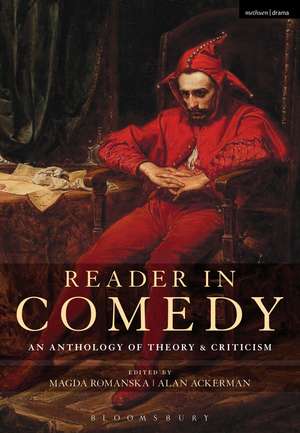
Reader in Comedy: An Anthology of Theory and Criticism
Editat de Magda Romanska, Prof. Alan Ackermanen Limba Engleză Paperback – 17 noi 2016
Publicată sub prestigioasa amprentă Methuen Drama a editurii Bloomsbury Publishing, Reader in Comedy se prezintă ca o resursă academică de o densitate remarcabilă, un volum în format paperback ce reunește peste șaptezeci de texte esențiale. Remarcăm imediat calitatea organizării materialului, cele 388 de pagini fiind tipărite cu o claritate care facilitează parcurgerea unor fragmente teoretice complexe, de la manuscrise antice la eseuri contemporane. Experiența de lectură este una de tip exploratoriu, oferind o perspectivă panoramică asupra modului în care gândirea umană a conceptualizat umorul de-a lungul a peste două milenii.
Structura este riguros cronologică, divizată în cinci mari epoci: Antichitatea și Evul Mediu, Renașterea, de la Restaurație la Romantism, Era Industrială și, în final, secolele XX și XXI. Această progresie ne permite să urmărim cum „malicia” identificată de Platon în Philebus evoluează spre analizele structurale ale lui Mikhail Bakhtin sau perspectivele deconstructiviste ale lui Jacques Derrida. Ca și The Routledge Comedy Studies Reader, volumul pune în valoare pluralitatea perspectivelor critice, dar se distinge printr-o ancorare mult mai profundă în istoria filosofiei și a literaturii clasice, nu doar în studiile media recente.
În contextul operei editorilor, Magda Romanska continuă aici preocuparea pentru fundamentele teoretice ale spectacolului, vizibilă și în The Routledge Companion to Dramaturgy, însă aici accentul cade pe mecanismele specifice ale comicului ca fenomen trans-istoric. Descoperim o lucrare care demonstrează că, departe de a fi un gen periferic, comedia este intrinsec legată de politică, economie și religie, oferind un instrument de analiză indispensabil pentru studenții de la litere și arte dramatice.
Preț: 271.58 lei
Preț vechi: 346.06 lei
-22%
Carte tipărită la comandă
Livrare economică 27 noiembrie-11 decembrie
Specificații
ISBN-10: 1474247881
Pagini: 388
Dimensiuni: 170 x 244 x 26 mm
Greutate: 0.74 kg
Editura: Bloomsbury Publishing
Colecția Methuen Drama
Locul publicării:London, United Kingdom
V-ar putea interesa
-
 The Pot of Gold and Other PlaysPlautusPreț: 92.62 lei
 -
 EmmaJane Austen-24%Preț: 50.51 lei66.77 lei
 -
 Comedy: A Very Short IntroductionMatthew Bevis-20%Preț: 56.97 lei71.00 lei
 -
 HumourTerry EagletonPreț: 81.29 lei
 -
 The Routledge Comedy Studies ReaderIan WilkiePreț: 377.12 lei
 -
 The Norton Anthology of Theory and CriticismVincent B. LeitchPreț: 484.91 lei
 -
 Nagler, A: Source Book in Theatrical HistoryAlois Maria NaglerPreț: 199.22 lei
 -
 PoeticsAristotle-19%Preț: 20.09 lei24.92 lei
 -
 Art in Theory 1900-2000 - An Anthology of Changing Ideas 2eCharles HarrisonPreț: 315.21 lei
 -
 Brecht on TheatreBertolt BrechtPreț: 143.63 lei
 -
 Funnier: A New Theory for the Practice of ComedyAnne LiberaPreț: 181.39 lei
 -
 Theatre Symposium, Vol. 16: Comedy Tonight!Jay MalarcherPreț: 238.31 lei
 -
 A Cultural History of Comedy in the Age of EnlightenmentElizabeth Kraft-30%Preț: 540.97 lei770.88 lei
 -
 A Cultural History of Comedy in AntiquityMichael Ewans-49%Preț: 134.03 lei262.25 lei
 -
 A Cultural History of Comedy in the Age of EmpireMatthew Kaiser-49%Preț: 135.14 lei262.88 lei
 -
 A Cultural History of Comedy in the Age of EnlightenmentElizabeth Kraft-49%Preț: 135.13 lei262.87 lei
 -
 A Cultural History of Comedy in the Early Modern AgeProfessor Andrew McConnell Stott-49%Preț: 134.44 lei262.49 lei
 -
 A Cultural History of Comedy in the Middle AgesMartha Bayless-49%Preț: 133.48 lei261.95 lei
 -
 -15%Preț: 441.70 lei519.65 lei
 -
 Golden Age ComediaCharles GanelinPreț: 185.14 lei
De ce să citești această carte
Această antologie este esențială pentru oricine dorește să înțeleagă rădăcinile intelectuale ale râsului. Cititorul câștigă acces la o bibliotecă întreagă de critică într-un singur volum, beneficiind de introduceri care contextualizează fiecare epocă. Este o achiziție valoroasă pentru studenți și cercetători, oferind argumente teoretice solide care explică de ce comedia rămâne unul dintre cele mai pragmatice și revelatoare aspecte ale vieții umane.
Despre autor
Magda Romanska este profesor asociat de studii teatrale și dramaturgie la Emerson College și profesor vizitator la Yale School of Drama. Expertiza sa vastă în teoria dramei este reflectată în lucrări precum The Post-Traumatic Theatre of Grotowski and Kantor. Prof. Alan Ackerman predă engleza la Universitatea din Toronto și este editorul jurnalului Modern Drama. Împreună, aceștia au curatoriat o selecție care reflectă rigoarea academică necesară pentru a cartografia evoluția teoriei comice de la Aristotel până în prezent.
Cuprins
ACKNOWLEDGEMENTSGENERAL INTRODUCTION CHAPTER 1: ANTIQUITY AND THE MIDDLE AGESINTRODUCTIONTEXTSAncient Views of Comedy 1) Plato, Philebus ("The Basis of comedy is malice") 2) Aristotle on the Origins and Function of Comedya. Poeticsb. "On the qualities of character that are moderate" from Nicomachean Ethics c. Tractatus Coislinianus 3) Horace, "Remarks on Comedy" from Epistles, Satires 4) Quintilian, Institutio oratoria (A.D. 95) Medieval Views of Comedy5) Evanthius, On Drama (ca. A.D. 350) 6) Donatus, On Comedy (ca. A.D. 350) 7) Hrotsvita of Gandersheim, Prologue to the comedies (ca. A.D. 935-972) 8) Dante Alighieri, De vulgari eloquentia (On Eloquence in the vernacular) (1302-1305) 9) Definitions of Comedy (John of Garland, Dante, John Lydgate) 10) Attitudes to the Comic Theater (John of Salisbury, Honorius of Autun, Liuprand of Cremona) CHAPTER 2: THE RENAISSANCEINTRODUCTION TEXTS1) Erasmus, Collected Works of Erasmus (1512) 2) Gian Giorgio Trissino, "Division VI: Comedy", Poetica (1529) 3) Sir Thomas Elyot, , "XII: The Second and third decay of leaning" The Governor The boke named the gouernour / deuised by Thomas Elyot knight(1531) 4) Nicholas Udall, Prologue to Ralph Roster Doister (1538) 5) Thomas Wilson, "Of Delighting the Hearers and Stirring Them to Laughter" fromThe Arte of Rhetorique (1560) 6) George Gascoigne, Prologue to The Glasse of Governement (1575) 7) Stephen Gosson, The School of Abuse: containing a pleasant invective against poets, pipers, players, jesters, etc (1579) 8) Sir Philip Sidney, "Comedy," "Tragicomedy," The Nature of Laughter" from The Defence of Poesie (1595) 9) Ben Jonson, Every Man Out of his Humour (1599) 10) Battista Guarini, Compendium of Tragicomic Poetry (1601) CHAPTER 3: RESTORATION TO ROMANTICISM INTRODUCTION TEXTS1) Samuel Butler, Characters and Passages from Notebooks (ca. 1650) 2) Molière, Preface to Tartuffe (1667) 3) William Congreve, Dedication to The Double-Dealer (1693) 4) John Dryden, Of Dramatick Poesie, an Essay(1668) 5) Aphra Behn "Epistle to the Reader", from The Dutch Lover (1673) 6) John Dryden, "A Discourse Concerning the Original and Progress of Satire" (1693) 7) Jeremy Collier, A Short View of the Immorality and Profaneness of the English Stage (1698) 8) Anthony Ashley Cooper, Third Earl of Shaftesbury, "The Freedom of Wit and Humour" from Sensus communis: An essay on the freedom of wit and humour (1709) 9) Richard Blackmore, Essay upon Wit(1716) 10) Henry Fielding, selections from the Preface to Joseph Andrews (1742) 11) Samuel Johnson, "The Difficulty of Defining Comedy", The Rambler (1751) 12) Oliver Goldsmith, "A Comparison between Laughing and Sentimental Comedy" (1773) 13) Immanuel Kant, "Comparison of the Aesthetic Value of the Various Fine Arts" from Critique of Judgment, 14) Jean Paul Richter, "On the Ridiculous" (1804) 15) William Hazlitt, "On Wit and Humour" (1819) 16) Charles Lamb, "On the Artificial Comedy of the Last Century" (1822) CHAPTER 4: THE INDUSTRIAL AGEINTRODUCTION TEXTS1) Søren Kierkegaard, "The reality of suffering (humor)"; "Humor as an incognito for religiosity"; "Humor - The religiosity of hidden inwardness" from Concluding Unscientific Postscript (1846) 2) W. M. Thackeray, The English Humourists of the Eighteenth Century (1853) 3) Charles Baudelaire, "On the Essence of Laughter" (1855) 4) George Meredith, An Essay on Comedy and the Uses of the Comic Spirit (1897) 5) George Bernard Shaw, "Meredith on Comedy" (1897) 6) Mark Twain, "How to Tell a Story" (1897) 7) Henri Bergson, "Laughter" (1901) 8) Sigmund Freud, "Wit and the Various Forms of the Comic" (1905) CHAPTER 5: THE TWENTIETH CENTURY AND EARLY-TWENTY-FIRST CENTURY INTRODUCTIONTEXTS1) Luigi Pirandello, On Humor (1908, 1920) 2) Virginia Woolf, "Pure English" (1920) 3) Constance Rourke, American Humor: A Study of the National Character (1931) 4) Kenneth Burke, "Comic Correctives" from Attitudes Toward History (1937) 5) Susanne Langer, "The Comic Rhythm" from Feeling and Form (1953) 6) Georges Bataille, "Un-Knowing: Laughter and Tears" (1953) 7) Northrop Frye "Comic Fictional Modes" from Anatomy of Criticism: Four Essays (1965) 8) Jacques Derrida, "From Restricted to General Economy: A Hegelianism without Reserve" from Writing and Difference (1967) 9) Mikhail Bakhtin, "Rabelais in the History of Laughter" from Rabelais and His World (1965) 10) René Girard, "Perilous Balance: a Comic Hypothesis" (1972) 11) Gerald Mast, "Comic Films-Categories and Definitions" from The Comic Mind: Comedy and the Movies (1973) 12) Stanley Cavell, Pursuits of Happiness: The Hollywood Comedy of Remarriage (1981) 13) Mahadev L. Apte, "Sexual Inequality in Humor" from Humor and Laughter: An Anthropological Approach (1984) 14) Linda Hutcheon, A Theory of Parody (1985) 15) Henry Jenkins, "Agee, Mast, and the Classical Tradition" and "Early Sound Comedy and the Vaudeville Aesthetic" from What Made Pistachio Nuts?: Early Sound Comedy and the Vaudeville Aesthetic (1992) 16) Simon Critchley, On Humour (2002) 17) Glenda R. Carpio, Black Humor in the Fictions of Slavery (2008) 18) Michael North, Machine-Age Comedy (2009) 19) Ruth Wisse, No Joke: Making Jewish Humor (2013) 20) Magda Romanska, "Disability in Tragic and Comic Frame" (2015) PERMISSIONS ACKNOWLEDGEMENTSINDEX
Recenzii
[The editors] model a clear acceptance of historical shifts in ideas on the function of comedy, providing rigorous contextualization that locates each idea in its moment in time, and makes this a robust and useful primer for Western comedy theory through the ages . A strong collection of foundational texts for those looking to ground themselves in Western scholarship of the comic over time.
Editors Magda Romanska and Alan Ackerman open their book by admitting the difficulty of their tasks: to historicize a genre so diverse in form and style and to define a genre (and its many subgenres) that itself resists definition. Rising to the challenge, the editors of Reader in Comedy: An Anthology of Theory and Criticism have created a temporally expansive analysis of western comic theory. Romanska and Ackerman's collection of theoretical texts tells a story of how comedy and comic theory reflect and influence theatrical and performance conventions, social structures, technology, philosophy, and civic life. It is a substantial anthology that interweaves performance studies, drama, literature, and critical theory. Romanska and Ackerman have curated a collection that charts continuity in comic theory without diluting historical specificities. Each introduction to the chapters succinctly contextualizes the comic theory of its time and also links the annotated texts to previous chapters. Consequently, I would recommend this text for a survey course on comedy and comic theory in the United States and Europe, or to any scholar seeking a broad overview of writings on comedy.
Reader in Comedy is a full, rich and highly informative anthology that can be dipped into time and time again ... For the scholar of comic theory and criticism, this is an extremely valuable reference tool.
Additional readings from important authors, such as Kenneth Burke, Mikhail Bakhtin, Linda Hutcheson and Simon Critchley, makes it a valuable addition to the bookshelf of any scholar or student of comedy.
This is an immense resource covering a lot of ground.
The main benefit of this collection is in presenting these texts together as a starting place for those interested in genre studies ... It would provide a wonderful introduction to those interested in exploring genre across time periods, and for that reason it makes a welcome addition to the Bloomsbury Methuen Drama series.
A much-needed compendium on comedy tracking the narrative arc of the funny bone from Plato to the present day.
This is a comprehensive and thoughtful selection of texts. All of the key theorists are represented and the book's chronological structure is clear. There are useful introductions to each section, as well as a general introduction which offers a worthwhile overview. It is a perfect selection for courses on humour theory and literary humour. [...] In short, it is the best on the market, and the editors are to be congratulated.
Reader in Comedy presents a rich resource in helping students and scholars chronologically organize theories of humor, laughter, and comedy and demonstrates the dialogic nature of humor theories across continents and over centuries as well as the ways in which these theories are so often interrelated.
Reader in Comedy presents a rich resource in helping students and scholars chronologically organize theories of humor, laughter, and comedy and demonstrates the dialogic nature of humor theories across continents and over centuries as well as the ways in which these theories are so often interrelated.
Caracteristici
Notă biografică
Magda Romanska is Associate Professor of Theatre Studies and Dramaturgy at Emerson College, USA, and Visiting Associate Professor of Dramaturgy and Dramatic Criticism at Yale School of Drama.Alan Ackerman is Professor of English at the University of Toronto, Canada, where he also holds a joint-appointment in the Centre for Drama, Theatre, and Performance Studies. He is the editor of Arthur Miller's Broken Glass (Bloomsbury Methuen Drama, 2011) and since 2005 has served as Editor of the journal Modern Drama.
Descriere scurtă
This unique anthology presents a selection of over seventy of the most important historical essays on comedy, ranging from antiquity to the present, divided into historical periods and arranged chronologically. Across its span it traces the development of comic theory, highlighting the relationships between comedy, politics, economics, philosophy, religion, and other arts and genres. Students of literature and theatre will find this collection an invaluable and accessible guide to writing from Plato and Aristotle through to the twenty-first century, in which special attention has been paid to writings since the start of the twentieth century.Reader in Comedy is arranged in five sections, each featuring an introduction providing concise and informed historical and theoretical frameworks for the texts from the period:* Antiquity and the Middle Ages* The Renaissance* Restoration to Romanticism* The Industrial Age* The Twentieth and Early Twenty-First CenturiesAmong the many authors included are: Plato, Aristotle, Horace, Donatus, Dante Alighieri, Erasmus, Trissino, Sir Thomas Elyot, Thomas Wilson, Sir Philip Sidney, Ben Jonson, Battista Guarini, Molière, William Congreve, John Dryden, Henry Fielding, Samuel Johnson, Oliver Goldsmith, Jean Paul Richter, William Hazlitt, Charles Lamb, Søren Kierkegaard, Charles Baudelaire, Bernard Shaw, Mark Twain, Henri Bergson, Constance Rourke, Northrop Frye, Jacques Derrida, Mikhail Bakhtin, Georges Bataille, Simon Critchley and Michael North.As the selection demonstrates, from Plato and Aristotle to Henri Bergson and Sigmund Freud, comedy has attracted the attention of serious thinkers. Bringing together diverse theories of comedy from across the ages, the Reader reveals that, far from being peripheral, comedy speaks to the most pragmatic aspects of human life.