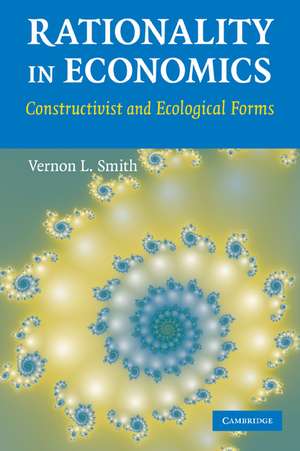
Rationality in Economics: Constructivist and Ecological Forms
Autor Vernon L. Smithen Limba Engleză Paperback – 11 oct 2009
Ne-a atras atenția modul în care Rationality in Economics redefinește fundamentele deciziei umane, pornind de acolo de unde The Art of Experimental Economics de Gary Charness se oprește în analiza metodologică. Cititorul care a aplicat ideile despre puterea metodelor experimentale va găsi aici o sinteză teoretică de o profunzime rară, care explică de ce piețele converg spre echilibru chiar și atunci când participanții nu dețin toate datele problemei. Notăm cu interes că Vernon L. Smith, laureat al Premiului Nobel, nu se limitează la prezentarea unor date de laborator, ci propune o viziune sistemică asupra ordinii spontane. În contextul operei sale, dacă A Life of Experimental Economics, Volume I oferea cadrul biografic și intelectual, iar Adam Smith's Theory of Society explora rădăcinile filosofice ale moralei, lucrarea de față reprezintă punctul culminant al efortului de a reconcilia rațiunea cu evoluția culturală. Autorul demonstrează că, în timp ce constructivismul oferă variație prin intermediul rațiunii, procesele ecologice sunt cele care selectează normele și instituțiile ce servesc nevoile de adaptare ale societății. Merită menționat că volumul integrează magistral ideile lui F. A. Hayek și ale Iluminismului scoțian, oferind o explicație solidă pentru modul în care oamenii ating scopuri neintenționate prin instituții pe care adesea le înțeleg doar parțial. Este o lectură densă, riguroasă, care transformă economia dintr-o știință a calculului rece într-una a adaptării complexe.
Preț: 335.04 lei
Carte tipărită la comandă
Livrare economică 06-20 iunie
Specificații
ISBN-10: 0521133386
Pagini: 386
Ilustrații: 10 tables
Dimensiuni: 152 x 226 x 13 mm
Greutate: 0.54 kg
Editura: Cambridge University Press
Colecția Cambridge University Press
Locul publicării:New York, United States
V-ar putea interesa
-
 How Markets Fail: The Logic of Economic CalamitiesCassidy John-20%Preț: 71.97 lei89.59 lei
 -
 -33%Preț: 738.31 lei1106.81 lei
 -
 Essentials of Econophysics ModellingFrantisek Slanina-11%Preț: 447.21 lei502.47 lei
 -
 The Winner's CurseRichard H. ThalerPreț: 183.69 lei
 -
 Papers in Experimental EconomicsVernon L. SmithPreț: 437.63 lei
 -
 Preț: 128.49 lei
 -
 Two Paths to ProsperityAvner GreifPreț: 295.09 lei
 -
 Economic Approaches to OrganizationsSytse Douma-15%Preț: 630.79 lei742.10 lei
 -
 The New Nature of BusinessAndre HoffmannPreț: 110.69 lei
 -
 Preț: 130.72 lei
 -
 Games, Strategies, and Decision MakingJoseph Harrington-41%Preț: 512.89 lei863.49 lei
 -
 Social, Methods, and MicroeconomicsFrederic S Lee-23%Preț: 560.66 lei728.13 lei
 -
 -29%Preț: 62.60 lei87.92 lei
 -
 Institutional and Organizational EconomicsTore EllingsenPreț: 134.87 lei
 -
 Good Ideas and Power MovesSinéad O'SullivanPreț: 117.35 lei
 -
 10 to 25David YeagerPreț: 89.98 lei
 -
 The Winner's CurseRichard H ThalerPreț: 166.24 lei
 -
 The Betrayal of Liberal EconomicsAmos WitztumPreț: 441.82 lei
 -
 Another WayDave WhortonPreț: 176.65 lei
De ce să citești această carte
Această carte este esențială pentru economiști și cercetători care doresc să înțeleagă mecanismele invizibile din spatele piețelor. Veți învăța cum normele culturale și instituțiile emergente compensează limitele raționalității individuale. Este o oportunitate rară de a studia viziunea unui laureat Nobel despre modul în care cooperarea umană depășește previziunile matematice rigide ale teoriei jocurilor clasice.
Despre autor
Vernon L. Smith a fost onorat cu Premiul Nobel pentru Științe Economice în 2002, fiind considerat părintele economiei experimentale. Cu o carieră academică impresionantă la Chapman University și anterior la University of Arizona, Dr. Smith a publicat peste 250 de articole și cărți care au revoluționat înțelegerea piețelor și a comportamentului uman. Expertiza sa acoperă teoria capitalului, finanțele și economia resurselor naturale, fiind o figură centrală în consiliile editoriale ale celor mai prestigioase publicații economice internaționale.
Descriere scurtă
Cuprins
Recenzii
'Vernon Smith has spent a lifetime of research, combining theory and experimental evidence, exploring the idea and implications of rationality in economics. This book recounts that lifetime, synthesizes it and adds to it - producing a volume that soars above the usual material of economics. The end-product is a volume that takes an eagle's eye view of rationality in economics, and puts it in a new and glorious perspective. Reading it is essential for theorists and practitioners.' John D. Hey, University of York, UK and LUISS, Italy
'Rationality in Economics is a delight, garnished with fascinating historical detail, philosophical scientific insights, and an eye on current public policy issues. Vernon Smith, as always, shows a skeptical, irreverent attitude toward 'rationality models' based on assumptions that are not stress-tested with cash-motivated subjects in the lab. His own policy recommendations, like the 'Combinatorial Clock Auction', are original and innovative.' Charles Holt, University of Virginia
'Locating human sociality as a centerpiece of economics, Smith's clear vision of the meaning of rationality pierces the fog surrounding the place of economics in human society. Ideas of David Hume, Adam Smith, Friedrich Hayek and Herbert Simon are masterfully synthesized with fifty years of experimental data from the economics laboratory to bring us a book that might as well be called 'The Origin of Human Institutions'.' Shyam Sunder, School of Management, Yale University
'I am pleased to report that Vernon Smith's new volume of opinions amounts to the most important book on economic methodology of the past decade.' Journal of Economics and Philosophy
'… a rich book that is full of stimulating ideas …' History of Economic Ideas