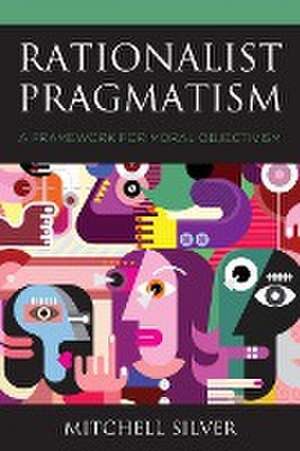
Rationalist Pragmatism: A Framework for Moral Objectivism: Philosophy of Language: Connections and Perspectives
Autor Mitchell Silveren Limba Engleză Paperback – 17 mai 2022
| Toate formatele și edițiile | Preț | Express |
|---|---|---|
| Paperback (1) | 244.06 lei 6-8 săpt. | |
| Bloomsbury Publishing – 17 mai 2022 | 244.06 lei 6-8 săpt. | |
| Hardback (1) | 554.68 lei 6-8 săpt. | |
| Bloomsbury Publishing – 7 iul 2020 | 554.68 lei 6-8 săpt. |

Preț: 244.06 lei
Preț vechi: 330.37 lei
-26%
Puncte Express: 366
Preț estimativ în valută:
43.20€ • 50.36$ • 37.42£
43.20€ • 50.36$ • 37.42£
Carte tipărită la comandă
Livrare economică 27 februarie-13 martie
Preluare comenzi: 021 569.72.76
Specificații
ISBN-13: 9781793605412
ISBN-10: 1793605416
Pagini: 222
Dimensiuni: 148 x 226 x 16 mm
Greutate: 0.34 kg
Editura: Bloomsbury Publishing
Colecția Lexington Books
Seria Philosophy of Language: Connections and Perspectives
Locul publicării:New York, United States
ISBN-10: 1793605416
Pagini: 222
Dimensiuni: 148 x 226 x 16 mm
Greutate: 0.34 kg
Editura: Bloomsbury Publishing
Colecția Lexington Books
Seria Philosophy of Language: Connections and Perspectives
Locul publicării:New York, United States
Cuprins
Preface
Introduction: Ideal vs. Non-ideal Moral Theory
Chapter One: The Quest for Justification
Chapter Two: Objectivity and Truth
Chapter Three: Others
Chapter Four: Meaning, Morality, and Social Agreement
Chapter Five: Morality's Motivational Power
Chapter Six: No Double Standards
Chapter Seven: Our Morality
Chapter Eight: Political Implications
Appendix: Weighing Value
Works Cited
Introduction: Ideal vs. Non-ideal Moral Theory
Chapter One: The Quest for Justification
Chapter Two: Objectivity and Truth
Chapter Three: Others
Chapter Four: Meaning, Morality, and Social Agreement
Chapter Five: Morality's Motivational Power
Chapter Six: No Double Standards
Chapter Seven: Our Morality
Chapter Eight: Political Implications
Appendix: Weighing Value
Works Cited
Recenzii
Silver (formerly, Univ. of Massachusetts, Boston) offers an ethical theory based on philosophical pragmatism. Pragmatism has always been rationalist. Worthy beliefs require sufficient reasons to justify them, reasons appreciable and sharable by others, and justified beliefs in turn inferentially support conclusions about judging situations and actions. Beliefs about values are no exceptions. Pragmatist ethics expects worthy moral beliefs and judgments to meet these cognitivist standards. Silver argues that neither subjectivism nor relativism, long associated with pragmatism by critics, stands in the way of attaining objective moral truths through reasoning, so long as enough people over a long enough time assess all implications of their conduct. Subjectivism and relativism, like prejudice and oppression, are unintelligent refusals to care about wider consequences. This practical ethics, unlike constructivism or discourse ethics, methodically reaches social agreements for attaining common goals despite shared problems. Pluralism is an opportunity, not a roadblock. Silver then shows how this ethics is compatible with naturalism on normativity, defensible against Humean emotivism, and unaffected by post hoc rationalizings. Politics, for Silver, is the public space for practical reason's management of civic institutions in accord with objective morality. Summing Up: Recommended. Lower-division undergraduates through faculty.
"Mitchell Silver's new book argues that any account of moral objectivity must incorporate a pragmatic conception of moral justification. The argument is original, interesting, and perhaps even true. Best of all, Silver argues for his position with wit and verve. It was a pleasure to read this book."
"Mitchell Silver's new book argues that any account of moral objectivity must incorporate a pragmatic conception of moral justification. The argument is original, interesting, and perhaps even true. Best of all, Silver argues for his position with wit and verve. It was a pleasure to read this book."