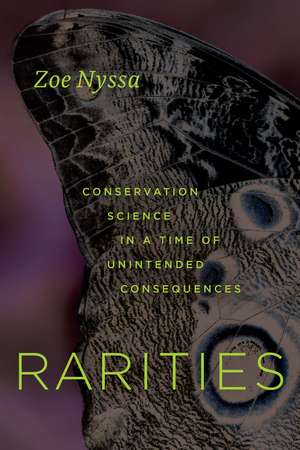
Rarities: Conservation Science in a Time of Unintended Consequences
Autor Zoe Nyssaen Limba Engleză Paperback – 10 iun 2026
Climate change and other environmental transformations are causing species to go extinct at accelerating rates. What, then, should a science of saving nature look like? In Rarities, Zoe Nyssa traces how conservation emerged as a distinct scientific endeavor in the United States over the twentieth century and how this history has shaped environmental research practices and policy today. Drawing on archival and ethnographic research with leading conservation labs and programs, Nyssa explores how conservation science appears to generate contradictory, even counterintuitive, results, as scientists, policymakers, and the public all take up, respond to, and repurpose scientists’ ideas about rarity, vulnerability, and endangerment. The designation of new nature reserves can lead to increased poaching and habitat destruction. The listing of a species as endangered fuels their black-market consumption as pets, food, or luxury items. Protection of natural resources can push resource extraction into unprotected areas. Other effects are less simple to calculate; persuading the public to care about one species might siphon support for another, and paying for one kind of conservation behavior can discourage other forms of conservation activity.
The science of saving nature spans a century of work by ecologists and others to develop a scientific basis for conservation. Yet Nyssa shows how their efforts to understand the natural world in terms of endangerment and extinction unleashed new ways for nonscientists to experience and understand nature as well. The scientific values that emerge, she argues, can transform the complex interconnections between human and nonhuman life. Rarities offers a framework for understanding these surprising socioecological dynamics and why they matter, both for contemporary science and for the planet.
| Toate formatele și edițiile | Preț | Express |
|---|---|---|
| Paperback (1) | 250.65 lei Precomandă | |
| University of Chicago Press – 10 iun 2026 | 250.65 lei Precomandă | |
| Hardback (1) | 627.98 lei Precomandă | |
| University of Chicago Press – 10 iun 2026 | 627.98 lei Precomandă |
Preț: 250.65 lei
Precomandă
Puncte Express: 376
Preț estimativ în valută:
44.35€ • 52.01$ • 38.95£
44.35€ • 52.01$ • 38.95£
Carte nepublicată încă
Doresc să fiu notificat când acest titlu va fi disponibil:
Se trimite...
Preluare comenzi: 021 569.72.76
Specificații
ISBN-13: 9780226849423
ISBN-10: 0226849422
Pagini: 352
Ilustrații: 25 halftones, 1 tables
Dimensiuni: 152 x 229 mm
Greutate: 0.45 kg
Editura: University of Chicago Press
Colecția University of Chicago Press
ISBN-10: 0226849422
Pagini: 352
Ilustrații: 25 halftones, 1 tables
Dimensiuni: 152 x 229 mm
Greutate: 0.45 kg
Editura: University of Chicago Press
Colecția University of Chicago Press
Notă biografică
Zoe Nyssa is associate professor of anthropology at Purdue University.
Cuprins
List of Figures
List of Abbreviations
Introduction: Knowledge
Chapter One: Value
Chapter Two: Place
Chapter Three: Field
Chapter Four: Model
Chapter Five: People
Chapter Six: Possibility
Conclusion: Reimagining Conservation
Acknowledgments
Notes
Bibliography
Index
List of Abbreviations
Introduction: Knowledge
Chapter One: Value
Chapter Two: Place
Chapter Three: Field
Chapter Four: Model
Chapter Five: People
Chapter Six: Possibility
Conclusion: Reimagining Conservation
Acknowledgments
Notes
Bibliography
Index
Recenzii
“Nyssa has written a rare and necessary book that asks us to sit with the profound ethical, political, and ecological tensions at the heart of conservation science. Rarities illuminates how our ways of knowing and valuing the natural world can both sustain and imperil it, revealing the unintended consequences that shape life in the Anthropocene. With clarity, rigor, and deep care, Nyssa invites us to rethink what it means to protect the more-than-human world and the human communities who have historically sustained it. This is essential reading for anyone committed to imagining more just and life-affirming futures.”