
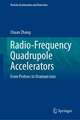
Radio-Frequency Quadrupole Accelerators: Particle Acceleration and Detection
Autor Chuan Zhangen Limba Engleză Paperback – 19 noi 2024
| Toate formatele și edițiile | Preț | Express |
|---|---|---|
| Paperback (1) | 788.31 lei 38-44 zile | |
| Springer – 19 noi 2024 | 788.31 lei 38-44 zile | |
| Hardback (1) | 856.76 lei 3-5 săpt. | |
| Springer Nature Switzerland – 19 noi 2023 | 856.76 lei 3-5 săpt. |
Din seria Particle Acceleration and Detection
-
 Preț: 417.43 lei
 -
 Preț: 410.60 lei
 -
 Preț: 338.46 lei
 - 24%
 Preț: 727.49 lei
 - 18%
 Preț: 856.76 lei
 -
 Preț: 437.87 lei
 - 14%
 Preț: 716.35 lei
 - 15%
 Preț: 611.89 lei
 - 15%
 Preț: 624.46 lei
 - 15%
 Preț: 620.86 lei
 - 15%
 Preț: 618.50 lei
 - 18%
 Preț: 1350.81 lei
 - 18%
 Preț: 1176.26 lei
 - 15%
 Preț: 621.03 lei
 - 15%
 Preț: 623.39 lei
 - 18%
 Preț: 922.11 lei
 - 15%
 Preț: 631.53 lei
 - 18%
 Preț: 707.06 lei
 -
 Preț: 375.44 lei
 - 24%
 Preț: 804.04 lei
 - 24%
 Preț: 899.30 lei
 - 18%
 Preț: 854.31 lei
 -
 Preț: 169.15 lei
 - 18%
 Preț: 1070.67 lei
 - 24%
 Preț: 864.99 lei
 - 24%
 Preț: 802.57 lei
 - 18%
 Preț: 852.51 lei
 - 24%
 Preț: 697.39 lei
 - 18%
 Preț: 972.77 lei
Preț: 788.31 lei
Preț vechi: 1037.25 lei
-24%
Puncte Express: 1182
Preț estimativ în valută:
139.28€ • 160.12$ • 120.95£
139.28€ • 160.12$ • 120.95£
Carte tipărită la comandă
Livrare economică 09-15 mai
Specificații
ISBN-13: 9783031409691
ISBN-10: 3031409698
Pagini: 188
Dimensiuni: 155 x 235 x 10 mm
Greutate: 0.33 kg
Editura: Springer
Seria Particle Acceleration and Detection
ISBN-10: 3031409698
Pagini: 188
Dimensiuni: 155 x 235 x 10 mm
Greutate: 0.33 kg
Editura: Springer
Seria Particle Acceleration and Detection
Cuprins
Preface.- Chapter 1: Introduction.- Chapter 2: Beam Physics with Space Charge Challenges.- Chapter 3: Injectors for Modern Science Facilities.- Chapter 4: Injectors for Accelerator-Driven Systems.- Chapter 5: Towards Efficient Long RFQ Accelerators.- Chapter 6: Frequency Jump Using 704.4 MHz RFQ and CH Accelerators.
Notă biografică
Chuan Zhang holds a Doctor of Engineering degree in nuclear techniques and applications from Peking University (2005) and a Ph.D. degree in physics from Goethe-University Frankfurt (2009). In 2010, he received the Juan Antonio Rubio – Paul Govaerts EUROTRANS – ENEN Prize at the EUROSAFE Forum. As a side activity, he was a visiting professor at the Institute of Modern Physics, Chinese Academy of Sciences, from 2010 to 2013. Joining GSI Helmholtz Centre for Heavy Ion Research in 2013, he contributed to the FAIR project's project management office and in parallel focused on linear accelerator design and space charge physics as an accelerator physicist. Presently, he leads the R&D team for stochastic cooling physics and technology at GSI. In 2023, he completed his habilitation and obtained the title of Privatdozent (a qualification for professorship in many European countries) from the Department of Physics at Goethe-University Frankfurt. Additionally, in 2023, he became a short-term invited fellow at the High Energy Accelerator Research Organization (KEK) in Japan, a principal investigator at the Helmholtz Research Academy Hesse for FAIR in Germany, and the GSI-Representative (Observer) of the ESS (European Spallation Source) Accelerator Collaboration Board in Sweden.
With over 20 years of experience, Dr. Zhang has specialized in RF linear accelerators, particularly Radio Frequency Quadrupole (RFQ) accelerators. Many accelerators designed by him, such as the EBIS-RFQ at Brookhaven National Laboratory, the CW HLI-RFQ at GSI, the China ADS Injector-II RFQ and the PIP2IT RFQ at Fermilab (the latter two in collaboration with Lawrence Berkeley National Laboratory), and the MYRRHA RFQ at Belgian Nuclear Research Centre, have demonstrated exceptional performance and have been in successful operation for many years.
With over 20 years of experience, Dr. Zhang has specialized in RF linear accelerators, particularly Radio Frequency Quadrupole (RFQ) accelerators. Many accelerators designed by him, such as the EBIS-RFQ at Brookhaven National Laboratory, the CW HLI-RFQ at GSI, the China ADS Injector-II RFQ and the PIP2IT RFQ at Fermilab (the latter two in collaboration with Lawrence Berkeley National Laboratory), and the MYRRHA RFQ at Belgian Nuclear Research Centre, have demonstrated exceptional performance and have been in successful operation for many years.
Textul de pe ultima copertă
This book guides readers into the realm of particle accelerators, which have served as indispensable tools for fundamental research, energy development, medical therapy, industrial applications, national security, etc., since 1924. Towards a new generation of high power proton and ion accelerators, challenges often come from space charge effects, which are most pronounced in low-velocity beams. This book focuses on Radio-Frequency Quadrupole (RFQ) accelerators, one of the most popular front-end structures for accelerator facilities, and their beam physics. Uncovering the limitations of the classic design methods, novel approaches to achieve efficient RFQ accelerators with high beam quality will be presented. In addition, new ideas for possible future developments, such as how to realize long RFQs with high performance and how RFQs can be applied for much higher beam-velocities to shorten large-scale accelerators, will be introduced. To provide a general overview of the research and development of RFQs accelerating particle species from protons to uranium ions, this book uses over 10 real examples developed or proposed in the twenty-first century for various facilities of different dimensions (from large scale e.g. a collider to small scale e.g. university experimental setups). With its rich content and comprehensive scope, this book is an invaluable reference for researchers and graduate students interested in RFQ accelerators and the intricacies of space charge physics in low-velocity beams.
Caracteristici
Unveils challenges and solutions in RFQ accelerators' space charge physics for efficient beam acceleration with high beam quality Explores new design guidelines for minimizing emittance growth via low emittance transfer Analyzes over 10 modern RFQ accelerators, encompassing diverse operational parameters