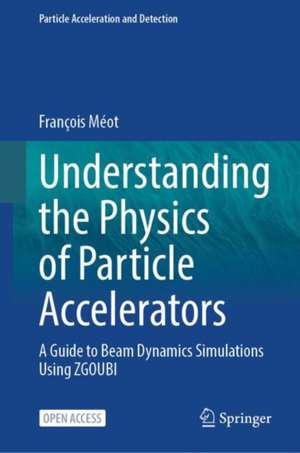
Understanding the Physics of Particle Accelerators: Particle Acceleration and Detection
Autor François Méoten Limba Engleză Hardback – 2 oct 2024
Bazându-ne pe datele furnizate de editura Springer, descoperim în Understanding the Physics of Particle Accelerators un instrument pedagogic care transformă studiul teoretic în experiment virtual. Ediția din 2024 se distinge prin utilizarea sistematică a codului de calcul ZGOUBI, permițând cititorului să manipuleze direct fasciculele de particule încărcate. Putem afirma că rigoarea matematică este dublată de o abordare aplicată, unde conceptele de optică a fasciculelor sunt testate prin simulări ce vizează scenarii reale, precum radioterapia sau producția de radiații de sincrotron. Structura volumului urmează o progresie istorică și tehnică logică. Începând cu acceleratoarele electrostatice și ciclotronii clasici, parcurgem evoluția către betatroni, microtroni și, în final, sincrotroni cu focalizare puternică. Această organizare, reflectată clar în cuprins, facilitează înțelegerea modului în care limitările tehnologice ale unei epoci au condus la inovațiile următoare. Cartea completează perspectiva oferită de A Practical Introduction to Beam Physics and Particle Accelerators de Santiago Bernal; în timp ce Bernal utilizează limbaje generale precum Matlab, lucrarea de față se concentrează pe utilizarea unui cod specializat de înaltă precizie (ZGOUBI), oferind un control mai fin asupra dinamicii spinului și a radiației de sincrotron. În contextul operei autorului, François Méot continuă cercetările prezentate în Polarized Beam Dynamics and Instrumentation in Particle Accelerators, extinzând aici aria de acoperire de la dinamica spinului la întreaga arhitectură a componentelor unui accelerator, de la magneți de ghidare la cavități de radiofrecvență. Este o resursă care îmbină prezentarea istorică cu rigoarea necesară în fizica particulelor elementare.
Din seria Particle Acceleration and Detection
- 15%
 Preț: 564.69 lei
 -
 Preț: 417.43 lei
 -
 Preț: 410.60 lei
 -
 Preț: 338.46 lei
 - 24%
 Preț: 727.49 lei
 - 18%
 Preț: 856.76 lei
 - 14%
 Preț: 716.35 lei
 - 15%
 Preț: 611.89 lei
 - 15%
 Preț: 624.46 lei
 - 15%
 Preț: 620.86 lei
 - 15%
 Preț: 618.50 lei
 - 18%
 Preț: 1350.81 lei
 - 18%
 Preț: 1176.26 lei
 - 15%
 Preț: 621.03 lei
 - 15%
 Preț: 627.62 lei
 - 18%
 Preț: 922.11 lei
 - 15%
 Preț: 631.53 lei
 - 18%
 Preț: 707.06 lei
 -
 Preț: 377.29 lei
 - 24%
 Preț: 804.04 lei
 - 24%
 Preț: 899.30 lei
 - 18%
 Preț: 854.31 lei
 -
 Preț: 169.15 lei
 - 18%
 Preț: 1070.67 lei
 - 24%
 Preț: 864.99 lei
 - 24%
 Preț: 802.57 lei
 - 18%
 Preț: 852.51 lei
 - 24%
 Preț: 697.39 lei
 - 18%
 Preț: 972.77 lei
Preț: 441.81 lei
Carte disponibilă
Livrare economică 11-25 mai
Specificații
ISBN-10: 3031599780
Pagini: 664
Ilustrații: X, 690 p. 100 illus. in color.
Dimensiuni: 160 x 241 x 39 mm
Greutate: 1.27 kg
Ediția:2024
Editura: Springer
Colecția Particle Acceleration and Detection
Seria Particle Acceleration and Detection
Locul publicării:Cham, Switzerland
De ce să citești această carte
Această lucrare este esențială pentru studenții și cercetătorii care doresc să treacă de la ecuații la simulări numerice concrete. Prin utilizarea codului ZGOUBI, cititorul câștigă experiență practică în proiectarea și calibrarea acceleratoarelor, înțelegând nu doar fizica din spate, ci și aplicațiile medicale și industriale ale acestor tehnologii complexe. Include soluții, fiind ideală pentru studiu individual.
Despre autor
François Méot este un specialist recunoscut în fizica acceleratoarelor, cu o activitate susținută în domeniul dinamicii fasciculelor și al simulărilor numerice. Expertiza sa este consolidată de experiența didactică, acesta susținând cursuri la prestigioasa U.S. Particle Accelerator School (USPAS). Opera sa se concentrează pe aspecte avansate ale fizicii particulelor, fiind autorul unor lucrări de referință despre dinamica spinului polarizat. În volumul de față, publicat la Springer, Méot își valorifică cunoștințele tehnice pentru a oferi un ghid practic bazat pe codul ZGOUBI, instrument pe care l-a promovat constant în comunitatea științifică internațională.
Descriere scurtă
The book offers computer simulations in which readers can manipulate, guide, and accelerate charged particles and particle beams in most types of particle accelerator. By performing these simulation exercises, they will acquire a deeper understanding of charged particle beam optics, accelerator physics and technology, as well as the why and how of when to use one technology or the other. These exercises guide readers through a virtual world of accelerator and beam simulations, and involve e.g. manipulating beams for cancer therapy, producing synchrotron radiation for condensed matter research, accelerating polarized ion beams for nuclear physics research, etc. In addition to acquiring an enhanced grasp of physics, readers will discover the basic theoretical and practical aspects of particle accelerators’ main components: guiding and focusing magnets, radio-wave accelerating cavities, wigglers, etc.