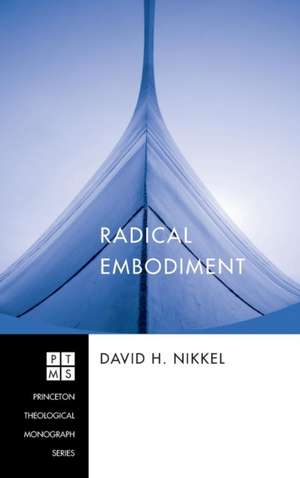
Radical Embodiment
Autor David H. Nikkelen Limba Engleză Hardback – 31 dec 2009
Preț: 284.37 lei
Puncte Express: 427
Carte tipărită la comandă
Livrare economică 18 noiembrie-02 decembrie
Livrare prin curier în România Termenul estimat este afișat lângă disponibilitate.
Transport gratuit de la 400.00 lei Plată online sau ramburs, în funcție de opțiunile comenzii.
Retur gratuit în 14 zile Comandă securizată și suport în română.
Specificații
ISBN-13: 9781498250665
ISBN-10: 1498250661
Pagini: 202
Dimensiuni: 152 x 229 x 13 mm
Greutate: 0.44 kg
Editura: Pickwick Publications
ISBN-10: 1498250661
Pagini: 202
Dimensiuni: 152 x 229 x 13 mm
Greutate: 0.44 kg
Editura: Pickwick Publications
V-ar putea interesa
-
 Religion for AtheistsAlain de Botton-19%Preț: 76.22 lei93.82 lei
 -
 The Justification of Science and the Rationality of Religious BeliefMichael C. Banner-18%Preț: 321.61 lei393.14 lei
 -
 Molinism: The Contemporary DebateKen Perszyk-31%Preț: 646.82 lei937.94 lei
 -
 -10%Preț: 284.08 lei315.43 lei
 -
 -13%Preț: 260.69 lei298.59 lei
 -
 The Oxford Handbook of Global ReligionsMark Juergensmeyer-29%Preț: 437.91 lei616.92 lei
 -
 The Orthodox Church and Russian PoliticsIrina Papkova-19%Preț: 538.02 lei664.22 lei
 -
 Religion and Human Security: A Global PerspectiveJames K. Wellman-11%Preț: 382.88 lei431.73 lei
 -
 -19%Preț: 337.78 lei417.70 lei
 -
 Preț: 405.77 lei
 -
 Towards The True Kinship Of Faiths: How the World's Religions Can Come TogetherHis Holiness The Dalai Lama-46%Preț: 47.08 lei86.48 lei
 -
 The Political Morality of Liberal DemocracyMichael J. PerryPreț: 309.06 lei
 -
 The Right of the Protestant LeftM. EdwardsPreț: 392.00 lei
 -
 Preț: 385.28 lei
 -
 -26%Preț: 55.99 lei75.72 lei
 -
 The Undead and TheologyJohn W. MoreheadPreț: 309.05 lei
 -
 Representing Jihad: The Appearing and Disappearing RadicalJacqueline O'Rourke-25%Preț: 188.73 lei251.79 lei
Recenzii
"The desire to know the elemental structure of existence drove philosophy's earliest inquiries. David H. Nikkel, of the University of California, makes this quest contemporary. Instead of looking for the essential components constituting the world, he presents our biological creatureliness as phenomenologically basic to our religious experience. Nikkel's concept of 'radical embodiment' attempts to develop this claim and to essentialize human materiality within his portrayal of religion, God's existence, transcendence and the afterlife. [ - ] Nikkel's argument draws upon a startling range of resources to produce a colourful mosaic that, while not always cohesive, invites readers into scientific and psychological discussions not usually heard among theologians." Nathan D. Hieb, New Jersey in Theology Vol. 115 (No.3), May/ June 2012. 'This is an interesting book that engages with a number of disciplines to bring together an argument that is radical embodiment and to situate it within the current theological world. It is a loud call for recognising intersubjectivity as a theological given which seems to me to be a message that needs to be repeated many times in these days.' A. J. Cocksworth in The Expository Times, Vol. 124 (1), October 2012 '...[Nikkel] never tries to disguise that the motivation for his thinking it 'trusting our religious demands' and 'trusting our bodily naturalness'. That makes his argument very personable, vey understandable - and sometime very suggestive...' Christina Aus der Au, Theologische Revue, Number 1, 2013
"The desire to know the elemental structure of existence drove philosophy's earliest inquiries. David H. Nikkel, of the University of California, makes this quest contemporary. Instead of looking for the essential components constituting the world, he presents our biological creatureliness as phenomenologically basic to our religious experience. Nikkel's concept of 'radical embodiment' attempts to develop this claim and to essentialize human materiality within his portrayal of religion, God's existence, transcendence and the afterlife. [ - ] Nikkel's argument draws upon a startling range of resources to produce a colourful mosaic that, while not always cohesive, invites readers into scientific and psychological discussions not usually heard among theologians." Nathan D. Hieb, New Jersey in Theology Vol. 115 (No.3), May/ June 2012. 'This is an interesting book that engages with a number of disciplines to bring together an argument that is radical embodiment and to situate it within the current theological world. It is a loud call for recognising intersubjectivity as a theological given which seems to me to be a message that needs to be repeated many times in these days.' A. J. Cocksworth in The Expository Times, Vol. 124 (1), October 2012
"The desire to know the elemental structure of existence drove philosophy's earliest inquiries. David H. Nikkel, of the University of California, makes this quest contemporary. Instead of looking for the essential components constituting the world, he presents our biological creatureliness as phenomenologically basic to our religious experience. Nikkel's concept of 'radical embodiment' attempts to develop this claim and to essentialize human materiality within his portrayal of religion, God's existence, transcendence and the afterlife. [ - ] Nikkel's argument draws upon a startling range of resources to produce a colourful mosaic that, while not always cohesive, invites readers into scientific and psychological discussions not usually heard among theologians." Nathan D. Hieb, New Jersey in Theology Vol. 115 (No.3), May/ June 2012. 'This is an interesting book that engages with a number of disciplines to bring together an argument that is radical embodiment and to situate it within the current theological world. It is a loud call for recognising intersubjectivity as a theological given which seems to me to be a message that needs to be repeated many times in these days.' A. J. Cocksworth in The Expository Times, Vol. 124 (1), October 2012 "Almost effortlessly Nikkel weaves together studies from linguistics, zoology, neurobiology, art history, and theological revelation. These seemingly disparate topics work surprisingly well together to show the significance of the body in different ways of being. [ - ] More than anything else, the posing of his final question demonstrates that the goal of the book is to challenge what readers think they know. In this, it is undeniably a success." Brooke J. Nelson, Reviews in Religion & Theology, March 2013
"The desire to know the elemental structure of existence drove philosophy's earliest inquiries. David H. Nikkel, of the University of California, makes this quest contemporary. Instead of looking for the essential components constituting the world, he presents our biological creatureliness as phenomenologically basic to our religious experience. Nikkel's concept of 'radical embodiment' attempts to develop this claim and to essentialize human materiality within his portrayal of religion, God's existence, transcendence and the afterlife. [ - ] Nikkel's argument draws upon a startling range of resources to produce a colourful mosaic that, while not always cohesive, invites readers into scientific and psychological discussions not usually heard among theologians." Nathan D. Hieb, New Jersey in Theology Vol. 115 (No.3), May/ June 2012. 'This is an interesting book that engages with a number of disciplines to bring together an argument that is radical embodiment and to situate it within the current theological world. It is a loud call for recognising intersubjectivity as a theological given which seems to me to be a message that needs to be repeated many times in these days.' A. J. Cocksworth in The Expository Times, Vol. 124 (1), October 2012
"The desire to know the elemental structure of existence drove philosophy's earliest inquiries. David H. Nikkel, of the University of California, makes this quest contemporary. Instead of looking for the essential components constituting the world, he presents our biological creatureliness as phenomenologically basic to our religious experience. Nikkel's concept of 'radical embodiment' attempts to develop this claim and to essentialize human materiality within his portrayal of religion, God's existence, transcendence and the afterlife. [ - ] Nikkel's argument draws upon a startling range of resources to produce a colourful mosaic that, while not always cohesive, invites readers into scientific and psychological discussions not usually heard among theologians." Nathan D. Hieb, New Jersey in Theology Vol. 115 (No.3), May/ June 2012. 'This is an interesting book that engages with a number of disciplines to bring together an argument that is radical embodiment and to situate it within the current theological world. It is a loud call for recognising intersubjectivity as a theological given which seems to me to be a message that needs to be repeated many times in these days.' A. J. Cocksworth in The Expository Times, Vol. 124 (1), October 2012 "Almost effortlessly Nikkel weaves together studies from linguistics, zoology, neurobiology, art history, and theological revelation. These seemingly disparate topics work surprisingly well together to show the significance of the body in different ways of being. [ - ] More than anything else, the posing of his final question demonstrates that the goal of the book is to challenge what readers think they know. In this, it is undeniably a success." Brooke J. Nelson, Reviews in Religion & Theology, March 2013