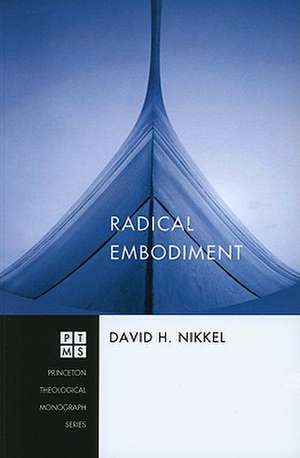
Radical Embodiment: Princeton Theological Monograph, cartea 125
Autor David H. Nikkelen Limba Engleză Paperback – 31 dec 2009
Din seria Princeton Theological Monograph
-
 Preț: 201.01 lei
 -
 Preț: 145.35 lei
 -
 Preț: 202.48 lei
 -
 Preț: 195.70 lei
 -
 Preț: 207.41 lei
 -
 Preț: 138.37 lei
 -
 Preț: 151.78 lei
 -
 Preț: 271.22 lei
 -
 Preț: 276.16 lei
 -
 Preț: 209.45 lei
 -
 Preț: 133.08 lei
 -
 Preț: 176.11 lei
 -
 Preț: 182.91 lei
 -
 Preț: 225.94 lei
 -
 Preț: 163.68 lei
 -
 Preț: 170.62 lei
 -
 Preț: 361.31 lei
 -
 Preț: 237.81 lei
 -
 Preț: 189.50 lei
 -
 Preț: 151.94 lei
 -
 Preț: 271.42 lei
 -
 Preț: 214.77 lei
 -
 Preț: 163.68 lei
 -
 Preț: 226.84 lei
 -
 Preț: 132.92 lei
 -
 Preț: 234.38 lei
 -
 Preț: 201.94 lei
 -
 Preț: 233.09 lei
 -
 Preț: 288.07 lei
 -
 Preț: 268.83 lei
 -
 Preț: 131.98 lei
 -
 Preț: 255.66 lei
 -
 Preț: 195.96 lei
 -
 Preț: 310.07 lei
 -
 Preț: 168.04 lei
 -
 Preț: 138.59 lei
 -
 Preț: 118.60 lei
 -
 Preț: 195.35 lei
 -
 Preț: 305.62 lei
 -
 Preț: 257.49 lei
 -
 Preț: 226.11 lei
 -
 Preț: 206.68 lei
 -
 Preț: 262.26 lei
 -
 Preț: 201.01 lei
 -
 Preț: 256.59 lei
 -
 Preț: 175.55 lei
 -
 Preț: 299.05 lei
 -
 Preț: 286.78 lei
Preț: 170.82 lei
Puncte Express: 256
Carte tipărită la comandă
Livrare economică 07-21 decembrie
Livrare prin curier în România Termenul estimat este afișat lângă disponibilitate.
Transport gratuit de la 400.00 lei Plată online sau ramburs, în funcție de opțiunile comenzii.
Retur gratuit în 14 zile Comandă securizată și suport în română.
Specificații
ISBN-13: 9781556355783
ISBN-10: 1556355785
Pagini: 191
Dimensiuni: 152 x 226 x 15 mm
Greutate: 0.3 kg
Editura: Pickwick Publications
Seria Princeton Theological Monograph
ISBN-10: 1556355785
Pagini: 191
Dimensiuni: 152 x 226 x 15 mm
Greutate: 0.3 kg
Editura: Pickwick Publications
Seria Princeton Theological Monograph
V-ar putea interesa
-
 Religion for AtheistsAlain de Botton-18%Preț: 76.83 lei93.96 lei
 -
 The Justification of Science and the Rationality of Religious BeliefMichael C. Banner-18%Preț: 321.61 lei393.14 lei
 -
 Molinism: The Contemporary DebateKen Perszyk-31%Preț: 663.27 lei954.52 lei
 -
 -8%Preț: 293.73 lei319.77 lei
 -
 -13%Preț: 260.69 lei298.59 lei
 -
 The Oxford Handbook of Global ReligionsMark Juergensmeyer-28%Preț: 452.59 lei625.46 lei
 -
 The Orthodox Church and Russian PoliticsIrina Papkova-19%Preț: 538.02 lei664.22 lei
 -
 Religion and Human Security: A Global PerspectiveJames K. Wellman-10%Preț: 395.68 lei439.29 lei
 -
 -18%Preț: 349.06 lei425.05 lei
 -
 Preț: 408.25 lei
 -
 Towards The True Kinship Of Faiths: How the World's Religions Can Come TogetherHis Holiness The Dalai Lama-45%Preț: 48.72 lei88.00 lei
 -
 The Political Morality of Liberal DemocracyMichael J. PerryPreț: 309.06 lei
 -
 The Right of the Protestant LeftM. EdwardsPreț: 392.00 lei
 -
 Preț: 385.28 lei
 -
 -26%Preț: 55.99 lei75.72 lei
 -
 The Undead and TheologyJohn W. MoreheadPreț: 309.05 lei
 -
 Representing Jihad: The Appearing and Disappearing RadicalJacqueline O'Rourke-25%Preț: 188.73 lei251.79 lei
Notă biografică
David H. Nikkel is Associate Professor of Religion at the University of North Carolina at Pembroke. He is the author of Panentheism in Hartshorne and Tillich: A Creative Synthesis (1995).