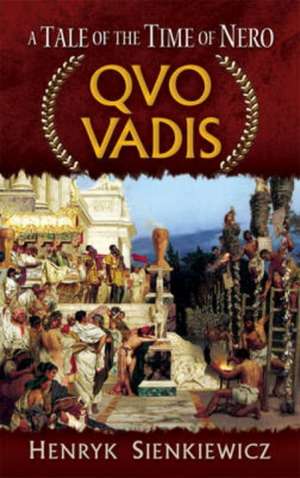
Quo Vadis
Autor Henryk Sienkiewicz Traducere de Jeremiah Curtinen Limba Engleză Paperback – 17 feb 2011
"Quo Vadis" ("Where are you going?") was one of the world's first bestsellers and contributed toward the author's 1905 receipt of the Nobel Prize in literature. Originally written in Polish, its tale of the Roman suppression of Christianity echoes the Russian domination of Poland. This edition features Jeremiah Curtin's English translation of Henryk Sienkiewicz's enduring epic.
Preț: 144.88 lei
Puncte Express: 217
Carte disponibilă
Livrare economică 16-30 noiembrie
Livrare prin curier în România Termenul estimat este afișat lângă disponibilitate.
Transport gratuit de la 400.00 lei Plată online sau ramburs, în funcție de opțiunile comenzii.
Retur gratuit în 14 zile Comandă securizată și suport în română.
Specificații
ISBN-13: 9780486476865
ISBN-10: 0486476863
Pagini: 432
Dimensiuni: 144 x 217 x 27 mm
Greutate: 0.47 kg
Editura: Dover Publications
ISBN-10: 0486476863
Pagini: 432
Dimensiuni: 144 x 217 x 27 mm
Greutate: 0.47 kg
Editura: Dover Publications
V-ar putea interesa
-
 Enchanted GlassDiana Wynne JonesPreț: 57.69 lei
 -
 A Matter of PersuasionTheresa HowesPreț: 69.87 lei
 -
 Forged in RomeConn IgguldenPreț: 150.68 lei
 -
 The Stars Over RomeCharlotte BettsPreț: 77.98 lei
 -
 The RobeLloyd C DouglasPreț: 123.39 lei
 -
 Cyrano de BergeracEdmond RostandPreț: 49.42 lei
 -
 The Wine-Dark SeaRobert AickmanPreț: 80.96 lei
 -
 Quo Vadis?Henryk SienkiewiczPreț: 174.24 lei
 -
 -26%Preț: 59.17 lei79.56 lei
 -
 -25%Preț: 85.95 lei115.08 lei
 -
 -25%Preț: 42.89 lei57.36 lei
 -
 ZadigVoltairePreț: 38.49 lei
 -
 The Lighthouse at the End of the WorldJules VernePreț: 78.31 lei
 -
 Terra IncognitaSimon Turney-25%Preț: 54.58 lei72.44 lei
 -
 No Way BackTheodor FontanePreț: 79.80 lei
 -
 CapitalKarl MarxPreț: 50.05 lei
 -
 Gone with the Wind: Annotated EditionMargaret MitchellPreț: 64.19 lei
 -
 Empire: A sweeping epic saga of Ancient RomeSteven Saylor-23%Preț: 74.24 lei96.63 lei
Notă biografică
Henryk Adam Aleksander Pius Sienkiewicz (1846 - 1916) was a Polish journalist, novelist and the Nobel Prize laureate. He is best remembered for his historical novels, especially for his internationally known best-seller Quo Vadis (1896). Born into an impoverished Polish noble family in Russian-ruled Congress Poland, in the late 1860s Sienkiewicz began publishing journalistic and literary pieces. In the late 1870s he traveled to the United States, sending back travel essays that won him popularity with Polish readers. In the 1880s he began serializing novels that further increased his popularity. He soon became one of the most popular Polish writers at the turn of the 20th century and numerous translations gained him international renown, culminating in his receipt of the 1905 Nobel Prize in Literature for his "outstanding merits as an epic writer."