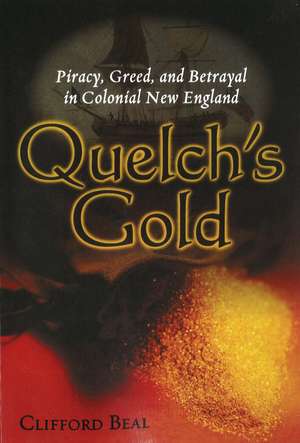
Quelch's Gold: Piracy, Greed, and Betrayal in Colonial New England
Autor Clifford Bealen Limba Engleză Paperback – aug 2008
In May 1704 an eighty-ton brigantine, the Charles, quietly slipped into the cove at Marblehead, Massachusetts. Her sudden and unexpected appearance, some ten months after she had left Marblehead under mysterious circumstances, started tongues wagging down at the docks and in the town’s dim, cramped, seafront taverns. During the following three weeks, a drama played out involving the crew of the Charles; her commander, John Quelch; and the colonial governments of Massachusetts, Rhode Island, and New Hampshire. In the hold of the Charles lay large quantities of Brazilian sugar, hides, cloth, guns, and gold dust and coins worth more than 10,000 sterling—a huge fortune for the time.This booty and the circumstances of the ship’s voyage led to Quelch’s arrest on charges of piracy and murder against the subjects of Queen Anne’s newest ally, the king of Portugal. One historian called Quelch’s trial, the first admiralty trial ever held outside England, “the first case of judicial murder in America.” Beyond the lure of the immediate charges, what drew folks to the Quelch case were the first stirrings of American rebellion against English rule, for the mob saw the high-handed treatment of Quelch as an attack on personal liberty and freedom. Whether pirate or privateer, Quelch suffered a travesty of justice, even by the legal standards of the time. His is a dramatic and tragic story about a man caught up in a political world he no longer understands.A legend persists that before they were captured, Quelch’s crew buried some of their gold on Star Island off the New Hampshire coast. Every summer to this day the island has continued to attract treasure hunters searching for Quelch’s gold. Quelch’s Gold tells the story behind the legend.
Preț: 116.35 lei
Puncte Express: 175
Carte indisponibilă temporar
Livrare prin curier în România Termenul estimat este afișat lângă disponibilitate.
Transport gratuit de la 400.00 lei Plată online sau ramburs, în funcție de opțiunile comenzii.
Retur gratuit în 14 zile Comandă securizată și suport în română.
Specificații
ISBN-13: 9781597972338
ISBN-10: 1597972339
Pagini: 272
Dimensiuni: 147 x 226 x 18 mm
Greutate: 0.39 kg
Editura: Potomac Books Inc
Colecția Potomac Books
Locul publicării:United States
ISBN-10: 1597972339
Pagini: 272
Dimensiuni: 147 x 226 x 18 mm
Greutate: 0.39 kg
Editura: Potomac Books Inc
Colecția Potomac Books
Locul publicării:United States
V-ar putea interesa
-
 Then Everything ChangedJeff GreenfieldPreț: 145.49 lei
 -
 A Concise History of the United States of AmericaSusan-Mary GrantPreț: 256.37 lei
 -
 Colt Single-Action RevolversMartin Pegler-31%Preț: 85.45 lei123.13 lei
 -
 -31%Preț: 85.31 lei123.05 lei
 -
 -31%Preț: 89.85 lei130.81 lei
 -
 -35%Preț: 83.42 lei129.05 lei
 -
 -39%Preț: 75.25 lei123.13 lei
 -
 -39%Preț: 69.76 lei114.36 lei
 -
 Panzer 38(t) vs BT-7: Barbarossa 1941Steven J. Zaloga-30%Preț: 85.88 lei123.39 lei
 -
 Soviet Cold War Guided Missile CruisersDr Edward Hampshire-31%Preț: 68.44 lei99.47 lei
 -
 Imperial Roman Warships 193–565 ADRaffaele D’Amato-37%Preț: 61.32 lei97.69 lei
 -
 Vietnam War US & Allied Combat EquipmentsGordon L. Rottman-32%Preț: 78.84 lei115.16 lei
 -
 Brassey's Air Combat Reader: Historic Feats and Aviation LegendsPhilip HandlemanPreț: 60.62 lei
 -
 Patton's Photographs: War as He Saw ItKevin HymelPreț: 136.03 lei
 -
 Preț: 310.33 lei
 -
 Preț: 238.18 lei
 -
 Beyond the Killing Fields: War WritingsSydney SchanbergPreț: 234.75 lei
 -
 Global Air PowerJohn Andreas OlsenPreț: 242.62 lei
 -
 King of Poisons: A History of ArsenicJohn ParascandolaPreț: 163.15 lei
 -
 A True and Exact History of the Island of BarbadosRichard Ligon-16%Preț: 116.67 lei139.68 lei
 -
 Preț: 250.69 lei
 -
 Folsom Street BluesJ. I. M. StewartPreț: 109.93 lei
Recenzii
"Beal cuts to the heart of one authentic pirate in his new book Quelch's Gold. John Quelch is not as famous as Captain Kidd and Edmund "Blackbeard" Teach, who also sailed these waters, but his story reveals much about how pirates actually lived...Quelch's Gold is a thrilling pirate story, now finally and dramatically told, as bizarre as anything Disney might dream up but this one is true."—SeacoastNH.com
“Beal deftly weaves a tale of intrigue and abuse by authorities to prosecute Quelch for piracy."—Pirates and Privateers
“A worthwhile acquisition for history buffs.”—Midwest Book Review
Descriere
Descriere de la o altă ediție sau format:
In May 1704, an 80-ton brigantine under Captain John Quelch slipped into the cove at Marblehead, Mass. carrying Brazilian sugar, hides, cloth, guns, and gold dust and coins worth over 10,000 sterling-a huge fortune for the time. It was this booty and the circumstances of the voyage of the Charles, that led to Quelch's arrest on charges of piracy and murder against the subjects of Queen Anne's newest ally, the King of Portugal. Quelch's trial, called by one historian the first case of judicial murder in America, greatly influenced pirates who followed, making them far more violent and destructive. One can also see in the Quelch case the first stirrings of American rebellion against English rule. Whether pirate or privateer, Quelch suffered a travesty of justice, even by the legal standards of the time. His is a dramatic and tragic story about a man caught up in a world he no longer understands.
In the middle of May in the year 1704, an 80-ton brigantine, the Charles, quietly slipped into the cove at Marblehead, Massachusetts. Her sudden and unexpected reappearance, some ten months after she had left Marblehead under mysterious circumstances, started tongues wagging down at the docks and in the dim, cramped, seafront taverns of the town. Over the following three weeks, a drama played out involving the crew of the Charles, her commander, John Quelch, and the colonial governments of Massachusetts, Rhode Island, and New Hampshire. For in the hold of the Charles lay a large quantity of Brazilian sugar, hides, cloth, guns, and gold dust and coins worth over 10,000 sterling-a huge fortune for the time.
It was this booty, and the circumstances of the voyage of the Charles, that led to Quelch's arrest on charges of piracy and murder against the subjects of Queen Anne's newest ally, the King of Portugal. Occurring only three years after Captain Kidd met his end on the gallows in London, the case of John Quelch has been long overshadowed by his more infamous predecessor, but it is no less compelling. Quelch's trial, the first admiralty trial ever held outside England, was called by one historian the first case of judicial murder in America. The fate of Captain Quelch greatly influenced pirates who followed. Knowing they no longer had friends in high places rendered their careers far more violent and destructive, directed against all, including colonial governors, who represented the rule of law.
Beyond the lure of the immediate charges, one can see in the Quelch case the first stirrings of American rebellion against English rule. The mob saw the high-handed treatment of Quelch as an attack on personal liberty and freedom. His trial and subsequent execution created a small chink in the wall, later widened by Boston revolts against foreign-made legislation and taxation. Quelch, like Kidd before him, could be termed a pirate-in-denial, not comprehending the changes in his political world. Whether pirate or privateer, Quelch suffered a travesty of justice, even by the legal standards of the time. His is a dramatic and tragic story about a man caught up in a world he no longer understands.
Jack Quelch was hanged in Boston in 1704, but his legacy lives on. The legend persists that before they were captured, Quelch's crew managed to bury some of their gold on Star Island off the New Hampshire coast. Gold coins were actually found hidden in a stone wall there in the late 1800s. Every summer to this day the island has continued to lure treasure hunters, still searching for Quelch's gold.
In May 1704, an 80-ton brigantine under Captain John Quelch slipped into the cove at Marblehead, Mass. carrying Brazilian sugar, hides, cloth, guns, and gold dust and coins worth over 10,000 sterling-a huge fortune for the time. It was this booty and the circumstances of the voyage of the Charles, that led to Quelch's arrest on charges of piracy and murder against the subjects of Queen Anne's newest ally, the King of Portugal. Quelch's trial, called by one historian the first case of judicial murder in America, greatly influenced pirates who followed, making them far more violent and destructive. One can also see in the Quelch case the first stirrings of American rebellion against English rule. Whether pirate or privateer, Quelch suffered a travesty of justice, even by the legal standards of the time. His is a dramatic and tragic story about a man caught up in a world he no longer understands.
In the middle of May in the year 1704, an 80-ton brigantine, the Charles, quietly slipped into the cove at Marblehead, Massachusetts. Her sudden and unexpected reappearance, some ten months after she had left Marblehead under mysterious circumstances, started tongues wagging down at the docks and in the dim, cramped, seafront taverns of the town. Over the following three weeks, a drama played out involving the crew of the Charles, her commander, John Quelch, and the colonial governments of Massachusetts, Rhode Island, and New Hampshire. For in the hold of the Charles lay a large quantity of Brazilian sugar, hides, cloth, guns, and gold dust and coins worth over 10,000 sterling-a huge fortune for the time.
It was this booty, and the circumstances of the voyage of the Charles, that led to Quelch's arrest on charges of piracy and murder against the subjects of Queen Anne's newest ally, the King of Portugal. Occurring only three years after Captain Kidd met his end on the gallows in London, the case of John Quelch has been long overshadowed by his more infamous predecessor, but it is no less compelling. Quelch's trial, the first admiralty trial ever held outside England, was called by one historian the first case of judicial murder in America. The fate of Captain Quelch greatly influenced pirates who followed. Knowing they no longer had friends in high places rendered their careers far more violent and destructive, directed against all, including colonial governors, who represented the rule of law.
Beyond the lure of the immediate charges, one can see in the Quelch case the first stirrings of American rebellion against English rule. The mob saw the high-handed treatment of Quelch as an attack on personal liberty and freedom. His trial and subsequent execution created a small chink in the wall, later widened by Boston revolts against foreign-made legislation and taxation. Quelch, like Kidd before him, could be termed a pirate-in-denial, not comprehending the changes in his political world. Whether pirate or privateer, Quelch suffered a travesty of justice, even by the legal standards of the time. His is a dramatic and tragic story about a man caught up in a world he no longer understands.
Jack Quelch was hanged in Boston in 1704, but his legacy lives on. The legend persists that before they were captured, Quelch's crew managed to bury some of their gold on Star Island off the New Hampshire coast. Gold coins were actually found hidden in a stone wall there in the late 1800s. Every summer to this day the island has continued to lure treasure hunters, still searching for Quelch's gold.