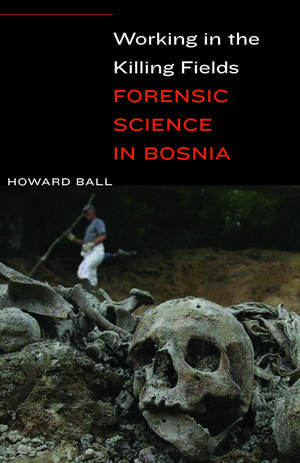
Working in the Killing Fields: Forensic Science in Bosnia
Autor Howard Ballen Limba Engleză Hardback – 15 apr 2015
Working in the Killing Fields integrates discussion of cutting-edge forensic technology into a wider view of what these searches mean, the damage they do to people, and the healing and good they bring to those in search of answers. Even though the Balkan wars took place two decades ago, the fields where so many men, women, and children died still have gruesome and disturbing stories to tell. Ball puts the spotlight on the forensic professionals tasked with telling that story and on what their work means to them as individuals and to the wider world’s understanding of genocide and war.
Preț: 250.69 lei
Puncte Express: 376
Carte tipărită la comandă
Livrare economică 21 noiembrie-05 decembrie
Livrare prin curier în România Termenul estimat este afișat lângă disponibilitate.
Transport gratuit de la 400.00 lei Plată online sau ramburs, în funcție de opțiunile comenzii.
Retur gratuit în 14 zile Comandă securizată și suport în română.
Specificații
ISBN-13: 9781612347189
ISBN-10: 1612347185
Pagini: 232
Ilustrații: 1 illustration, 1 chart
Dimensiuni: 140 x 216 x 23 mm
Greutate: 0.42 kg
Editura: Potomac Books Inc
Colecția Potomac Books
Locul publicării:United States
ISBN-10: 1612347185
Pagini: 232
Ilustrații: 1 illustration, 1 chart
Dimensiuni: 140 x 216 x 23 mm
Greutate: 0.42 kg
Editura: Potomac Books Inc
Colecția Potomac Books
Locul publicării:United States
V-ar putea interesa
-
 -41%Preț: 353.73 lei600.84 lei
 -
 -27%Preț: 498.86 lei679.89 lei
 -
 -40%Preț: 372.35 lei620.47 lei
 -
 Prosecuting War Crimes and GenocideHoward BallPreț: 366.06 lei
 -
 Battle StudiesCharles Jean Jacques Ardant Du PicqPreț: 236.83 lei
 -
 Preț: 298.55 lei
 -
 Insurgencies and CounterinsurgenciesBeatrice HeuserPreț: 317.17 lei
 -
 The Right to Die: A Reference HandbookHoward Ball-46%Preț: 289.40 lei533.93 lei
 -
 Fighting for CredibilityFrank P HarveyPreț: 294.26 lei
 -
 Silent Warfare: Understanding the World of Intelligence, 3rd EditionAbram N. ShulskyPreț: 149.86 lei
 -
 Preț: 137.26 lei
 -
 War: Ends and Means, Second EditionAngelo CodevillaPreț: 203.06 lei
 -
 Claim Denied!: How to Appeal a VA Denial of BenefitsJohn D. RochePreț: 91.31 lei
 -
 Eyewitness to Chaos: Personal Accounts of the Intervention in Haiti, 1994Walter E. KretchikPreț: 204.13 lei
Notă biografică
Howard Ball is a professor emeritus of political science at the University of Vermont. He is the author of more than thirty books, including At Liberty to Die; Genocide; and Bush, the Detainees, and the Constitution.
Cuprins
Acknowledgments
Introduction: On the Bank of the River Drina, May 10, 2003
Abbreviations
Chapter 1. The “Disappeared” in War and the Need to Find and Identify Them
Chapter 2. Balkan Nationalism, the Creation and the Collapse of Yugoslavia, and “Ethnic Cleansing”
Chapter 3. Finding, Exhuming, and Identifying the Human Remains in Bosnia
Chapter 4. The Forensic Scientists at Work in Bosnia’s “Killing Fields”
Chapter 5. The Stark Realities Confronting the Searchers and the Survivors in Bosnia
Notes
Bibliography
Index
Introduction: On the Bank of the River Drina, May 10, 2003
Abbreviations
Chapter 1. The “Disappeared” in War and the Need to Find and Identify Them
Chapter 2. Balkan Nationalism, the Creation and the Collapse of Yugoslavia, and “Ethnic Cleansing”
Chapter 3. Finding, Exhuming, and Identifying the Human Remains in Bosnia
Chapter 4. The Forensic Scientists at Work in Bosnia’s “Killing Fields”
Chapter 5. The Stark Realities Confronting the Searchers and the Survivors in Bosnia
Notes
Bibliography
Index
Recenzii
"Highly recommended for students of human rights politics and forensic sciences."—P. G. Conway, CHOICE
“An excellent and accurate book that tells the story about the role of forensic scientists in the recovery and identification effort in the former Yugoslavia. It is well researched and thorough.”—Eric Bartelink, associate professor of physical anthropology and director of the California State University–Chico Human Identification Laboratory
“Howard Ball’s erudite overview of the history behind [the Balkans] conflict and the responses of the forensic and psychosocial communities . . . are fascinating and in some ways diverse. . . . It behooves us all to look at the lessons and issues set out in works such as this and to try and slow down, and ultimately halt, what would seem to be the consequences of the worst of humankind.”—Margaret Cox, president of Inforce Foundation and a former professor at the Cranfield Forensic Centre, Cranfield University