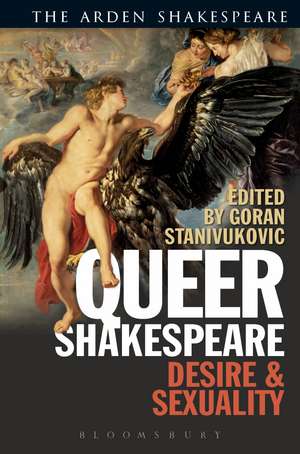
Queer Shakespeare: Desire and Sexuality
Editat de Goran Stanivukovicen Limba Engleză Hardback – 13 iul 2017
Observăm că volumul Queer Shakespeare, editat de Goran Stanivukovic, se poziționează ca o resursă fundamentală în cadrul studiilor de gen și al criticii literare timpurii moderne, fiind esențial pentru curriculumul universitar de literatură engleză. Publicat sub egida The Arden Shakespeare la Bloomsbury Publishing, acest titlu reprezintă o evoluție necesară a ediției din 2017, aducând în prim-plan discuții actuale despre dorință, sexualitate și corporalitate în opera bardului. Apreciem în mod deosebit modul în care textul depășește analizele tradiționale, integrând în această a doua ediție cinci capitole noi care explorează intersecțiile dintre identitatea trans, rasă și dizabilitate în contextul poeziei și dramaturgiei shakespeariene.
Structura volumului este riguros organizată pentru a facilita o progresie logică a ideilor. Prima parte, „Queer Time”, analizează temporalitatea și obiectele dorinței în piese precum „The Two Gentlemen of Verona” sau în „Sonete”, în timp ce a doua parte, „Queer Language”, se concentrează pe dimensiunea lingvistică a erotismului în „Love’s Labour’s Lost” sau „Cymbeline”. Remarcăm că această ediție nu doar revizuiește argumentele anterioare, ci propune o nouă introducere care extinde posibilitățile de predare a teoriei queer prin intermediul textelor clasice.
Ca alternativă la Shakespeare and Queer Theory de Melissa E. Sanchez pentru cursurile de teorie critică, volumul de față are avantajul unei abordări aplicate pe spectacolul de scenă și pe analize trans-textuale specifice. În contextul operei editorului, Queer Shakespeare continuă preocupările lui Goran Stanivukovic pentru corporalitate și gen, teme explorate anterior în Ovid and the Renaissance Body, dar cu o focalizare mult mai strânsă pe dinamica dorinței care perturbă normele sociale ale epocii elisabetane.
Preț: 695.54 lei
Preț vechi: 1139.70 lei
-39%
Carte disponibilă
Livrare economică 06-20 noiembrie
Specificații
ISBN-10: 147429524X
Pagini: 420
Dimensiuni: 134 x 202 x 28 mm
Greutate: 0.57 kg
Editura: Bloomsbury Publishing
Colecția The Arden Shakespeare
Locul publicării:London, United Kingdom
V-ar putea interesa
-
 The Sonnets and a Lover's ComplaintWilliam Shakespeare-31%Preț: 55.69 lei80.42 lei
 -
 -28%Preț: 479.79 lei663.94 lei
 -
 Preț: 213.45 lei
 -
 How to do ShakespeareAdrian NoblePreț: 346.44 lei
 -
 Beginning ShakespeareLisa HopkinsPreț: 97.72 lei
 -
 Shakespeare Made Easy: MacbethAlan Durband-29%Preț: 98.76 lei139.47 lei
 -
 Othello: Character StudiesDr Nicholas Potter-17%Preț: 155.60 lei187.49 lei
 -
 Hamlet: Character StudiesDr Michael Davies-12%Preț: 155.89 lei176.26 lei
 -
 Shakespeare's Sonnets: RevisedProf Katherine Duncan-Jones-14%Preț: 82.23 lei95.28 lei
 -
 -28%Preț: 51.05 lei71.32 lei
 -
 Shakespeare in Our Time: A Shakespeare Association of America CollectionProf. Dympna Callaghan-21%Preț: 181.76 lei228.96 lei
 -
 Shakespeare and Early Modern Drama: Text and PerformanceDr. Pamela Bickley-25%Preț: 199.41 lei265.77 lei
 -
 Romeo and Juliet: A Critical ReaderJulia Reinhard Lupton-16%Preț: 183.02 lei219.01 lei
 -
 Teaching Shakespeare with Purpose: A Student-Centred ApproachProfessor Ayanna Thompson-20%Preț: 192.53 lei239.90 lei
 -
 Shakespeare's Creative Legacies: Artists, Writers, Performers, ReadersDr Peter Holbrook-17%Preț: 192.53 lei231.49 lei
 -
 -17%Preț: 56.93 lei68.73 lei
 -
 Shakespeare Goes to ParisJohn PemblePreț: 349.10 lei
De ce să citești această carte
Recomandăm această carte studenților și cercetătorilor care doresc să înțeleagă cum sexualitatea și dorința subminează structurile sociale în opera lui Shakespeare. Cititorul câștigă acces la cele mai noi dezbateri din domeniu, inclusiv perspective despre identitatea trans și intersecționalitate. Este un instrument critic esențial pentru oricine dorește să analizeze textele clasice dincolo de interpretările heteronormative, beneficiind de rigoarea academică a seriei Arden.
Despre autor
Goran Stanivukovic este profesor în cadrul Departamentului de Engleză la Saint Mary's University din Halifax, Noua Scoție. Expertiza sa vastă în literatura Renașterii engleze este reflectată în lucrări de referință precum Tragedies of the English Renaissance și Knights in Arms. Preocupările sale academice se concentrează pe istoria genului, sexualitate și influența clasică asupra scriitorilor moderni timpurii. Prin coordonarea acestui volum, Stanivukovic consolidează puntea dintre studiile shakespeariene tradiționale și teoriile critice contemporane, fiind recunoscut pentru capacitatea de a sintetiza discursuri complexe despre masculinitate și erotism.
Descriere
Cuprins
1.'Which is worthiest love' in Two Gentlemen of Verona?, by David L. Orvis, Appalachan State University, USA
2. 'Glass: The Sonnets' Desiring Object', by John Garrison, Carroll University USA
3. 'The Sport of Asses: A Midsummer Night's Dream', by Kirk Quinsland, Fordham University, USA
4. 'As You Like It or What You Will: Shakespeare's Sonnets and Beccadelli's Hermaphroditus', by Ian F. Moulton, Arizona State University, USA
5. 'The Queer Language of Size in Love's Labour's Lost', by Valerie Billing, Knox College, USA
6. 'Locating Queerness in Cymbeline', by Stephen Guy-Bray, University of British Columbia, Canada
7. 'Desiring H: Much Ado About Nothing and the Sound of Women's Desire', by Holly Dugan, George Washington University, USA
8. '"Two lips, indifferent red:' Queer Styles in Twelfth Night', by Goran Stanivukovic, Saint Mary's University, Halifax, Canada
9. 'Queer Nature, or the Weather in Macbeth', by Christine Varnado, State University of New York, Buffalo, USA
10. 'Strange Insertions in The Merchant of Venice', by Eliza Greenstadt, Portland State University, USA
11. 'Male Femininity and Male-to-Female Crossdressing in Shakespeare's Plays and Poems,' by Simone Chess, Wayne State University, USA
12. 'Held in Common: Romeo and Juliet and The Promiscuous Seductions of Plague', by Kathryn Schwarz, Vanderbilt University, USA
13. 'Antisocial Procreation in Measure for Measure', by Melissa E. Sanchez, University of Pennsylvania, USA
Afterword by Vin Nardizzi, University of British Columbia, Canada
Recenzii
Through its insightful and apt discussions of Shakespeare's plays and poems, this volume offers specialists of early modern queer studies plenty to reflect upon. It will also be of great interest to readers who are not already conversant with queer theory.