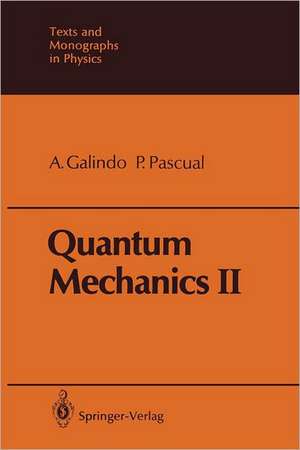
Quantum Mechanics II: Theoretical and Mathematical Physics
Autor Alberto Galindo, Pedro Pascual Traducere de Luis Alvarez-Gauméen Limba Engleză Paperback – 6 ian 2012
Din seria Theoretical and Mathematical Physics
- 15%
 Preț: 509.55 lei
 - 15%
 Preț: 627.93 lei
 - 18%
 Preț: 935.59 lei
 -
 Preț: 380.24 lei
 -
 Preț: 381.19 lei
 - 18%
 Preț: 1081.04 lei
 -
 Preț: 474.49 lei
 - 18%
 Preț: 878.33 lei
 -
 Preț: 375.07 lei
 - 15%
 Preț: 614.60 lei
 - 15%
 Preț: 638.68 lei
 -
 Preț: 384.40 lei
 - 19%
 Preț: 587.38 lei
 - 15%
 Preț: 489.05 lei
 - 15%
 Preț: 679.66 lei
 - 18%
 Preț: 919.64 lei
 - 15%
 Preț: 632.98 lei
 - 15%
 Preț: 627.79 lei
 -
 Preț: 388.04 lei
 - 18%
 Preț: 1072.55 lei
 - 18%
 Preț: 1645.28 lei
 - 15%
 Preț: 634.70 lei
 -
 Preț: 385.68 lei
 - 15%
 Preț: 568.05 lei
 - 18%
 Preț: 923.48 lei
 - 15%
 Preț: 530.30 lei
 - 18%
 Preț: 1078.91 lei
 - 15%
 Preț: 580.94 lei
 - 15%
 Preț: 621.80 lei
 - 18%
 Preț: 753.04 lei
 - 18%
 Preț: 963.80 lei
 - 15%
 Preț: 623.84 lei
 - 15%
 Preț: 628.83 lei
 - 18%
 Preț: 922.72 lei
 -
 Preț: 397.88 lei
 - 18%
 Preț: 850.37 lei
 -
 Preț: 390.61 lei
 - 15%
 Preț: 634.02 lei
 - 15%
 Preț: 570.53 lei
 -
 Preț: 381.51 lei
 - 20%
 Preț: 627.33 lei
 - 15%
 Preț: 620.38 lei
Preț: 569.91 lei
Preț vechi: 670.47 lei
-15%
Puncte Express: 855
Carte tipărită la comandă
Livrare economică 01-15 iunie
Specificații
ISBN-13: 9783642841316
ISBN-10: 3642841317
Pagini: 396
Ilustrații: XVI, 374 p.
Dimensiuni: 155 x 235 x 22 mm
Greutate: 0.6 kg
Ediția:1991
Editura: Springer
Colecția Theoretical and Mathematical Physics
Seria Theoretical and Mathematical Physics
Locul publicării:Berlin, Heidelberg, Germany
ISBN-10: 3642841317
Pagini: 396
Ilustrații: XVI, 374 p.
Dimensiuni: 155 x 235 x 22 mm
Greutate: 0.6 kg
Ediția:1991
Editura: Springer
Colecția Theoretical and Mathematical Physics
Seria Theoretical and Mathematical Physics
Locul publicării:Berlin, Heidelberg, Germany
V-ar putea interesa
-
 Quantum Field Theory DemystifiedDavid McMahon-32%Preț: 195.43 lei286.49 lei
 -
 -15%Preț: 234.86 lei276.76 lei
 -
 Mathematical Theory of Quantum FieldsHuzihiro Araki-23%Preț: 429.37 lei556.22 lei
 -
 -29%Preț: 490.15 lei693.51 lei
 -
 Quantum Physics Workbook For DummiesSteven HolznerPreț: 109.00 lei
 -
 Coming of Age With Quantum InformationChristopher A FuchsPreț: 482.82 lei
 -
 Quantum Processes Systems, and InformationBenjamin Schumacher-8%Preț: 510.76 lei555.17 lei
 -
 Quantum Mechanics with Basic Field TheoryBipin R Desai-8%Preț: 611.47 lei664.63 lei
 -
 Hamiltonian Mechanics of Gauge SystemsLev V. Prokhorov-14%Preț: 850.56 lei989.02 lei
 -
 Quantum Mechanics for Scientists and EngineersDavid A. B. Miller-19%Preț: 703.32 lei868.30 lei
 -
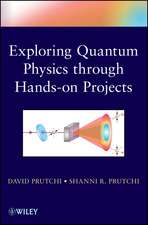 Exploring Quantum Physics Through Hands-On ProjectsDavid Prutchi-8%Preț: 472.06 lei513.11 lei
 -
 DecoherenceMaximilian A. Schlosshauer-15%Preț: 631.92 lei743.44 lei
Public țintă
ResearchCuprins
8. Scattering Theory.- 8.1 Introduction.- 8.2 General Description of Scattering Processes.- 8.3 Cross Sections.- 8.4 Invariance of the Cross Section. Change LAB ? C.M..- 8.5 Simple Scattering: Classical Case.- 8.6 Simple Scattering: Quantum Case.- 8.7 Scattering Operator or S Matrix. Unitarity of the S Matrix.- 8.8 Intertwining Property and Energy Conservation.- 8.9 d?/d? as a Function of TE.- 8.10 Scattering into Cones.- 8.11 The Optical Theorem.- 8.12 Computation of the Scattering Amplitude.- 8.13 Space-Time Description of Simple Scattering.- 8.14 Symmetries of the Scattering Operator.- 8.15 Scattering by a Central Potential: Partial Waves and Phase Shifts.- 8.16 Computation and Properties of Phase Shifts.- 8.17 Scattering by a Central Square Well.- 8.18 Analyticity Properties of the Partial Amplitudes.- 8.19 Analyticity Properties of the Scattering Amplitude.- 8.20 Coulomb Scattering.- 8.21 Two Body Elastic Scattering.- 8.22 Multichannel Scattering.- 8.23 General Form of the OpticalTheorem.- 8.24 Symmetries in Multichannel Scattering.- 8.25 The Optical Potential.- 9. The W.B.K. Method.- 9.1 Introduction.- 9.2 The W.B.K. Method in One-Dimensional Problems.- 9.3 Connection Formulae.- 9.4 Bound State Energies.- 9.5 The Potential Barrier.- 9.6 The Miller-Good Method.- 9.7 Transmission by Double Potential Barriers.- 9.8 Potential Wells: Several Turning Points.- 9.9 Central Potentials.- 10. Time-Independent Perturbation Theory and Variational Method.- 10.1 Introduction.- 10.2 Time-Independent Perturbations. The Non-Degenerate Case.- 10.3 The Harmonic Oscillator with ?x4 Perturbation.- 10.4 The Harmonic Oscillator with ?x3 Perturbation.- 10.5 Two-Electron Atoms (I).- 10.6 Van der Waals Forces (I).- 10.7 Kato’s Theory.- 10.8 The Stark Effect.- 10.9 The Variational Method.- 10.10 Two-Electron Atoms (II).- 10.11 Van der Waals Forces (II).- 10.12 One-Electron Atoms.- 10.13 Eigenvalues for Large Coupling Constants.- 11. Time-Dependent Perturbation Theory.- 11.1 Introduction.- 11.2 Nuclear Spin Resonance.- 11.3 The Forced Harmonic Oscillator.- 11.4 The Interaction Picture.- 11.5 Transition Probability.- 11.6 Constant Perturbations.- 11.7 Turning on Perturbations Adiabatically.- 11.8 Periodic Perturbations.- 11.9 Sudden Perturbations.- 11.10 The Adiabatic Theorem.- 11.11 The Adiabatic Approximation.- 11.12 The Decay Law for Unstable Quantum Systems.- 12. Particles in an Electromagnetic Field.- 12.1 Introduction.- 12.2 The Schrödinger Equation.- 12.3 Uncertainty Relations.- 12.4 The Aharonov-Bohm Effect.- 12.5 Spin-1/2 Particles in an E.M. Field.- 12.6 A Particle in a Constant Uniform Magnetic Field.- 12.7 The Fine Structure of Hydrogen-Like Atoms.- 12.8 One-Electron Atoms in a Magnetic Field.- 13. Systems of Identical Particles.- 13.1 Introduction.- 13.2 Symmetrization of Wave Functions.- 13.3 Non-Interacting Identical Particles.- 13.4 Fermi Gas.- 13.5 Bose Gas.- 13.6 Creation and Annihilation Operators.- 13.7 Correlation Functions.- 13.8 Superfluidity.- 13.9 Superconductivity.- 14. Atoms.- 14.1 Introduction.- 14.2 The Thomas-Fermi Method.- 14.3 The Hartree-Fock Method.- 14.4 The Central Field Approximation.- 14.5 Perturbative Calculations.- 14.6 Russell-Saunders or LS Coupling.- 14.7 jj Coupling.- 15. Quantum Theory of Radiation.- 15.1 Introduction.- 15.2 Plane Wave Expansions.- 15.3 Quantization of the E.M. Field.- 15.4 Multipole Waves.- 15.5 Interaction Between Matter and Radiation.- 15.6 Transition Probabilities.- 15.7 Emission and Absorption of Photons.- 15.8 Angular Distribution of Multipole Radiation.- 15.9 Electric Dipole Transitions in Atoms.- 15.10 Radiative Transitions in Nuclei.- 15.11 Low Energy Compton Scattering.- of Quantum Mechanics I.