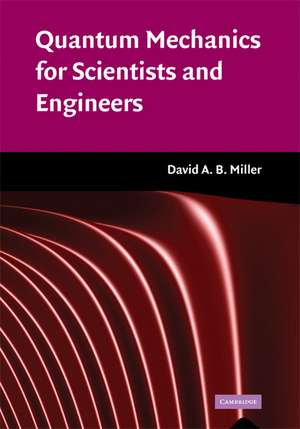
Quantum Mechanics for Scientists and Engineers
Autor David A. B. Milleren Limba Engleză Hardback – 19 iun 2008
Observăm în Quantum Mechanics for Scientists and Engineers o abordare riguroasă, dar orientată pragmatic, fundamentată pe expertiza autorului David A. B. Miller. Profesor la Stanford University și fost cercetător la Bell Laboratories, Miller aduce o perspectivă rară ce îmbină rigoarea academică cu necesitățile practice ale industriei de fotonică și semiconductori. Lucrarea sa extinde cadrul propus de Applied Quantum Mechanics de A F J Levi prin integrarea unor algoritmi specifici pentru analiza computațională și a unui aparat matematic mai detaliat, adaptat cercetării contemporane. Suntem de părere că progresia materialului este ideală pentru mediul universitar tehnic. Primele capitole introduc ecuația lui Schrödinger și operatorii fundamentali fără a solicita un bagaj vast de mecanică clasică, facilitând tranziția studenților către mecanica cuantică aplicată. Structura este echilibrată: după stabilirea bazelor teoretice, textul avansează spre metode de aproximare și teoria perturbațiilor, culminând cu analize detaliate ale atomului de hidrogen și ale materialelor cristaline. Descoperim aici un accent deosebit pe aplicațiile în nanotehnologie și optică, capitolele finale despre matrici de densitate și informație cuantică fiind esențiale pentru noile generații de ingineri. Cele peste 160 de probleme și exemplele de calcul integrate direct în text transformă teoria abstractă într-un instrument de lucru concret. Editura Cambridge University Press oferă prin acest volum un suport didactic complet, susținut de numeroase anexe matematice și fizice care elimină necesitatea consultării altor manuale auxiliare.
Preț: 750.15 lei
Preț vechi: 974.22 lei
-23%
Carte tipărită la comandă
Livrare economică 03-17 decembrie
Specificații
ISBN-10: 0521897831
Pagini: 572
Ilustrații: 73 b/w illus.
Dimensiuni: 183 x 260 x 35 mm
Greutate: 1.2 kg
Editura: Cambridge University Press
Locul publicării:New York, United States
V-ar putea interesa
-
 Operator Methods in Quantum MechanicsO.L. de Lange-33%Preț: 637.96 lei945.82 lei
 -
 -11%Preț: 463.19 lei520.45 lei
 -
 Elementary Particles and the Laws of PhysicsRichard P. FeynmanPreț: 93.97 lei
 -
 The Quantum Theory of Fields v2Steven Weinberg-11%Preț: 509.02 lei571.94 lei
 -
 A Short Introduction to Quantum Information and Quantum ComputationMichel Le Bellac-19%Preț: 673.88 lei831.95 lei
 -
 Quantum Field TheoryMark Srednicki-8%Preț: 570.66 lei620.28 lei
 -
 Quantum Information, Computation and CommunicationJonathan A. Jones-11%Preț: 468.93 lei526.88 lei
 -
 Exploring Quantum Physics Through Hands-On ProjectsDavid Prutchi-8%Preț: 490.59 lei533.24 lei
 -
 Physics of the SoulAmit Goswami-23%Preț: 118.87 lei155.34 lei
 -
 Quantum: A Guide For The PerplexedJim Al–khalili-26%Preț: 59.24 lei79.63 lei
 -
 A Modern Approach to Quantum Mechanics, second editionJohn S. Townsend-18%Preț: 789.94 lei963.35 lei
De ce să citești această carte
Recomandăm această carte studenților și cercetătorilor care doresc să înțeleagă mecanica cuantică nu doar ca teorie, ci ca fundament al tehnologiei moderne. Câștigați o înțelegere aplicată asupra materialelor nanostructurate și a dispozitivelor semiconductoare, beneficiind de expertiza unui pionier în fotonică de la Stanford. Este resursa ideală pentru a trece de la ecuațiile fundamentale la algoritmi de calcul utilizați în ingineria cuantică actuală.
Despre autor
David A. B. Miller este profesor de inginerie electrică (W. M. Keck Professor) la Stanford University, unde conduce Laboratorul de Solid State și Fotonică. Cu un doctorat obținut la Heriot-Watt University în 1979, Miller a activat peste 15 ani la Bell Laboratories, unde a condus departamentul de cercetare în fotonică avansată. Experiența sa vastă în dezvoltarea dispozitivelor optoelectronice și nanotehnologice se reflectă în modul în care explică fenomenele cuantice, făcându-le accesibile și relevante pentru inginerii care lucrează la granița dintre fizică și tehnologie.
Descriere scurtă
Cuprins
Recenzii
'I think this is an excellent book. It will become my standard reference for text for quantum mechanics and I will expect to see it on the shelves of my PhD students as well as undergraduate students. If students want to find one book that that will serve as both an introductory and future reference text on quantum mechanics, condensed matter and quantum optics they should buy this one.' Gareth Parry, Imperial College London