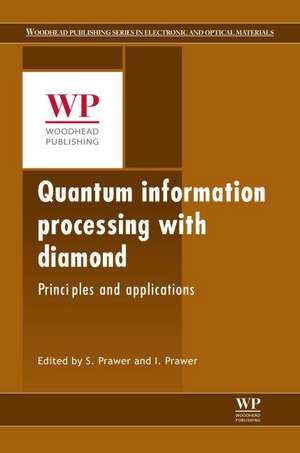
Quantum Information Processing with Diamond: Principles and Applications: Woodhead Publishing Series in Electronic and Optical Materials
Editat de Steven Prawer, Igor Aharonovichen Limba Engleză Hardback – 8 mai 2014
Actualizarea majoră pe care o aduce volumul Quantum Information Processing with Diamond constă în tranziția de la aspectele pur teoretice ale mecanicii cuantice către implementarea practică a centrelor de culoare azot-vacanță (NV) în dispozitive funcționale. Într-un domeniu care evoluează rapid, această lucrare din Woodhead Publishing Series in Electronic and Optical Materials sintetizează progresele în fabricarea materialelor și controlul defectelor structurale pentru a transforma diamantul într-o platformă viabilă pentru calculul cuantic și criptografie.
Descoperim aici o structură riguroasă, organizată în trei secțiuni fundamentale. Prima parte analizează principiile de procesare a informației și tehnicile de fabricare, cu un focus tehnic pe implantarea ionică și dopaj. În cea de-a doua parte, suntem introduși în demonstrațiile experimentale, unde capitolul dedicat protocolului BB84 în distribuția cheilor cuantice (QKD) oferă o perspectivă aplicată asupra securității comunicațiilor. Ultima parte proiectează viitorul tehnologiei, investigând senzori cuantici și dispozitive optice hibride. Pe linia practică a volumului Diamond for Quantum Applications Part 2, dar cu focus pe arhitectura rețelelor fotonice și integrarea sistemelor, lucrarea de față servește drept punte între fizica semiconductorilor și ingineria electronică.
Notăm cu interes modul în care editorii Steven Prawer și Igor Aharonovich au reușit să integreze capitole despre microscopia cuantică și monitorizarea proceselor biologice moleculare. Această abordare este similară cu cea din Quantum Nano-Photonics, însă volumul de față se distinge prin specializarea strictă pe proprietățile unice ale diamantului. Ritmul expunerii este unul tehnic, dens în date experimentale și referințe bibliografice, fiind o resursă esențială pentru cercetarea și dezvoltarea în nanotehnologie.
Din seria Woodhead Publishing Series in Electronic and Optical Materials
- 9%
 Preț: 1191.03 lei
 - 27%
 Preț: 1193.57 lei
 - 9%
 Preț: 969.46 lei
 - 31%
 Preț: 1027.21 lei
 - 31%
 Preț: 927.69 lei
 - 26%
 Preț: 724.09 lei
 - 35%
 Preț: 1217.06 lei
 - 9%
 Preț: 980.11 lei
 - 31%
 Preț: 1571.56 lei
 - 31%
 Preț: 1697.42 lei
 - 40%
 Preț: 1176.31 lei
 - 9%
 Preț: 973.47 lei
 - 26%
 Preț: 1023.49 lei
 - 31%
 Preț: 1401.72 lei
 - 41%
 Preț: 1227.57 lei
 - 26%
 Preț: 1004.88 lei
 - 9%
 Preț: 1034.41 lei
 - 31%
 Preț: 1242.91 lei
 - 32%
 Preț: 1106.47 lei
 - 26%
 Preț: 1613.58 lei
 - 31%
 Preț: 1031.32 lei
 - 9%
 Preț: 1195.98 lei
 - 9%
 Preț: 1163.47 lei
 - 26%
 Preț: 1166.82 lei
 - 41%
 Preț: 876.67 lei
 - 31%
 Preț: 1442.79 lei
 - 9%
 Preț: 1133.65 lei
 - 26%
 Preț: 1027.64 lei
 - 31%
 Preț: 1363.71 lei
 - 30%
 Preț: 1009.26 lei
 - 31%
 Preț: 1065.91 lei
 - 9%
 Preț: 1087.49 lei
 - 9%
 Preț: 1031.25 lei
 - 31%
 Preț: 1024.79 lei
 - 9%
 Preț: 1033.39 lei
 - 31%
 Preț: 1528.27 lei
 - 9%
 Preț: 1035.52 lei
 - 31%
 Preț: 1314.18 lei
 - 31%
 Preț: 1157.59 lei
 - 35%
 Preț: 360.99 lei
 - 26%
 Preț: 1038.24 lei
 - 31%
 Preț: 1440.74 lei
 - 26%
 Preț: 1044.02 lei
 - 31%
 Preț: 1240.71 lei
 - 30%
 Preț: 343.70 lei
 - 26%
 Preț: 940.97 lei
 - 26%
 Preț: 1003.95 lei
Preț: 944.69 lei
Preț vechi: 1277.71 lei
-26%
Carte tipărită la comandă
Livrare economică 19 noiembrie-03 decembrie
Specificații
ISBN-10: 0857096567
Pagini: 345
Dimensiuni: 156 x 234 x 30 mm
Editura: ELSEVIER SCIENCE
Seria Woodhead Publishing Series in Electronic and Optical Materials
V-ar putea interesa
-
 Quantum 2.0Paul DaviesPreț: 144.29 lei
 -
 Quantum Computing for EveryoneChris Bernhardt-20%Preț: 94.74 lei118.43 lei
 -
 Theoretical Foundations of Quantum ComputingDaowen Qiu-32%Preț: 477.46 lei706.44 lei
 -
 Systematic Security: A CISO’s PlaybookTimur Qader-20%Preț: 367.98 lei459.97 leiRecomandat
 -
 Quantum Computing For DummiesWhurley-20%Preț: 142.20 lei177.76 lei
 -
 Nanodiamonds in Analytical and Biological SciencesWesley Wei-Wen Hsiao-23%Preț: 839.26 lei1089.95 lei
 -
 Preț: 364.39 lei
 -
 Learn Quantum Computing with Python and QChris Granade-20%Preț: 391.90 lei489.88 lei
 -
 Quantum Programming in DepthMariia Mykhailova-20%Preț: 378.22 lei472.78 lei
 -
 Quantum Computing: From Concepts to CodeAndrew Glassner-35%Preț: 241.67 lei371.43 lei
 -
 Quantum ComputingBrian CleggPreț: 76.85 lei
 -
 Progress in Nanophotonics 7Takashi Yatsui-18%Preț: 779.45 lei950.55 lei
 -
 Integrated Quantum PhotonicsKrishna Thyagarajan-15%Preț: 621.11 lei730.71 lei
 -
 Carbon Nanoparticles and NanostructuresNianjun Yang-15%Preț: 675.79 lei795.05 lei
 -
 -14%Preț: 925.04 lei1075.63 lei
 -
 Photonic Quantum TechnologiesMohamed Benyoucef-23%Preț: 1481.15 lei1923.57 lei
 -
 -11%Preț: 395.24 lei444.09 lei
 -
 Quantum Biocomputing in Quantum Biology Volume IHafiz Md. Hasan Babu-20%Preț: 445.11 lei556.39 lei
 -
 Special Topics in Quantum OpticsWeiping Zhang-18%Preț: 702.67 lei856.92 lei
De ce să citești această carte
Recomandăm această lucrare specialiștilor în inginerie electronică și nanotehnologie care doresc să înțeleagă cum defectele controlate din structura diamantului pot genera tehnologii de calcul ultra-rapide și sigure. Cititorul câștigă o înțelegere profundă a centrelor NV, de la metodele de implantare ionică până la aplicații în biotehnologie, primind un avantaj competitiv în înțelegerea viitoarelor rețele de comunicații cuantice.
Descriere scurtă
Part one provides an introduction to quantum information processing using diamond, as well as its principles and fabrication techniques. Part two outlines experimental demonstrations of quantum information processing using diamond, and the emerging applications of diamond for quantum information science. It contains chapters on quantum key distribution, quantum microscopy, the hybridization of quantum systems, and building quantum optical devices. Part three outlines promising directions and future trends in diamond technologies for quantum information processing and sensing.
Quantum Information Processing with Diamond is a key reference for R&D managers in industrial sectors such as conventional electronics, communication engineering, computer science, biotechnology, quantum optics, quantum mechanics, quantum computing, quantum cryptology, and nanotechnology, as well as academics in physics, chemistry, biology, and engineering.
- Brings together the topics of diamond and quantum information processing
- Looks at applications such as quantum computing, neural circuits, and in vivo monitoring of processes at the molecular scale
Cuprins
- Contributor contact details
- Woodhead Publishing Series in Electronic and Optical Materials
- Foreword
- Part I: Principles and fabrication techniques
- 1. Principles of quantum information processing (QIP) using diamond
- Abstract:
- 1.1 Introduction
- 1.2 The role of diamond impurities in quantum information processing (QIP)
- 1.3 Types of diamond color center
- 1.4 Key properties of nitrogen–vacancy (NV) centers
- 1.5 Techniques for creating NV centers
- 1.6 QIP with NV centers: diamond photonic networks
- 1.7 Conclusion
- 1.8 References
- 2. Principles of quantum cryptography/quantum key distribution (QKD) using attenuated light pulses
- Abstract:
- 2.1 Introduction
- 2.2 Principles of quantum key distribution (QKD): the BB84 protocol
- 2.3 Protocol extensions and alterations
- 2.4 Implementing QKD
- 2.5 Fiber-based QKD
- 2.6 Free-space QKD
- 2.7 Future trends
- 2.8 Conclusion
- 2.9 References
- 3. Ion implantation in diamond for quantum information processing (QIP): doping and damaging
- Abstract:
- 3.1 Introduction
- 3.2 Doping diamond
- 3.3 Doping diamond by ion implantation
- 3.4 Controlled formation of implant–defect centers
- 3.5 Applications of graphitization of diamond by highly damaging implantations
- 3.6 Computer simulations of damage in diamond
- 3.7 Conclusion
- 3.8 Acknowledgments
- 3.9 References
- 4. Characterisation of single defects in diamond in the development of quantum devices
- Abstract:
- 4.1 Introduction
- 4.2 Experimental methods for fluorescence microscopy of single colour centres in diamond
- 4.3 Optical spectroscopy of single defects
- 4.4 Photon statistics
- 4.5 Spin resonance
- 4.6 Conclusions and future trends
- 4.7 References
- 5. Nanofabrication of photonic devices from single-crystal diamond for quantum information processing (QIP)
- Abstract:
- 5.1 Introduction
- 5.2 Fabrication approaches for single-crystal diamond nanostructures
- 5.3 Single-photon sources in nanostructured diamond: diamond nanowires and diamond–silver hybrid resonators
- 5.4 Single-photon sources in nanostructured diamond: integrated ring resonators and photonic-crystal cavities
- 5.5 Conclusions and future trends
- 5.6 Acknowledgments
- 5.7 References
- 1. Principles of quantum information processing (QIP) using diamond
- Part II: Experimental demonstrations and emerging applications of quantum information processing (QIP) using diamond
- 6. Diamond-based single-photon sources and their application in quantum key distribution
- Abstract:
- 6.1 Introduction
- 6.2 Characterization and key parameters of a single-photon source
- 6.3 Suitability of colour centres in diamond as single-photon sources
- 6.4 Colour centres in diamond as single-photon sources: types of colour centres investigated as single emitters
- 6.5 Colour centres in diamond as single-photon sources: specific properties
- 6.6 Quantum key distribution with nitrogen–vacancy (NV) and silicon–vacancy (SiV) centres
- 6.7 Future trends
- 6.8 References
- 7. Using defect centres in diamonds to build photonic and quantum optical devices
- Abstract:
- 7.1 Introduction
- 7.2 Architectures for single-photon collection and single-photon interaction
- 7.3 Properties of defect centres in nanodiamonds
- 7.4 A method for the controlled assembly of fundamental photonic elements using a scanning probe technique
- 7.5 Fundamental photonic and plasmonic elements assembled from nanodiamonds by a scanning probe technique
- 7.6 Photonic elements made from nanodiamonds in laser-written structures
- 7.7 Applications of engineered single-photon sources based on nanodiamonds
- 7.8 Future trends
- 7.9 Acknowledgements
- 7.10 References
- 8. Spin–photon entanglement in diamond for quantum optical networks
- Abstract:
- 8.1 Introduction
- 8.2 How measurements of single photons result in entanglement
- 8.3 Optical properties of the nitrogen–vacancy (NV) center for spin–photon entanglement generation
- 8.4 Generation of spin–photon entanglement
- 8.5 Hong–Ou–Mandel interference between identical photons from NV centers
- 8.6 Single-shot projective readout of NV centers
- 8.7 Future trends
- 8.8 Sources of further information and advice
- 8.9 Acknowledgments
- 8.10 References
- 9. Quantum microscopy using nanodiamonds
- Abstract:
- 9.1 Introduction
- 9.2 Properties of nanodiamonds for bioimaging
- 9.3 Conventional microscopy with nanodiamonds
- 9.4 Quantum microscopy with nanodiamonds I:magnetometry
- 9.5 Quantum microscopy with nanodiamonds II:rotational tracking, electrometry and thermometry
- 9.6 Future trends
- 9.7 Sources of further information and advice
- 9.8 References
- 10. Diamond magnetic sensors
- Abstract:
- 10.1 Introduction
- 10.2 Magnetometry with nitrogen–vacancy (NV) centers
- 10.3 Scanning NV magnetometry
- 10.4 Conclusion and future trends
- 10.5 References
- 11. Hybridization of quantum systems: coupling nitrogen–vacancy (NV) centers in diamond to superconducting circuits
- Abstract:
- 11.1 Introduction
- 11.2 Spin ensembles
- 11.3 Superconducting circuits
- 11.4 Collective coupling in the hybrid system
- 11.5 Towards quantum memory operations
- 11.6 Conclusions and future trends
- 11.7 References
- 12. Neural circuits and in vivo monitoring using diamond
- Abstract:
- 12.1 Introduction
- 12.2 The diamond–cell interface
- 12.3 Diamond biosensors
- 12.4 Neural networks using diamond
- 12.5 Neural stimulation and recording using diamond
- 12.6 Future trends
- 12.7 References
- 6. Diamond-based single-photon sources and their application in quantum key distribution
- Part III: The future
- 13. Promising directions in diamond technologies for quantum information processing (QIP) and sensing
- Abstract:
- 13.1 Introduction
- 13.2 Nanodiamonds for high-resolution sensors
- 13.3 Exploiting fundamental properties: optomechanics and other areas of advanced research
- 13.4 Challenges in diamond materials science
- 13.5 Conclusion
- 13.6 References
- 13. Promising directions in diamond technologies for quantum information processing (QIP) and sensing
- Index