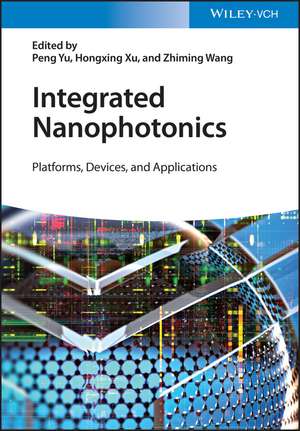
Integrated Nanophotonics – Platforms, Devices, and Applications
Autor P Yuen Limba Engleză Hardback – 4 iul 2023
Destinat studenților la masterat și doctorat, cercetătorilor în știința materialelor și practicienilor din industria optoelectronicii, Integrated Nanophotonics – Platforms, Devices, and Applications oferă o sinteză tehnică a progreselor recente în dezvoltarea circuitelor integrate fotonice (PIC). Subliniem capacitatea autorului P Yu de a trece dincolo de abordările teoretice, oferind soluții concrete pentru barierele tehnologice actuale, de la producția pe scară largă până la integrarea surselor de lumină pe cip.
Suntem de părere că volumul se distinge prin actualitatea temelor abordate în capitolele 6 și 7, unde este explorată utilizarea algoritmilor de Deep Learning pentru modelarea și designul dispozitivelor nanofotonice. Această abordare extinde cadrul propus de Nanophotonics and Machine Learning cu date noi despre procesarea datelor și designul invers, facilitând înțelegerea modului în care inteligența artificială optimizează performanța componentelor optice. Structura cărții urmărește o progresie logică: începe cu bazele testării și ambalării circuitelor, trece prin analize detaliate ale platformelor materiale (siliciu, niobat de litiu) și culminează cu aplicații de frontieră în calculul cuantic și rețele neurale.
Spre deosebire de lucrări fundamentale precum Principles of Photonic Integrated Circuits, care se concentrează pe principiile de design, acest volum pune un accent deosebit pe „ultima milă” a tehnologiei fotonice pe siliciu și pe integrarea surselor de lumină în materiale bidimensionale. Textul este riguros, integrând progresele din optica neliniară și fotonica reconfigurabilă, fiind esențial pentru cei care urmăresc implementarea senzorilor LIDAR sau a sistemelor de comunicații optice de generație viitoare.
Preț: 893.62 lei
Preț vechi: 1039.09 lei
-14%
Carte disponibilă
Livrare economică 25 mai-08 iunie
Livrare express 08-14 mai pentru 51.67 lei
Specificații
ISBN-10: 352734912X
Pagini: 384
Dimensiuni: 175 x 249 x 23 mm
Greutate: 0.9 kg
Ediția:1
Editura: Wiley Vch
Locul publicării:Weinheim, Germany
V-ar putea interesa
-
 Telescope PowerGregory L MatloffPreț: 84.78 lei
 -
 An Introduction to Modern ElectronicsWilliam L. Faissler-27%Preț: 1359.43 lei1862.22 lei
 -
 The Art of Experimental PhysicsDietz Preston-27%Preț: 1106.79 lei1516.16 lei
 -
 -27%Preț: 713.67 lei977.64 lei
 -
 Theory Atomic StructureCowan-23%Preț: 604.25 lei784.74 lei
 -
 Inside RelativityDelo E. MookPreț: 394.82 lei
 -
 More Surprises in Theoretical PhysicsR. Peierls-19%Preț: 450.85 lei556.61 lei
 -
 Supersymmetry and Supergravity – Revised EditionJulius Wess-19%Preț: 583.80 lei720.75 lei
 -
 Complex DynamicsR Livi-25%Preț: 986.65 lei1321.29 lei
 -
 Infrared Astronomy with ISOTherese Encrenaz-25%Preț: 1368.40 lei1832.03 lei
 -
 Wie löst man Randwertprobleme in Physik und TechnikFerdinand Cap-23%Preț: 847.81 lei1101.04 lei
 -
 Grundkurs der Physik 2Karl HammerPreț: 231.93 lei
 -
 FOUNDATIONS OF QUANTUM MECHANICSBlack T-18%Preț: 733.97 lei895.08 lei
 -
 CONCEPTUAL FOUNDATIONS OF MODERN...R E Marshak-15%Preț: 492.17 lei579.03 lei
De ce să citești această carte
Această lucrare este indispensabilă inginerilor și fizicienilor care lucrează la intersecția dintre optică și inteligența artificială. Cititorul câștigă o perspectivă integrată asupra întregului ecosistem nanofotonic: de la alegerea materialului suport (siliciu sau niobat de litiu) până la tehnici avansate de design asistat de AI. Este un instrument practic pentru înțelegerea modului în care nanofotonica redefinește calculul neuromorfic și biosenzorii moderni.
Despre autor
P Yu este un cercetător recunoscut în domeniul fotonicii, contribuind activ la dezvoltarea noilor generații de circuite integrate. Expertiza sa acoperă atât fundamentarea teoretică a materialelor nanostructurate, cât și aplicațiile lor practice în sisteme complexe de comunicații și computație. Colaborarea sa cu specialiști din domenii interdisciplinare a permis publicarea acestei sinteze sub egida editurii Wiley Vch, reflectând standardele înalte de cercetare din sfera fizicii aplicate și a nanotehnologiei.