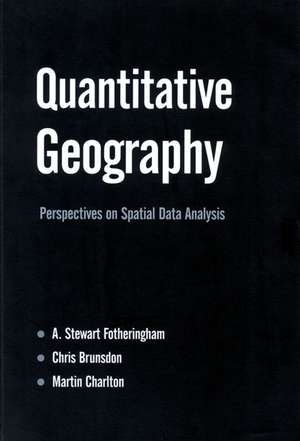
Quantitative Geography
Autor A Stewart Fotheringham, Chris Brunsdon, Martin Charltonen Limba Engleză Hardback – 13 ian 2000
În lucrarea Quantitative Geography, autorii A Stewart Fotheringham, Chris Brunsdon și Martin Charlton propun o recalibrare a modului în care înțelegem analiza datelor spațiale în contextul academic actual. Această ediție reușește să sintetizeze tranziția de la metodele asociate cu „Revoluția Cantitativă” a anilor 1960 către noile metodologii contemporane, oferind o perspectivă teoretică și practică asupra disciplinei. Suntem de părere că volumul corectează eficient concepția eronată conform căreia geografia cantitativă ar fi fost complet absorbită de sistemele informatice geografice (GIS), demonstrând că aceasta rămâne un domeniu de cercetare dinamic și esențial. Structura cărții urmărește o progresie logică, pornind de la stabilirea frontierelor disciplinei și natura datelor spațiale, continuând cu analiza vizuală și a modelelor de puncte, până la regresia spațială și modelele geostatistice. Această organizare permite cititorului să înțeleagă nu doar „cum” se aplică o metodă, ci și filosofia din spatele ei. Volumul completează perspectiva oferită de The SAGE Handbook of Spatial Analysis, adăugând o dimensiune narativă și critică asupra evoluției teoriei spațiale, în timp ce se diferențiază de Geographic Information Analysis prin accentul pus pe fundamentul statistic și inferențial, dincolo de simpla utilizare a software-ului GIS. În contextul operei autorilor, Quantitative Geography servește ca un fundament teoretic pentru lucrările lor mai specializate, precum Geographically Weighted Regression. Dacă în lucrarea menționată A Stewart Fotheringham se concentrează pe variația relațiilor în spațiu, aici oferă contextul larg necesar oricărui cercetător pentru a naviga între GIS, vizualizare și modelare matematică.
Preț: 1439.26 lei
Preț vechi: 1755.19 lei
-18%
Carte tipărită la comandă
Livrare economică 08-22 decembrie
Specificații
ISBN-10: 0761959475
Pagini: 286
Ilustrații: maps
Dimensiuni: 175 x 250 x 20 mm
Greutate: 0.62 kg
Ediția:First Edition
Editura: SAGE Publications Ltd
Locul publicării:London, United Kingdom
V-ar putea interesa
-
 Human Geography: A Very Short IntroductionPatricia Daley-20%Preț: 57.15 lei71.12 lei
 -
 Principles of Geographical Information SystemsThe late Professor Peter A. Burrough-19%Preț: 426.23 lei528.50 lei
 -
 Spatial Data Analysis: An Introduction for GIS usersChristopher Lloyd-22%Preț: 382.72 lei493.27 lei
 -
 -25%Preț: 470.82 lei625.85 lei
 -
 -9%Preț: 559.55 lei614.90 lei
 -
 Preț: 377.00 lei
 -
 Preț: 361.92 lei
 -
 Spatial Data Analysis With RDanlin Yu-9%Preț: 751.55 lei825.87 lei
 -
 -20%Preț: 339.99 lei424.99 lei
 -
 Geostatistical Functional Data AnalysisJorge Mateu-18%Preț: 767.17 lei935.56 lei
 -
 The ESRI Guide to GIS Analysis, Volume 2Andy MitchellPreț: 406.23 lei
 -
 Spatial Data ScienceJohn P. Wilson-15%Preț: 441.55 lei519.47 lei
 -
 Security FirstDarren Martin Ruddell-15%Preț: 523.45 lei615.83 lei
 -
 A Primer for Spatial EconometricsGiuseppe Arbia-15%Preț: 446.20 lei524.94 lei
 -
 Web and Wireless Geographical Information SystemsMaryam Lotfian-20%Preț: 785.00 lei981.25 lei
 -
 -18%Preț: 5736.76 lei6996.04 lei
 -
 Handling of Geospatial Data with QGISKo Ko Lwin-19%Preț: 640.81 lei791.13 lei
 -
 Geographic Data Analysis Using RXindong He-18%Preț: 1040.41 lei1268.80 lei
De ce să citești această carte
Această carte este esențială pentru studenții și cercetătorii care doresc să depășească nivelul de utilizatori de software și să înțeleagă mecanismele analizei spațiale. Subliniem relevanța ei pentru diverse discipline — de la geografie și ecologie la criminologie — oferind instrumentele necesare pentru a interpreta corect modelele spațiale complexe și pentru a răspunde provocărilor actuale din științele sociale și naturale.
Despre autor
Autorii sunt figuri centrale în geografia cantitativă modernă. A Stewart Fotheringham este recunoscut la nivel internațional pentru contribuțiile sale în analiza spațială și GIS, fiind unul dintre pionierii metodelor de regresie ponderată geografic. Împreună cu Chris Brunsdon și Martin Charlton, a format o echipă de cercetare de elită care a modelat standardele actuale în geostatistică. Experiența lor academică vastă se reflectă în capacitatea de a traduce concepte matematice riguroase în aplicații practice accesibile, transformând acest volum într-o referință standard pentru curriculumul universitar de geografie.
Descriere scurtă
`This is a veritable tour de force of everything that is exciting about quantitative geography and GIS. It is a timely, thorough and exciting account of the state of the art and science of spatial analysis' - Paul Longley, University of Bristol
`A highly innovative and up-to-date text. It is unique in its coverage of the many developments that have taken place in the field over the past few years. The book is one that is highly readable and stimulating for those with some background in the field, and its expositional style and many examples will make it stimulating to newcomers as well' - Peter Rogerson, State University of New York at Buffalo
`Brings the field thoroughly up to date, integrating modern methods of GIS with a comprehensive and easy-to-read overview of the most recent and powerful techniques of spatial analysis. The book will be valuable to students and researchers in any discipline that seeks to explore or explain phenomena in geographical context, and will make excellent reading for geographers, political scientists, criminologists, anthropologists, geologists, epidemiologists, ecologists, and many others. It offers a spirited challenge to critics of a scientific approach to social science, and demonstrates the value of its subject matter through abundant examples' - Michael Goodchild, National Center for Geographic Information and Analysis, University of California, Santa Barbara
`There is a view within some parts of academic geography that what used to be called "quantitative geography" is dead, having been subsumed within "geographical information systems" or else of no continuing interest. This book should correct this view. First, it shows that quantitative methods have remained an exciting area of development and, second, it shows that, if anything, they have more relevance to substantive problems of interest than they have ever had. Although not specifically about GIS, it is a book that should be read by everyone concerned with the analysis of geographical information' - David Unwin, Birkbeck College, University of London
Recenzii
`A highly innovative and up-to-date text. It is unique in its coverage of the many developments that have taken place in the field over the past few years. The book is one that is highly readable and stimulating for those with some background in the field, and its expositional style and many examples will make it stimulating to newcomers as well' - Peter Rogerson, State University of New York at Buffalo
`Brings the field thoroughly up to date, integrating modern methods of GIS with a comprehensive and easy-to-read overview of the most recent and powerful techniques of spatial analysis. The book will be valuable to students and researchers in any discipline that seeks to explore or explain phenomena in geographical context, and will make excellent reading for geographers, political scientists, criminologists, anthropologists, geologists, epidemiologists, ecologists, and many others. It offers a spirited challenge to critics of a scientific approach to social science, and demonstrates the value of its subject matter through abundant examples' - Michael Goodchild, National Center for Geographic Information and Analysis, University of California, Santa Barbara
`There is a view within some parts of academic geography that what used to be called "quantitative geography" is dead, having been subsumed within "geographical information systems" or else of no continuing interest. This book should correct this view. First, it shows that quantitative methods have remained an exciting area of development and, second, it shows that, if anything, they have more relevance to substantive problems of interest than they have ever had. Although not specifically about GIS, it is a book that should be read by everyone concerned with the analysis of geographical
information' - David Unwin, Birkbeck College, University of London
Cuprins
Spatial Data
The Role of Geographic Information Systems
Exploring Spatial Data Visually
Local Analysis
Point Pattern Analysis
Spatial Regression and Geostatistical Models
Statistical Inference for Spatial Data
Spatial Modelling and the Evolution of Spatial Theory
Challenges in Spatial Data Analysis