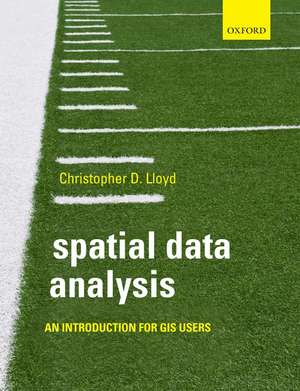
Spatial Data Analysis: An Introduction for GIS users
Autor Christopher Lloyden Limba Engleză Paperback – 3 dec 2009
Preț: 382.72 lei
Preț vechi: 493.27 lei
-22%
Puncte Express: 574
Carte disponibilă
Livrare economică 06-11 noiembrie
Livrare prin curier în România Termenul estimat este afișat lângă disponibilitate.
Transport gratuit de la 400.00 lei Plată online sau ramburs, în funcție de opțiunile comenzii.
Retur gratuit în 14 zile Comandă securizată și suport în română.
Specificații
ISBN-13: 9780199554324
ISBN-10: 0199554323
Pagini: 224
Ilustrații: 85 colour line drawings
Dimensiuni: 188 x 245 x 12 mm
Greutate: 0.44 kg
Ediția:New.
Editura: OUP OXFORD
Colecția OUP Oxford
Locul publicării:Oxford, United Kingdom
ISBN-10: 0199554323
Pagini: 224
Ilustrații: 85 colour line drawings
Dimensiuni: 188 x 245 x 12 mm
Greutate: 0.44 kg
Ediția:New.
Editura: OUP OXFORD
Colecția OUP Oxford
Locul publicării:Oxford, United Kingdom
V-ar putea interesa
-
 Principles of Geographical Information SystemsThe late Professor Peter A. Burrough-20%Preț: 421.78 lei528.50 lei
 -
 -9%Preț: 550.34 lei604.77 lei
 -
 Preț: 439.05 lei
 -
 Archaeological Spatial Analysis: A Methodological GuideMark GillingsPreț: 384.99 lei
 -
 Preț: 377.00 lei
 -
 Preț: 344.78 lei
 -
 Spatial Data Analysis With RDanlin Yu-9%Preț: 745.68 lei819.42 lei
 -
 -20%Preț: 339.99 lei424.99 lei
 -
 Geostatistical Functional Data AnalysisJorge Mateu-14%Preț: 742.10 lei862.91 lei
 -
 -23%Preț: 276.19 lei360.88 lei
 -
 -23%Preț: 731.00 lei949.35 lei
 -
 GIS For DummiesJami DennisPreț: 166.20 lei
 -
 Statistical Analysis with Python For DummiesJoseph SchmullerPreț: 197.44 lei
 -
 The Esri Guide to GIS Analysis, Volume 1Andy MitchellPreț: 413.86 lei
 -
 The ESRI Guide to GIS Analysis, Volume 2Andy MitchellPreț: 397.45 lei
 -
 Spatial Data ScienceJohn P. Wilson-15%Preț: 441.55 lei519.47 lei
 -
 Security FirstDarren Martin Ruddell-15%Preț: 506.24 lei595.57 lei
 -
 The Shape of Data: Geometry-Based Machine Learning and Data Analysis in RColleen M. Farrelly-21%Preț: 231.27 lei293.72 lei
 -
 Introduction to Spatial Data AnalysisMartin WegmannPreț: 348.42 lei
 -
 Geographic Data Analysis Using RXindong He-18%Preț: 964.40 lei1176.10 lei
Recenzii
It has long been this reviewers contention that if a student is taught the fundamentals and theory of geographic information systems, then all one has to ask is how does a particular software package do what I need? With this textbook Lloyd has achieved what he stated and provides a great resource for understanding advanced topics in spatial data analysis.
The authors approach in this text definitely strikes a chord not simply as a source for the geography user but also for wider clients of geographic information science (GISc). In favouring an education approach (rather than training), the book captures a progression of knowledge for the GISc undergraduate.The author has clearly faced the tribulations of constructing GISc/GIS courses and the focus reflected in this books approach and content are well worth consideration.
The authors approach in this text definitely strikes a chord not simply as a source for the geography user but also for wider clients of geographic information science (GISc). In favouring an education approach (rather than training), the book captures a progression of knowledge for the GISc undergraduate.The author has clearly faced the tribulations of constructing GISc/GIS courses and the focus reflected in this books approach and content are well worth consideration.
Notă biografică
Chris Lloyd is a Lecturer in Geography (GIS) in the School of Geography, Archaeology, and Paleoecology at Queen's University, Belfast.