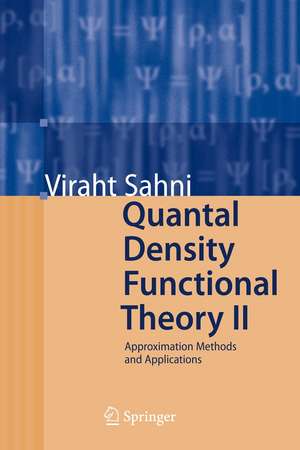
Quantal Density Functional Theory II: Approximation Methods and Applications
Autor Viraht Sahnien Limba Engleză Paperback – 26 noi 2014
Preț: 914.66 lei
Preț vechi: 1115.44 lei
-18%
Puncte Express: 1372
Carte tipărită la comandă
Livrare economică 28 noiembrie-12 decembrie
Livrare prin curier în România Termenul estimat este afișat lângă disponibilitate.
Transport gratuit pentru acest produs Plată online sau ramburs, în funcție de opțiunile comenzii.
Retur gratuit în 14 zile Comandă securizată și suport în română.
Specificații
ISBN-13: 9783642425417
ISBN-10: 3642425410
Pagini: 444
Ilustrații: XVIII, 426 p.
Dimensiuni: 155 x 235 x 23 mm
Greutate: 0.62 kg
Ediția:2009
Editura: Springer Berlin, Heidelberg
Colecția Springer
Locul publicării:Berlin, Heidelberg, Germany
ISBN-10: 3642425410
Pagini: 444
Ilustrații: XVIII, 426 p.
Dimensiuni: 155 x 235 x 23 mm
Greutate: 0.62 kg
Ediția:2009
Editura: Springer Berlin, Heidelberg
Colecția Springer
Locul publicării:Berlin, Heidelberg, Germany
V-ar putea interesa
-
 Information, Physics, and ComputationMarc Mézard-30%Preț: 676.71 lei970.50 lei
 -
 Essentials of Econophysics ModellingFrantisek Slanina-11%Preț: 469.59 lei527.63 lei
 -
 Probabilities in PhysicsClaus Beisbart-31%Preț: 779.16 lei1126.79 lei
 -
 Preț: 252.86 lei
 -
 -8%Preț: 505.94 lei549.93 lei
 -
 Quantum GravityCarlo Rovelli-11%Preț: 689.32 lei774.51 lei
 -
 Self-Organised CriticalityGunnar Pruessner-11%Preț: 706.28 lei793.57 lei
 -
 Star Maps for BeginnersTheodore LevittPreț: 89.02 lei
 -
 The Little Book of String TheorySteven S. GubserPreț: 127.76 lei
 -
 Groups, Representations and PhysicsH.F Jones-15%Preț: 632.97 lei744.67 lei
 -
 Geometry, Topology and PhysicsMikio Nakahara-18%Preț: 728.00 lei887.81 lei
 -
 A Student's Guide to Dimensional AnalysisDon S. LemonsPreț: 218.88 lei
 -
 Introduction to Mathematica® for PhysicistsAndrey GrozinPreț: 473.71 lei
 -
 Mathematical PhysicsSadri Hassani-17%Preț: 577.72 lei696.05 lei
 -
 Towards the Mathematics of Quantum Field TheoryFrédéric Paugam-18%Preț: 1165.29 lei1421.09 lei
Public țintă
ResearchCuprins
Schr#x00F6;dinger Theory from a #x201C;Newtonian#x201D; Perspective.- Quantal Density Functional Theory.- New Perspectives on Hohenberg#x2013;Kohn#x2013;Sham Density Functional Theory.- Nonuniqueness of the Effective Potential Energy and Wave Function in Quantal Density Functional Theory.- Approximations Within Quantal Density Functional Theory.- Analytical Asymptotic Structure in the Classically Forbidden Region of Atoms.- Analytical Asymptotic Structure At and Near the Nucleus of Atoms.- Application of the Q-DFT Hartree Uncorrelated Approximation to Atoms.- Application of the Q-DFT Pauli Correlated Approximation to Atoms and Negative Ions.- Quantal Density Functional Theory of the Density Amplitude: Application to Atoms.- Application of the Irrotational Component Approximation to Nonspherical Density Atoms.- Application of Q-DFT to Atoms in Excited States.- Application of the Multi-Component Q-DFT Pauli Approximation to the Anion#x2013;Positron Complex: Energies, Positron and Positronium Affinities.- Application of the Q-DFT Fully Correlated Approximation to the Helium Atom.- Application of the Q-DFT Fully Correlated Approximation to the Hydrogen Molecule.- Application of Q-DFT to the Metal#x2013;Vacuum Interface.- Many-Body and Pseudo M#x00F8;ller-Plesset Perturbation Theory within Quantal Density Functional Theory.- Epilogue.
Recenzii
From the reviews:
“QDFT II possesses an even greater expansiveness and richness of explanation that many readers will find very agreeable. … This book could serve two readerships. One would clearly be serious students and practitioners of density functional theories because QDFT II is replete with fresh ideas … . The other type of readership could very well be beginning students of the subject. … I recommended this volume to anyone with interests in or curiosities about density functional theories.” (Steven M. Valone, Journal of the American Chemical Society, Vol. 132 (32), 2010)
“QDFT II possesses an even greater expansiveness and richness of explanation that many readers will find very agreeable. … This book could serve two readerships. One would clearly be serious students and practitioners of density functional theories because QDFT II is replete with fresh ideas … . The other type of readership could very well be beginning students of the subject. … I recommended this volume to anyone with interests in or curiosities about density functional theories.” (Steven M. Valone, Journal of the American Chemical Society, Vol. 132 (32), 2010)
Textul de pe ultima copertă
This book is on approximation methods and applications of Quantal Density Functional Theory (QDFT), a new local effective-potential-energy theory of electronic structure. What distinguishes the theory from traditional density functional theory is that the electron correlations due to the Pauli exclusion principle, Coulomb repulsion, and the correlation contribution to the kinetic energy -- the Correlation-Kinetic effects -- are separately and explicitly defined. As such it is possible to study each property of interest as a function of the different electron correlations. Approximations methods based on the incorporation of different electron correlations, as well as a many-body perturbation theory within the context of QDFT, are developed. The applications are to the few-electron inhomogeneous electron gas systems in atoms and molecules, as well as to the many-electron inhomogeneity at metallic surfaces.
Caracteristici
Unique up-to-date book on the quantal density functional theory, the topic of the Nobel-prize-winning research work of Walter Kohn
Notă biografică
Viraht Sahni received his Bachelor of Technology (Honors) degree in Electrical Engineering from the Indian Institute of Technology, Bombay, India, in 1965, his Master of Science in Electrical Engineering (1968) and his Doctor of Philosophy in Physics (1972) from the Polytechnic Institute of Brooklyn, New York, USA. He was a post-doctoral associate at Brooklyn College of the City University of New York (CUNY) from 1972-1974, when he joined Brooklyn College as Assistant Professor and Member of the doctoral faculty in Physics of the Graduate Centre of CUNY. He became (and is presently) Professor of Physics at Brooklyn College and the Graduate Centre of CUNY in 1982. He was Visiting Research Physicist at the National (now Kavli) Institute of Theoretical Physics, Santa Barbara, California, in 1983. He was appointed Broeklundian Professor of Physics at Brooklyn College from 2001-2011. His interests lie in the theoretical foundations of and applications to the electronic structure of matter, both natural and artificial. He has published three books on a newly developed theory of electronic structure: Quantal Density Functional Theory, Springer-Verlag, 2004; Quantal density Functional Theory II: Approximation Methods and Applications, Springer-Verlag, 2010, and Quantal density Functional Theory, 2nd Edition, Springer-Verlag, 2016.