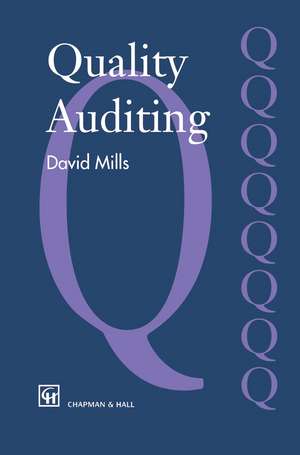
Quality Auditing
Autor J. Millsen Limba Engleză Hardback – 30 sep 1993
Preț: 1263.10 lei
Preț vechi: 1540.37 lei
-18%
Puncte Express: 1895
Carte tipărită la comandă
Livrare economică 05-19 decembrie
Livrare prin curier în România Termenul estimat este afișat lângă disponibilitate.
Transport gratuit pentru acest produs Plată online sau ramburs, în funcție de opțiunile comenzii.
Retur gratuit în 14 zile Comandă securizată și suport în română.
Specificații
ISBN-13: 9780412458903
ISBN-10: 041245890X
Pagini: 340
Ilustrații: XVII, 318 p.
Dimensiuni: 160 x 241 x 23 mm
Greutate: 0.62 kg
Ediția:1993
Editura: Springer
Locul publicării:Dordrecht, Netherlands
ISBN-10: 041245890X
Pagini: 340
Ilustrații: XVII, 318 p.
Dimensiuni: 160 x 241 x 23 mm
Greutate: 0.62 kg
Ediția:1993
Editura: Springer
Locul publicării:Dordrecht, Netherlands
V-ar putea interesa
-
 Essential Guide to Operations ManagementDavid BamfordPreț: 381.53 lei
 -
 Maintenance Planning, Coordination, & SchedulingDonald H Nyman-19%Preț: 466.70 lei576.18 lei
 -
 Exchange Rate AlignmentsJ. MillsPreț: 405.27 lei
 -
 Planning and Scheduling in Manufacturing and ServicesMichael L Pinedo-15%Preț: 662.93 lei779.91 lei
 -
 Just-in-Time for OperatorsProductivity Press Development TeamPreț: 332.36 lei
 -
 Identifying Waste on the ShopfloorProductivity Development TeamPreț: 334.04 lei
 -
 -15%Preț: 437.38 lei514.57 lei
 -
 Efficiency and Innovation in LogisticsUwe Clausen-43%Preț: 839.57 lei1479.79 lei
 -
 -15%Preț: 671.79 lei790.34 lei
 -
 -15%Preț: 561.73 lei660.86 lei
 -
 Handbook on Continuous Improvement TransformationAristide van Aartsengel-9%Preț: 1857.85 lei2041.60 lei
 -
 Lieferantenmanagement in der AutomobilindustrieJohannes E. Dölle-15%Preț: 424.67 lei499.62 lei
Public țintă
ResearchCuprins
One: An overview of audits.- Where have quality audits come from?.- Auditing status.- Where are quality audits heading?.- Two: What is a quality audit?.- Audit types.- Customer needs.- Audit categories.- Terms and difinitions.- Definitions published in standards.- Applications of definitions.- Three: Why audit?.- Audit objectives.- Compliance.- Effectiveness.- Mandatory audits.- Motivation for audits.- Continuity.- The auditee’s motivation for audit.- Relationships between the audit personnel.- Four: The audit maze.- Categories of audit.- Internal Audits.- External audits.- Extrinsic audits?.- Supplier visitations.- A need for sub-categories?.- Further audit definitions.- Audit types.- Performance audits.- Product audits.- Five: Audit boundaries.- Step 1. Reason.- Step 2. Measures.- Step 3. Coverage.- Step 4. Location.- Step 5. Resources.- Audit depth or involvement.- Resources.- Time.- Manpower.- Facilities.- Skills.- Audit scope decision.- Six: Audit personnel.- Personnel with accountability.- Audit team.- Size of team.- The make-up of a team.- Experts.- Observers.- Team selection.- Audit member’s tasks and responsibilities.- Lead auditor’s general responsibilities.- Lead auditor’s specific duties.- Objectivity of audit personnel.- Seven: Auditor qualifications.- Areas of competence.- Knowledge.- Human factors.- Eight: Audit activities.- The preparation phase.- The data collection phase.- Initial review phase.- The reporting phase.- Nine: The audit plan.- The audit plan.- Who is involved?.- Content of the plan.- Pre-announced or suprise audits?.- Ten: Working methods.- Audit assignments.- Solo auditing.- Auditing in pairs.- Team auditing.- Other team members.- Tasking the auditors.- Auditing tools.- To examine by asking questions.- The tactics of questioning.-Understanding the question.- The form of questions.- The summary question.- I may be stupid but?.- Intervals.- Input vs. output questioning.- Applied questioning.- Verification.- Eleven: Guiding the audit.- Audit checklists.- Aide-mémoire.- Guiding the process.- Lower order working documents.- Other working documents.- Twleve: On-site procedure.- Initial or opening meeting.- Examination.- The exit or closing meeting.- The ‘buffer’ stop situation.- Ethical questions.- Thirteen: Reporting the audit.- ‘In-process’ reports.- Audit results reporting.- Preparation of the report.- Acceptability of the report.- Strength and weakness reporting.- Corrective action.- Presentation of the report.- Fourteen: Problems during the audit.- Pre-audit problems.- ‘On-site’ auditing problems.- Timewasting.- Obstructing the audit.- The auditor’s difficulties.- Fifteen: Finished?.- Corrective action.- A poser for the auditor.- The final solution?.- Sixteen: Special cases?.- What special cases?.- The single product concept.- The case of the tangible vs. intangible.- Generic quality audits.- The case by definition.- The four categories.- Practical applications.- Conclusion.- Seventeen: Managing an audit programme.- The definition of audit programme management.- The functions of audit programme management.- Audit programme management staff.- Policy and strategy.- Provision of audit staff.- Audit team selection.- Audit performance monitoring.- Monitoring auditors’ performance and consistency.- Supplying the required training for auditors.- Audit effectiveness and worth.- Resourcing levels.- Operational review.- Codes of ethics.- Eighteen: Product auditing.- Definition and history.- Developments in product auditing.- Current product auditing processes.- The final goals.- Thecustomer expectation audit (CEA).- Use of the CEA type audit.- The management of a CEA programme.- Nineteen: Economical auditing.- Audit costs.- Sub-contracting the audit.- Systems audit benefits.- Control of systems audit costs.- Product audit benefits.- Control of product audit costs.- Twenty: Auditing at the end of the road.- Past and current status of auditing functions.- A future for the audit role?.- Future auditing methods.- Conclusion.- Twenty-one: Auditing in the ISO 9000 environment.- The first phase revisions.- The ten year review.- Reviews and audits — what’s the difference?.- Compliance with the 9000 series standards.- Understanding the standard’s requirements.- Relationship between quality systems compliance and product quality.- Does poor performance equal lack of conformity?.- Auditing to the ISO 9000 family of standards from the client’s view.- The auditor’s viewpoint and responsibilities.- Audit management.- The role of the consultant.- Integration.- References/Bibliography.
Notă biografică
JOHN MILLS is an Economist who has spent all of his working life running companies involved in making and selling consumer products. He combines a theoretical background in academic economics with years of practical experience both in international business and in political affairs. He has written or co-authored seven books and many articles on economics and related subjects.