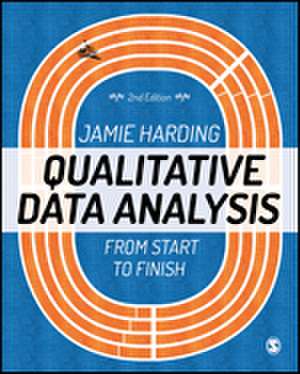
Qualitative Data Analysis
Autor Jamie Hardingen Limba Engleză Hardback – 20 noi 2018
Using multidisciplinary data from interviews and focus groups Jamie Harding provides clear guidance on how to apply key research skills such as making summaries, identifying similarities, drawing comparisons and using codes.
The book sets out real world applicable advice, provides easy to follow best practice and helps you to:
· Manage and sort your data
· Find your argument and define your conclusions
· Answer your research question
· Write up your research for assessment and dissemination
Clear, pragmatic and honest this book will give you the perfect framework to start understanding your qualitative data and to finish your research project.
Preț: 1020.97 lei
Preț vechi: 1325.93 lei
-23%
Carte tipărită la comandă
Livrare economică 28 noiembrie-12 decembrie
Specificații
ISBN-10: 1526402793
Pagini: 326
Dimensiuni: 196 x 241 x 22 mm
Greutate: 0.64 kg
Ediția:2. Auflage
Editura: SAGE Publications Ltd
Locul publicării:London, United Kingdom
V-ar putea interesa
-
 -23%Preț: 436.86 lei567.35 lei
 -
 Media Studies: Ethnomethodological ApproachesPaul L. Jalbert-34%Preț: 445.28 lei673.69 lei
 -
 -15%Preț: 614.96 lei723.49 lei
 -
 Multiple RegressionLeona S. Aiken-15%Preț: 628.29 lei739.17 lei
 -
 From Needs Assessment to ActionJames W. Altschuld-18%Preț: 955.38 lei1165.09 lei
 -
 High Impact Internal EvaluationRichard C. Sonnichsen-18%Preț: 957.61 lei1167.81 lei
 -
 The Handbook for Focus Group ResearchThomas L. Greenbaum-23%Preț: 505.61 lei656.63 lei
 -
 Moderating Focus GroupsThomas L. Greenbaum-18%Preț: 952.90 lei1162.08 lei
 -
 Test Item BiasSteven J OsterlindPreț: 327.79 lei
 -
 Qualitative Nursing ResearchJanice M. Morse-5%Preț: 691.65 lei728.06 lei
 -
 Foundations of Program EvaluationWilliam R. Shadish-18%Preț: 813.13 lei991.62 lei
 -
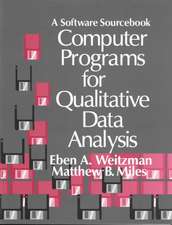 Computer Programs for Qualitative Data AnalysisEben A. Weitzman-18%Preț: 1145.15 lei1396.54 lei
 -
 Phenomenological Research MethodsClark Moustakas-15%Preț: 451.65 lei531.35 lei
 -
 Using Computers in Qualitative ResearchNigel G. Fielding-15%Preț: 563.07 lei662.44 lei
 -
 -8%Preț: 526.43 lei572.21 lei
 -
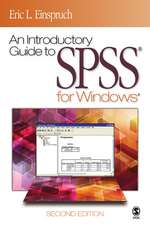 An Introductory Guide to SPSS® for Windows®Eric L. Einspruch-18%Preț: 811.25 lei989.33 lei
 -
 Measurement Error and Research DesignMadhu Viswanathan-18%Preț: 960.95 lei1171.88 lei
 -
 First Person Action ResearchJudi MarshallPreț: 465.45 lei
 -
 An Introduction to Criminal JusticeJamie HardingPreț: 460.07 lei
 -
 -29%Preț: 1125.51 lei1579.87 lei
 -
 Preț: 248.36 lei
 -
 Post-War Homelessness Policy in the UKJamie Harding-15%Preț: 546.89 lei643.39 lei
Recenzii
This text helps students apply qualitative research to the practice context. The book is punctuated with ‘real life’ practical examples from the author’s own experience of conducting qualitative investigations. In my opinion this is the best text of its kind.
A comprehensive, pragmatic book that uses real research to illustrate the steps and decisions that a researcher needs to take when using qualitative methodology.
A superb guide for qualitative research. Thorough and accessible, it walks students through all the steps, and provides compelling examples along the way.
The author uses nice examples from his own work to demonstrate how and why to apply his tips and principles. This is particularly useful in demonstrating coding in section three.
[...]
this is a useful and readable book on the practicalities of conducting a qualitative research project, and one to which I will certainly return for reference
It's main premise is that, to really get under the skin of a research issue, the research needs to look much deeper into the 'psycho-biography' of research participants. This mapping of people's psycho-biography determines people's personal identity -- their motives, personal style, and how they behave
[...]
Layder criticizes most research projects as being too one dimensional and simplistic. Investigative research is a largely exploratory methods of research. It encourages researchers to map the relevant psycho-biographies of individuals to formulate an initial 'conceptual scaffold' that is the basis for the explanation of the social behaviour under investigation. This guides and directs data collection processes. But Layder also advises being open to new concepts and encourages researchers to keep researching to test and/or revise theories and hypotheses
Cuprins
Chapter 1 Introduction to qualitative social research
Chapter 2 Designing qualitative research: your key questions
Chapter 3 Practical issues in qualitative research
STAGE 2 DATA COLLECTION AND MANAGEMENT
Chapter 4 Collecting and managing interview data
Chapter 5 Collecting and managing focus group data
STAGE 3 DATA ANALYSIS AND INTERPRETATION
Chapter 6 A brief introduction to the analysis of qualitative data
Chapter 7 Step one for analysing your interview data - making summaries and comparisons
Chapter 8 Step two for analysing your interview data – using codes
Chapter 9 Step three for analysing your interview data - finding conceptual themes and building theory
Chapter 10 Analysing your focus group data
Chapter 11 Alternative approaches to analysing qualitative data
STAGE 4 DISSEMINATION
Chapter 12 Writing about your qualitative research
Descriere
Notă biografică
Jamie Harding received his PhD from the Department of Sociology and Social Policy at the University of Newcastle upon Tyne. He has been employed at Northumbria University since 1995, first as a lecturer in Housing Studies and more recently as a Senior Lecturer in Research Methods in the Department of Social Sciences. Before moving into higher education he worked for a number of social housing organisations.
Jamie's main area of interest is qualitative and quantitative research methods, which he teaches at undergraduate, postgraduate and doctoral level. He also lectures on criminal justice - an area where he has edited a textbook - and homelessness, a subject on which he has written two monographs. He is programme leader for the Police Constable Degree Apprenticeship, which is run in partnership with Northumbria Police.
Jamie is married with two adult children and two grandchildren. He enjoys running and was delighted to win the highly prestigious Claremont Road Runners summer club handicap race in 2021.