
Python Machine Learning
Autor Sebastian Raschka, Vahid Mirjalilien Limba Engleză Paperback – 9 dec 2019
Observăm în Python Machine Learning o abordare practică riguroasă, unde raportul dintre fundamentul teoretic și implementarea de cod este echilibrat pentru a servi atât ca manual, cât și ca resursă de referință. Considerăm că forța acestui volum, ajuns la a treia ediție, rezidă în capacitatea autorilor Sebastian Raschka și Vahid Mirjalili de a nu se limita la simple instrucțiuni de utilizare a bibliotecilor, ci de a explica mecanismele matematice din spatele algoritmilor. Remarcăm integrarea completă a TensorFlow 2 și a noilor funcționalități din scikit-learn, elemente esențiale pentru un flux de lucru modern în știința datelor. Cititorul care a aplicat deja conceptele de bază din Hands-On Machine Learning with Scikit-Learn, Keras, and TensorFlow va găsi aici o aprofundare a arhitecturilor complexe, în special în zona rețelelor generative (GANs) și a tehnicilor de reinforcement learning. Față de abordarea orientată spre exemple rapide din Python Machine Learning by Example - Third Edition, lucrarea de față insistă pe bunele practici de evaluare și optimizare a modelelor, oferind o perspectivă mai analitică asupra procesului de învățare automată. În contextul operei sale, această carte reprezintă pilonul central al lui Sebastian Raschka. Dacă în Machine Learning Q and AI autorul clarifică lacune punctuale, iar în Build a Large Language Model (from Scratch) se concentrează pe arhitecturi specifice de limbaj, Python Machine Learning rămâne ghidul exhaustiv care acoperă întreg spectrul disciplinei, de la regresii clasice la analiza sentimentelor și aplicații web inteligente. Cele peste 700 de pagini publicate de Packt Publishing constituie un parcurs tehnic dens, susținut de vizualizări clare, menit să transforme un dezvoltator Python într-un specialist capabil să construiască sisteme predictive scalabile.
Preț: 344.57 lei
Preț vechi: 430.71 lei
-20%
Carte tipărită la comandă
Livrare economică 07-21 decembrie
Specificații
ISBN-10: 1789955750
Pagini: 772
Dimensiuni: 191 x 235 x 42 mm
Greutate: 1.3 kg
Ediția:Third
Editura: Packt Publishing
V-ar putea interesa
-
 Deep Learning IllustratedAglae Bassens-20%Preț: 333.73 lei417.17 lei
 -
 The Art of Statistics: Learning from DataDavid Spiegelhalter-30%Preț: 65.92 lei93.54 lei
 -
 Machine LearningKevin P. Murphy-20%Preț: 734.70 lei918.37 lei
 -
 Deep LearningIan Goodfellow-20%Preț: 691.69 lei865.01 lei
 -
 AI SuperpowersKai-Fu LeePreț: 93.21 lei
 -
 -39%Preț: 394.79 lei646.62 lei
 -
 -31%Preț: 607.05 lei885.58 lei
 -
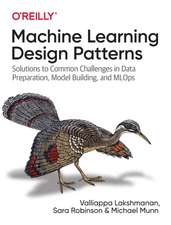 Machine Learning Design PatternsValliappa Lakshmanan-20%Preț: 328.72 lei410.90 lei
 -
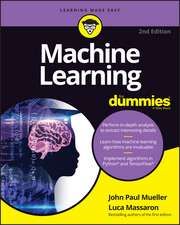 Mueller, J: Machine Learning For DummiesJohn Paul Mueller-20%Preț: 176.20 lei220.25 lei
 -
 Deep Learning with PyTorchEli Stevens-20%Preț: 293.41 lei366.76 lei
 -
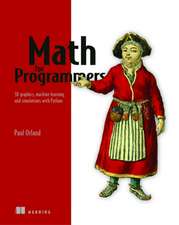 Math for ProgrammersPaul Orland-20%Preț: 361.44 lei451.79 lei
 -
 Deep Learning with Python, Second EditionFrancois Chollet-20%Preț: 358.75 lei448.44 lei
 -
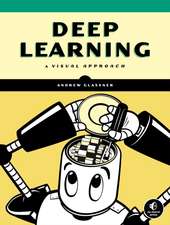 Deep Learning: A Visual ApproachAndrew Glassner-35%Preț: 504.69 lei777.34 lei
 -
 -34%Preț: 291.41 lei444.24 lei
 -
 Deep Learning Crash CourseGiovanni Volpe-35%Preț: 290.92 lei445.81 lei
 -
 Practical Deep Learning, 2nd Edition: A Python-Based IntroductionRonald T. Kneusel-35%Preț: 333.73 lei515.68 lei
 -
 -20%Preț: 267.72 lei334.65 lei
 -
 Advanced Guide to Python 3 ProgrammingJohn Hunt-20%Preț: 548.97 lei686.21 lei
 -
 Preț: 462.84 lei
 -
 Multivariate Analysis and Machine Learning TechniquesSrikrishnan Sundararajan-20%Preț: 569.31 lei711.63 lei
De ce să citești această carte
Recomandăm această carte programatorilor și cercetătorilor de date care doresc să stăpânească ecosistemul Python pentru AI. Este un instrument esențial pentru cei care vor să treacă de la simpla rulare a unor scripturi la înțelegerea profundă a modului în care modelele învață. Câștigați competențe practice în TensorFlow 2 și scikit-learn, aplicabile imediat în proiecte de clasificare a imaginilor, procesarea limbajului natural sau dezvoltarea de sisteme inteligente autonome.
Descriere scurtă
Key Features
- Third edition of the bestselling, widely acclaimed Python machine learning book
- Clear and intuitive explanations take you deep into the theory and practice of Python machine learning
- Fully updated and expanded to cover TensorFlow 2, Generative Adversarial Network models, reinforcement learning, and best practices
Python Machine Learning, Third Edition is a comprehensive guide to machine learning and deep learning with Python. It acts as both a step-by-step tutorial, and a reference you'll keep coming back to as you build your machine learning systems.
Packed with clear explanations, visualizations, and working examples, the book covers all the essential machine learning techniques in depth. While some books teach you only to follow instructions, with this machine learning book, Raschka and Mirjalili teach the principles behind machine learning, allowing you to build models and applications for yourself.
Updated for TensorFlow 2.0, this new third edition introduces readers to its new Keras API features, as well as the latest additions to scikit-learn. It's also expanded to cover cutting-edge reinforcement learning techniques based on deep learning, as well as an introduction to GANs. Finally, this book also explores a subfield of natural language processing (NLP) called sentiment analysis, helping you learn how to use machine learning algorithms to classify documents.
This book is your companion to machine learning with Python, whether you're a Python developer new to machine learning or want to deepen your knowledge of the latest developments.
What you will learn
- Master the frameworks, models, and techniques that enable machines to 'learn' from data
- Use scikit-learn for machine learning and TensorFlow for deep learning
- Apply machine learning to image classification, sentiment analysis, intelligent web applications, and more
- Build and train neural networks, GANs, and other models
- Discover best practices for evaluating and tuning models
- Predict continuous target outcomes using regression analysis
- Dig deeper into textual and social media data using sentiment analysis
If you know some Python and you want to use machine learning and deep learning, pick up this book. Whether you want to start from scratch or extend your machine learning knowledge, this is an essential resource. Written for developers and data scientists who want to create practical machine learning and deep learning code, this book is ideal for anyone who wants to teach computers how to learn from data.