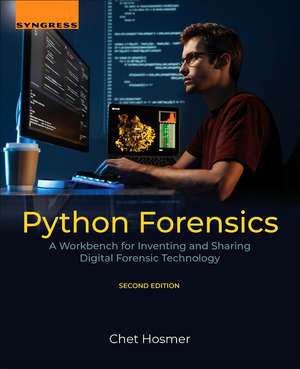
Python Forensics: A Workbench for Inventing and Sharing Digital Forensic Technology
Autor Chet Hosmeren Limba Engleză Paperback – 31 oct 2024
- Provides hands-on tools, code samples, and detailed instruction and documentation that can be put to use immediately
- Discusses how to create a Python forensics workbench
- Covers effective forensic searching and indexing using Python
- Shows how to use Python to examine mobile device operating systems
- Delves into extensive machine learning integration with the Python ecosystem, integration of Python with Generative Pre Trainer-Transformers such as GPT-3, ChatGPT, and other new and emerging applications of Python to digital forensics
Preț: 417.19 lei
Preț vechi: 521.49 lei
-20%
Carte disponibilă
Livrare economică 29 octombrie-12 noiembrie
Specificații
ISBN-10: 0443222339
Pagini: 400
Dimensiuni: 191 x 235 mm
Ediția:2
Editura: ELSEVIER SCIENCE
V-ar putea interesa
-
 Incident Response & Computer Forensics, Third EditionJason Luttgens-29%Preț: 325.09 lei459.30 lei
 -
 Python for ProgrammersHarvey Deitel-20%Preț: 313.76 lei392.21 lei
 -
 Forensic IntelligenceRobert Milne-15%Preț: 445.58 lei524.21 lei
 -
 -20%Preț: 222.84 lei278.55 lei
 -
 Artificial Intelligence (AI) in Forensic SciencesKatrin Franke-20%Preț: 678.35 lei847.94 lei
 -
 Python for CybersecurityHoward E Poston-20%Preț: 138.78 lei173.48 lei
 -
 Practical Forensic ImagingBruce Nikkel-36%Preț: 231.78 lei361.76 lei
 -
 -36%Preț: 200.14 lei314.37 lei
 -
 -36%Preț: 223.02 lei349.15 lei
 -
 Metasploit, 2nd EditionDavid Kennedy-20%Preț: 295.28 lei369.11 lei
 -
 -35%Preț: 260.49 lei398.05 lei
 -
 -34%Preț: 293.51 lei447.85 lei
 -
 -20%Preț: 199.71 lei249.64 lei
 -
 -36%Preț: 377.99 lei586.49 lei
 -
 The Crime Writers Casebook: Third EditionStuart Gibbon-17%Preț: 72.32 lei87.45 lei
 -
 -16%Preț: 74.95 lei89.14 lei
 -
 Advanced Guide to Python 3 ProgrammingJohn Hunt-20%Preț: 548.97 lei686.21 lei
 -
 Preț: 433.14 lei
 -
 -20%Preț: 418.84 lei523.54 lei
 -
 Digital Forensics for Enterprises Beyond Kali LinuxAbhirup GuhaPreț: 308.45 lei
Cuprins
2. Integrating advanced 3rd Party Libraries for Machine Learning, Natural Language Processing, eDiscovery, GPT, social media and malware investigations
3. Integrating Python with forensics and cyber security platforms
4. Forensics Searching using regular expressions, YARA rules, targeting static and dynamic environments including Web and Social Platforms
5. Analysis of photographic images for the identification of fake photos, deep fake videos/audio, and data hiding methods
6. Extracting and analyzing time of static and dynamic evidence sources including social platforms
7. Extracting meaning and sentiment from news stories, tweets, and other social media communications
8. Performing packet capture and deep packet analysis
9. Gathering open-source intelligence from social platforms and eDiscovery applications
10. Python Forensics in the Cloud
11. Integrating Python with GPT-3 and ChatGPT
12. Applying Python and Machine Learning within forensic investigations. Identifying fake news, Spear Phishing, GPT generated text, echo chambers, and propaganda
13. What is ahead for Python and Forensics
Recenzii
"Overall, the book is well laid out. The first few chapters cover some important forensic challenges. The code is easy to follow and well commented." --Help Net Security
Notă biografică
Chet Hosmer is a retired Assistant Professor of Practice at the University of Arizona and now serves as a Designated Campus Colleague. He previously taught in the Cybersecurity Graduate Program at Utica College and is the founder of Python Forensics, a nonprofit research and educational institution dedicated to advancing investigative capabilities through innovative research and specialized Python tools.
A recognized authority on emerging cyber threats, Chet has been featured by NPR, ABC News, Forbes, IEEE, The New York Times, The Washington Post, Government Computer News, Salon, and Wired. He is the author of seven books published by Elsevier and Apress covering passive cyber defense for OT environments, Python and PowerShell for investigators, data hiding and steganography, and IoT security. He has also delivered Congressional testimony before the House Science Committee on cybersecurity education.