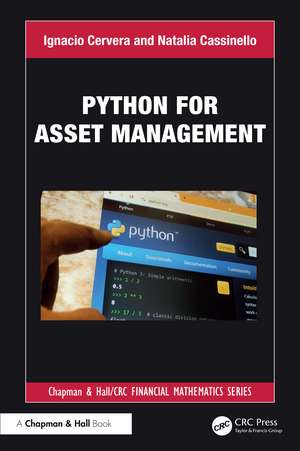
Python for Asset Management: Chapman and Hall/CRC Financial Mathematics Series
Autor Ignacio Cervera, Natalia Cassinelloen Limba Engleză Hardback – 30 aug 2026
Python for Asset Management fills that gap. The book empowers non-programmers – portfolio managers, risk analysts, and students – to implement advanced models themselves. It responds to the growing demand for quantitative literacy in finance, especially in sustainable investing and smart beta strategies, areas of active research for both of the authors.
Features
- 31 hands-on Python exercises with real data and executable code.
- Complete GitHub repository (MIT License) with all scripts, data pipelines, and results.
- Step-by-step implementation of VaR (historical, parametric, Monte Carlo), bond immunization, and factor models.
- Real-world decision tools – e.g., build a bullet/barbell/ladder bond portfolio, run Brinson–Fachler attribution, or backtest smart beta vs. index.
- Immediate applicability – every exercise produces a deliverable (e.g., optimal weights, risk report, attribution table) ready for client meetings.
- Focus on practical asset management workflows, not just theory.
Din seria Chapman and Hall/CRC Financial Mathematics Series
- 9%
 Preț: 984.40 lei
 - 9%
 Preț: 1663.93 lei
 -
 Preț: 449.39 lei
 - 18%
 Preț: 817.37 lei
 -
 Preț: 477.59 lei
 - 18%
 Preț: 939.28 lei
 - 18%
 Preț: 1111.54 lei
 - 15%
 Preț: 721.94 lei
 - 18%
 Preț: 766.85 lei
 - 15%
 Preț: 609.13 lei
 - 15%
 Preț: 561.25 lei
 - 18%
 Preț: 1428.40 lei
 - 18%
 Preț: 799.39 lei
 - 18%
 Preț: 1017.90 lei
 - 18%
 Preț: 715.44 lei
 - 18%
 Preț: 968.51 lei
 - 18%
 Preț: 922.61 lei
 - 15%
 Preț: 548.53 lei
 - 15%
 Preț: 678.95 lei
 - 15%
 Preț: 524.83 lei
 - 15%
 Preț: 569.15 lei
 - 18%
 Preț: 843.63 lei
 - 18%
 Preț: 721.58 lei
 - 18%
 Preț: 1051.61 lei
 - 18%
 Preț: 803.23 lei
 -
 Preț: 437.63 lei
 - 18%
 Preț: 699.41 lei
 -
 Preț: 484.25 lei
 - 15%
 Preț: 685.25 lei
 - 8%
 Preț: 445.62 lei
 - 18%
 Preț: 872.44 lei
 - 15%
 Preț: 617.81 lei
 - 18%
 Preț: 804.52 lei
 - 9%
 Preț: 665.33 lei
 - 18%
 Preț: 1428.74 lei
 - 18%
 Preț: 1157.10 lei
 - 20%
 Preț: 1439.36 lei
 - 15%
 Preț: 627.80 lei
 - 18%
 Preț: 893.94 lei
 - 18%
 Preț: 1013.72 lei
 - 20%
 Preț: 720.92 lei
Preț: 736.46 lei
Preț vechi: 866.42 lei
-15% Nou
Puncte Express: 1105
Carte tipărită la comandă
Livrare economică 07-21 decembrie
Livrare prin curier în România Termenul estimat este afișat lângă disponibilitate.
Transport gratuit pentru acest produs Plată online sau ramburs, în funcție de opțiunile comenzii.
Retur gratuit în 14 zile Comandă securizată și suport în română.
Specificații
ISBN-13: 9781041308324
ISBN-10: 1041308329
Pagini: 336
Ilustrații: 116
Dimensiuni: 156 x 234 mm
Greutate: 0.65 kg
Ediția:1
Editura: CRC Press
Colecția Chapman and Hall/CRC
Seria Chapman and Hall/CRC Financial Mathematics Series
ISBN-10: 1041308329
Pagini: 336
Ilustrații: 116
Dimensiuni: 156 x 234 mm
Greutate: 0.65 kg
Ediția:1
Editura: CRC Press
Colecția Chapman and Hall/CRC
Seria Chapman and Hall/CRC Financial Mathematics Series
Public țintă
Postgraduate and Professional Practice & DevelopmentCuprins
Chapter One: Python Libraries. Chapter Two: Python Applied to Market Index Analysis. Chapter Three: Python Applied to Equity Management. Chapter Four: Python Applied to Bond Management. Chapter Five: Python Applied to Return Attribution. Chapter Six: Python Applied to Investment Funds. Chapter Seven: Python Applied to Factor Investing. Chapter Eight: Python Applied to ESG Investment. Bibliography.
Notă biografică
Ignacio Cervera holds a PhD in business administration from Universidad Pontificia Comillas (Madrid) and an MBA from Instituto de Empresa (IE-Madrid) and is Professor of Corporate Finance and Portfolio Management & Investments. Since 2015, he has been an advisor on financial matters for the Pontificia Comillas University. He is currently co-director of the Asset Management Chair of this university. Lines of research are sustainability, investment funds, financial analysts, and financial and energy markets. He worked as Director of the Administrative and Financial Department at Tecnológica SA, Central de Aprovisionamiento y Diseño para Tecnología Espacial (Supply and Design Center for Space Technology) (1987–1990).
Natalia Cassinello holds a PhD in business administration and an executive master’s in behavioral economics from LSE and is Professor in Finance and ESG and Co-Director of the Asset Management Chair at Universidad Pontificia Comillas at Madrid Campus. She is the Deputy Chief Financial Officer at the university. Lines of research are sustainability, investment funds, and health economics. Her teaching has been combined with professional activity in the private sector, having worked from 1990 to 2006 first as a strategic consultant at the consulting firm McKinsey & Co (1990–1994), then as a financial and tax advisor at the law firms Consultores&Asociados and Ramón y Cajal Abogados (1995–2003), and finally as Director of the Recruitment Department at the consulting firm Boston Consulting Group (2003–2006).
Natalia Cassinello holds a PhD in business administration and an executive master’s in behavioral economics from LSE and is Professor in Finance and ESG and Co-Director of the Asset Management Chair at Universidad Pontificia Comillas at Madrid Campus. She is the Deputy Chief Financial Officer at the university. Lines of research are sustainability, investment funds, and health economics. Her teaching has been combined with professional activity in the private sector, having worked from 1990 to 2006 first as a strategic consultant at the consulting firm McKinsey & Co (1990–1994), then as a financial and tax advisor at the law firms Consultores&Asociados and Ramón y Cajal Abogados (1995–2003), and finally as Director of the Recruitment Department at the consulting firm Boston Consulting Group (2003–2006).
Descriere
The book empowers non-programmers—portfolio managers, risk analysts, and students—to implement advanced models themselves. It responds to the growing demand for quantitative literacy in finance, especially in sustainable investing and smart beta strategies, areas of active research for both of the authors.