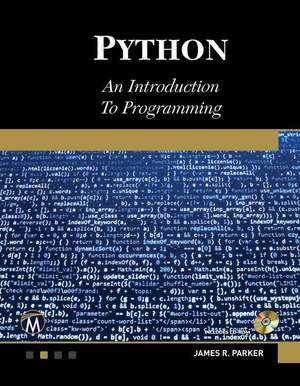
Python. An Introduction to Programming
Autor James R. Parkeren Limba Engleză Paperback – 12 dec 2016
| Toate formatele și edițiile | Preț | Express |
|---|---|---|
| Paperback (2) | 308.42 lei 22-36 zile | |
| Mercury Learning and Information – 12 dec 2016 | 308.42 lei 22-36 zile | |
| Mercury Learning and Information – 16 apr 2021 | 455.72 lei 22-36 zile |
Preț: 308.42 lei
Preț vechi: 385.54 lei
-20%
Puncte Express: 463
Preț estimativ în valută:
54.51€ • 64.13$ • 47.58£
54.51€ • 64.13$ • 47.58£
Carte disponibilă
Livrare economică 16-30 martie
Specificații
ISBN-13: 9781944534653
ISBN-10: 1944534652
Pagini: 548
Dimensiuni: 178 x 229 x 30 mm
Greutate: 0.92 kg
Ediția:1. Auflage
Editura: Mercury Learning and Information
ISBN-10: 1944534652
Pagini: 548
Dimensiuni: 178 x 229 x 30 mm
Greutate: 0.92 kg
Ediția:1. Auflage
Editura: Mercury Learning and Information
V-ar putea interesa
-
 -20%Preț: 258.61 lei323.27 lei
 -
 Programming SwiftOs Swift-20%Preț: 52.15 lei65.19 lei
 -
 JavaScriptAndrew Johansen-20%Preț: 101.91 lei127.38 lei
 -
 C Language /* & C++ *Cacildo Marques-20%Preț: 34.88 lei43.60 lei
 -
 Java 8 Exception Handling QuizMahavir Ds Rathore-20%Preț: 49.10 lei61.37 lei
 -
 PythonAndrew Johansen-20%Preț: 104.10 lei130.13 lei
 -
 C Programming Language and Software DesignMR Praveen Shandilya-20%Preț: 46.34 lei57.93 lei
 -
 Raspberry Pi 2Harry Colvin-20%Preț: 56.72 lei70.91 lei
 -
 Advanced Programming in Perl for BeginnersDorian Oria San Martin-20%Preț: 89.98 lei112.48 lei
 -
 PythonMax Green-20%Preț: 195.73 lei244.66 lei
 -
 PHP Grafica Dinamica, Funzioni E FigureMR Antonio Taccetti-20%Preț: 115.08 lei143.86 lei
 -
 PHP Grafica Dinamica, Grafici E GradientiMR Antonio Taccetti-20%Preț: 111.73 lei139.66 lei
 -
 PythonBen Abner-20%Preț: 64.70 lei80.87 lei
 -
 Start a Career with PythonPedro Rodrigues-20%Preț: 141.53 lei176.91 lei
 -
 Aprende a Programar En RPatricia Garcia Montero-20%Preț: 152.71 lei190.89 lei
 -
 JavaFelix Alvaro-20%Preț: 151.34 lei189.17 lei
 -
 The Visual Basic Programmer's Guide to JavaJames W. Cooper-20%Preț: 204.04 lei255.04 lei
 -
 dBASE IV 2.0 Programmer's ReferenceVirginia Andersen-20%Preț: 126.16 lei157.70 lei
 -
 Python 3James R. Parker-20%Preț: 148.73 lei185.91 lei
 -
![Game Development Using Python [OP]](https://i0.books-express.ro/bt/9781683921806/game-development-using-python-op.jpg) Game Development Using Python [OP]James R. Parker-20%Preț: 348.54 lei435.68 lei
Game Development Using Python [OP]James R. Parker-20%Preț: 348.54 lei435.68 lei -
 -20%Preț: 122.21 lei152.77 lei
 -
![Python [With CDROM]: Computer Concepts and Applications](https://i0.books-express.ro/bt/9781938549854/python-with-cdrom.jpg) Python [With CDROM]: Computer Concepts and ApplicationsOswald Campesato-20%Preț: 133.53 lei166.92 lei
Python [With CDROM]: Computer Concepts and ApplicationsOswald Campesato-20%Preț: 133.53 lei166.92 lei -
 Generative ArtSara L DiamondPreț: 190.40 lei
 -
 -20%Preț: 141.75 lei177.19 lei
Notă biografică
Parker James R. : James R. Parker, PhD is a professor of Art and Digital Media at the University of Calgary. His areas of research include computer games and media art, computer simulation, and educational technology. Dr. Parker is the author of Game Development Using Python, 2/E (Mercury Learning) and The Guide to Simulations and Games (Wiley).
Cuprins
1 - Computers and Programming.
2 - FOR Loops and While Loops: Repetition.
3 - Sequences: Strings, Tuples, and Lists.
4 - Functions and Parameters.
5 -Files: Input and Output.
6 - Classes.
7 - Graphics.
8 - Manipulating Data: Dictionaries, Formatted and Binary Files, Standard File Types.
9- Multimedia: Interaction, Sound, Video.
10 - Basic Algorithms for Computer Science.
11 - Programming for the Sciences.
12 - How to Write Good Programs.
13 - Communicating with the Outside World.
2 - FOR Loops and While Loops: Repetition.
3 - Sequences: Strings, Tuples, and Lists.
4 - Functions and Parameters.
5 -Files: Input and Output.
6 - Classes.
7 - Graphics.
8 - Manipulating Data: Dictionaries, Formatted and Binary Files, Standard File Types.
9- Multimedia: Interaction, Sound, Video.
10 - Basic Algorithms for Computer Science.
11 - Programming for the Sciences.
12 - How to Write Good Programs.
13 - Communicating with the Outside World.