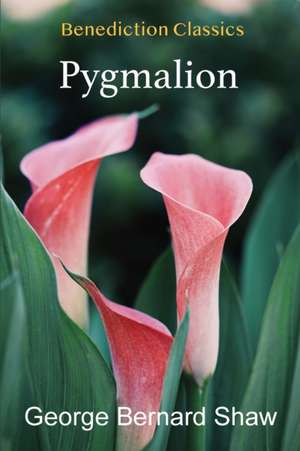
Pygmalion
Autor George Bernard Shawen Limba Engleză Paperback – 13 sep 2020
Recomandăm această ediție a piesei Pygmalion cititorilor pasionați de fineturi lingvistice și critică socială, celor care savurează dialogul ascuțit și personajele care refuză să fie simple piese într-un experiment. Considerăm că forța acestui text nu rezidă doar în transformarea spectaculoasă a Elizei Doolittle, ci în modul în care George Bernard Shaw demonstrează că limbajul este, în fond, o barieră de clasă aproape insurmontabilă.
Imaginați-vă tensiunea socială și rigurozitatea lingvistică din Lerner and Loewe's My Fair Lady, mutată într-un decor de realism didactic, unde muzica este înlocuită de observația tăioasă asupra ipocriziei britanice. Ne-a atras atenția în mod deosebit prefața autorului, care dezvăluie rădăcinile reale ale personajului Henry Higgins în figura foneticianului Henry Sweet. Shaw nu scrie doar o comedie de moravuri, ci un manifest despre cum modul de a vorbi îi condamnă pe oameni la disprețul semenilor lor.
Spre deosebire de alte lucrări ale sale, precum Major Barbara, unde dezbaterea ideologică vizează religia și capitalismul, în Pygmalion autorul se concentrează pe identitate și autodeterminare. Este o lucrare definitorie pentru stilul „shavian”, situându-se alături de Arms and the Man prin modul în care satirizează convențiile romantice. Ritmul este alert, susținut de replici care funcționează ca niște dueluri intelectuale, iar structura sa, deși clasică, rămâne surprinzător de modernă prin refuzul unui final convențional.
Preț: 54.87 lei
Carte tipărită la comandă
Livrare economică 28 noiembrie-12 decembrie
Specificații
ISBN-10: 1789432197
Pagini: 116
Dimensiuni: 156 x 234 x 7 mm
Greutate: 0.19 kg
Editura: BENEDICTION CLASSICS
V-ar putea interesa
-
 Principles of Mathematical Analysis (Int'l Ed)Walter Rudin-27%Preț: 375.61 lei516.26 lei
 -
 Things Fall ApartChinua Achebe-27%Preț: 51.94 lei71.25 lei
 -
 The Myth of SisyphusAlbert Camus-20%Preț: 45.43 lei56.72 lei
 -
 Death of a SalesmanArthur Miller-28%Preț: 50.97 lei70.66 lei
 -
 -13%Preț: 173.49 lei198.60 lei
 -
 -10%Preț: 82.33 lei91.16 lei
 -
 A Study Guide for Aravind Adiga's "The White Tiger"Cengage Learning GalePreț: 68.04 lei
 -
 AtonementIan McEwanPreț: 106.29 lei
 -
 Mother Courage and Her ChildrenBertolt Brecht-23%Preț: 85.41 lei111.57 lei
 -
 Chinua Achebe's Things Fall Apart: A Routledge Study GuideDavid WhittakerPreț: 379.42 lei
 -
 The Sorrow of WarBao Ninh-19%Preț: 58.02 lei71.65 lei
 -
 Waiting for GodotSamuel BeckettPreț: 83.86 lei
 -
 Brecht On TheatreBertolt Brecht-24%Preț: 186.77 lei245.30 lei
 -
 A Study Guide for Samuel Beckett's Waiting for GodotCengage Learning GalePreț: 67.63 lei
 -
 BelovedToni MorrisonPreț: 99.51 lei
 -
 The Myth of Sisyphus and the Stranger by Albert CamusRay Moore M. a.Preț: 55.39 lei
 -
 Preț: 74.26 lei
 -
 Preț: 57.78 lei
 -
 Preț: 61.78 lei
 -
 Preț: 58.76 lei
 -
 Edgar Allan Poe Short StoriesEdgar Allan Poe-28%Preț: 106.92 lei148.75 lei
 -
 Der VerscholleneFranz KafkaPreț: 59.06 lei
 -
 Analysis ITerence TaoPreț: 443.07 lei
De ce să citești această carte
Cititorul va câștiga o perspectivă fascinantă asupra modului în care educația și limbajul ne modelează locul în societate. Este o lectură esențială pentru cei care doresc să înțeleagă rădăcinile celebrei adaptări „My Fair Lady”, dar și pentru cei care apreciază umorul fin și critica socială care rămâne relevantă și după un secol de la publicare.
Despre autor
George Bernard Shaw (1856–1950) a fost un dramaturg irlandez, critic și activist politic, laureat al Premiului Nobel pentru Literatură în 1925. Stabilit la Londra, Shaw a devenit o figură centrală a teatrului occidental, scriind peste șaizeci de piese. Influențat de Ibsen, a introdus un nou realism în dramaturgia de limbă engleză, folosind scena ca platformă pentru ideile sale despre socialism, eugenie și reforma alfabetului. Printre cele mai cunoscute lucrări ale sale se numără Man and Superman și Saint Joan, Shaw fiind recunoscut pentru capacitatea sa unică de a îmbina satira contemporană cu alegoria istorică.
Descriere scurtă
Notă biografică
After his arrival in London in 1876 he became an active Socialist and a brilliant platform speaker. He wrote on many social aspects of the day: on Commonsense about the War (1914), How to Settle the Irish Question (1917), and The Intelligent Woman's Guide to Socialism and Capitalism (1928). He undertook his own education at the British Museum and consequently became keenly interested in cultural subjects. Thus his prolific output included music, art and theatre reviews which were collected into several volumes: Music In London 1890-1894 (3 vols., 1931); Pen Portraits and Reviews (1931); and Our Theatres in the Nineties (3 vols., 1931). He wrote five novels and some shorter fiction including The Black Girl in Search of God and some Lesser Tales and Cashel Byron's Profession.
He conducted a strong attack on the London theatre and was closely associated with the intellectual revival of British theatre. His many plays fall into several categories: 'Plays Pleasant'; 'Plays Unpleasant'; comedies, chronicle-plays, 'metabiological Pentateuch' (Back to Methuselah, a series of plays) and 'political extravaganzas'. Shaw died in 1950.
Descriere
George Bernard Shaw's witty comedy of manners, Pygmalion includes an introduction by Nicholas Grene in Penguin Classics.
Pygmalion both delighted and scandalized its first audiences in 1914. A brilliantly witty reworking of the classical tale of the sculptor Pygmalion, who falls in love with his perfect female statue, it is also a barbed attack on the British class system and a statement of Shaw's feminist views. In Shaw's hands, the phoneticist Henry Higgins is the Pygmalion figure who believes he can transform Eliza Doolittle, a cockney flower girl, into a duchess at ease in polite society. The one thing he overlooks is that his 'creation' has a mind of her own. Adapted into the Oscar-winning musical film My Fair Lady starring Audrey Hepburn and Rex Harrison in 1964, Pygmalion
This is the definitive text produced under the editorial supervision of Dan H. Laurence, with an illuminating introduction by Nicholas Grene, discussing the language and politics of the play. Also included in this volume is Shaw's preface, as well as his 'sequel' written for the first publication in 1916, to rebut public demand for a more conventially romantic ending.
Although essentially shy, Dublin-born George Bernard Shaw (1856-1950) created the persona of GBS, the showman, satirist, conversationalist, critic, pundit, wit, intellectual buffoon and dramatist. Commentators brought a new adjective into English: 'Shavian', a term used to embody all his brilliant qualities. Deeply concerned by what he saw as the exploitation of the working class, Shaw was an active Socialist and a brilliant platform speaker. He remains the only person ever to have been awarded both the Nobel Prize in Literature and an Oscar.
If you enjoyed Pygmalion, you might like Oscar Wilde's The Picture of Dorian Gray, also available in Penguin Classics.