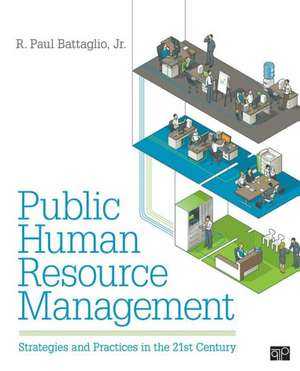
Public Human Resource Management: Strategies and Practices in the 21st Century
Autor Randy Paul Battaglioen Limba Engleză Hardback – 22 oct 2014
Recomandăm această lucrare managerilor din sectorul public, administratorilor de instituții guvernamentale și studenților la programele de Administrație Publică sau MBA care doresc să înțeleagă complexitatea gestionării capitalului uman într-un mediu aflat sub presiunea constantă a reformei. Observăm că Public Human Resource Management de Randy Paul Battaglio nu se mulțumește doar cu prezentarea fundamentelor, ci oferă o perspectivă critică asupra modului în care descentralizarea și privatizarea au rescris regulile jocului în instituțiile statului.
Pe linia practică a volumului Human Resource Management in Public Service de Evan M. Berman, dar cu focus pe impactul sistemic al celor cinci piloni ai reformei moderne (inclusiv dereglementarea și plata pe performanță), această carte acționează ca un ghid de navigare prin peisajul legislativ și operațional actual. Suntem de părere că valoarea adăugată a textului constă în includerea unor subiecte adesea ignorate, precum sistemele informatice de resurse umane (HRIS) și motivarea angajaților în contextul diminuării drepturilor tradiționale ale funcționarilor publici.
Structura volumului este riguroasă, pornind de la o bază istorică esențială în prima parte — unde este trasată evoluția serviciului public de la perioada 'Gentlemenilor' la cea a 'Eficienței' și până la 'Managerialismul' contemporan. Ulterior, autorul trece la aspecte tehnice vitale: dreptul muncii în sectorul public, recrutarea, retenția și evaluarea performanței. Cartea reușește să integreze studii de caz relevante și date statistice care transformă conceptele teoretice în instrumente de lucru pentru administratorul modern, oferind o analiză onestă a provocărilor aduse de noile modele de management.
Preț: 1013.64 lei
Preț vechi: 1369.78 lei
-26%
Carte tipărită la comandă
Livrare economică 23 noiembrie-07 decembrie
Specificații
ISBN-10: 1452218234
Pagini: 440
Dimensiuni: 187 x 232 x 42 mm
Greutate: 0.82 kg
Ediția:Revised.
Editura: SAGE Publications
Colecția CQ Press
Locul publicării:Washington DC, United States
V-ar putea interesa
-
 Human Resource Management: A Very Short IntroductionAdrian Wilkinson-20%Preț: 55.48 lei69.70 lei
 -
 Public Management Reform: A Comparative Analysis - Into The Age of AusterityChristopher Pollitt-26%Preț: 356.22 lei480.92 lei
 -
 People Resourcing and Talent PlanningStephen Pilbeam-15%Preț: 657.49 lei773.51 lei
 -
 Trauernicht, N: Human Resource Management for the Fire and ENathan Trauernicht-5%Preț: 432.72 lei457.23 lei
 -
 Public Sector Employment in a Time of TransitionDale BelmanPreț: 288.88 lei
 -
 Preț: 379.65 leiRecomandat
 -
 Human Resource Management in Public ServiceEvan M. Berman-13%Preț: 1020.63 lei1173.14 lei
 -
 -11%Preț: 670.85 lei753.77 lei
 -
 Handbook of Public AdministrationJames L Perry-14%Preț: 666.02 lei774.45 lei
 -
 Public Management and AdministrationOwen E. Hughes-27%Preț: 280.15 lei382.82 lei
 -
 Managing Human Resources: 2025 Release ISEWayne Cascio-4%Preț: 371.01 lei386.47 lei
 -
 -4%Preț: 381.74 lei397.65 lei
 -
 Human Resources Management, Global EditionGary Dessler-9%Preț: 611.94 lei672.46 lei
 -
 Preț: 525.43 lei
 -
 Preț: 130.07 lei
 -
 Contemporary Human Resource ManagementAdrian Wilkinson-18%Preț: 419.40 lei511.47 lei
 -
 Human CapitalSally Coleman Selden-13%Preț: 570.84 lei656.13 lei
 -
 Human Resource Management in Sport and RecreationAmy Chan Hyung Kim-9%Preț: 699.72 lei768.92 lei
De ce să citești această carte
Cititorul va dobândi o înțelegere profundă a modului în care reformele de privatizare și descentralizare afectează managementul cotidian al personalului. Este o resursă esențială pentru a învăța cum să gestionezi eficient echipe în sectorul public, integrând tehnologia și noile reglementări juridice. Veți câștiga capacitatea de a evalua critic politicile de HR și de a implementa strategii de performanță adaptate realităților secolului XXI.
Descriere scurtă
Recenzii
“Public Human Resource Management is very thorough and covers all of the important areas in preparing a 21st-century public administrator. I am very impressed with the case studies and tables within the book. They are very relevant to issues that are important to public administration practitioners. The text is definitely different than other books on the market because it covers new and exciting topics such as HR Information Systems and Privatization. In the past, I have found myself looking for several different resources and compiling them but this book has included those items, such as strategic planning and management and diversity and social equity. I am really excited about using this text.”
Cuprins
Chapter 1: Introduction: Public Human Resource Management in the 21st Century
Public HRM Reform: An Overview
Implications for Public HRM
Organization of the Book
References
Chapter 2: Evolution of the Public Service in the United States
Government by Gentlemen: The Guardian Period (1789-1829)
Government by the Common Man: The Spoils Period (1829-1883)
Government by the Good: The First Reform Period (1883-1906)
Government by the Efficient: The Scientific Management Period (1906-1937)
Government by Individuals: The Behavioralism Period (1937-1964)
Government by Equality: The Civil Rights Period (1964-1978)
Government by Reform: The Managerialist Period (1978-present)
Assessing the Impact of PHRM Reform
Conclusion
References
Chapter 3: Employment Law in the Public Sector
The Legal Landscape of PHRM
Codified Law in the United States and PHRM
The Constitutional Rights of Public Employees
Nonprofits in Focus: Employee Privacy and Nonprofit Organizations: The Age of Social Media
Public Employees and Constitutional Torts
The Legal Environment of PHRM in an Era of Reform
Conclusion
References
Appendix: Important Public Sector Employment Law Cases
Case 3.1: Freedom of Speech and Public Employment Law
Exercise
Chapter 4: Equal Employment Opportunity, Affirmative Action, and Diversity Planning
Representative Bureaucracy as Administrative Theory
The Civil Rights Movement
Equal Employment Opportunity, Affirmative Action, and Diversity
Does Diversity Matter?
Additional EEO Concerns
Nonprofits in Focus: Diversity, Sexual Orientation, and NPOs
Equal Employment, Diversity, and PHRM Reform
Conclusion
References
Case 4.1: The Courts and PHRM Reform – The Jefferson County, Alabama, Personnel Board
Exercise
Part II: Functions
Chapter 5: Recruitment and Selection
The Legal Climate Regulating Selection and Hiring Practices
Recruitment for Public Service
Nonprofits in Focus: Recruiting Online Volunteers
Selection Procedures
Assessing Reliability and Validity of Selection Procedures
Employee Recruitment and Selection in an Era of PHRM Reform
Conclusion
References
Case 5.1: Decentralization, Declassification, and Efficiency: Recruitment and Selection Reform in the State of New York Civil Service
Exercise
Chapter 6: Pay and Benefits
Laws Affecting Compensation Policy and Practice in the Public Sector
Job Analysis: The Foundation of Public Sector Compensation
Objectives, Strategies, and Structures of Public Sector Compensation
Nonprofits in Focus: Executive Pay in Nonprofit Organizations: A Comparison
Alternative Compensation Systems
Performance Appraisal in an Era of PHRM Reform
Contemporary Benefits in the Public Sector
Pay and Benefits in an Era of PHRM Reform
Conclusion
References
Case 6.1: Rhode Island’s Bid for Performance-Based Compensation Reform
Exercises
Chapter 7: Performance Appraisal
Performance Appraisal: Purpose and Process
Criteria Used in Performance Appraisals
The Question of Reliability and Validity
Methods for Appraising Employee Performance in the Public Sector
Nonprofits in Focus: Poor Performers in NPOs
Alternative Appraisal Methods
Avoiding Rater Error and Bias
Performance Appraisal in an Era of PHRM Reform
Conclusion
References
Appendix: Performance Appraisal Report Example
Case 7.1: The Mouse that Roared
Exercises
Chapter 8: Managing Motivation in the Public Service
Defining Public Service Motivation
Nonprofits in Focus: Do Public Employees Volunteer?
PSM and Public Human Resource Management
Motivation and PHRM Reform
References
Case 8.1: "Radical” Civil Service Reform in Georgia
Exercise
Chapter 9: Labor Relations in the Public Sector
Unions and Labor-Management Relations
Setting the Stage: Rise of Private Sector Labor Unions
Unionism in the Public Sector
Frameworks for Labor-Management Relations
Developing a Framework for Collective Bargaining
Labor Management Relations in a PHRM Reform Environment
Nonprofit in Focus: Labor Relations, Collective Bargaining, and NPOs
Conclusion
References
Case 9.1: Labor Unions and Civil Service Reform: Florida and Service First
Exercise
Part III: The Future
Chapter 10: Privatizing Human Resource Functions in the Public Sector
Privatization of Public HR Management
Nonprofits in Focus: Outsourcing Volunteer Management
The Legal Environment of PHRM Outsourcing
Managing Privatization
Pitfalls to PHRM Privatization
Conclusion: Incorporating Public Value into Privatization
References
Case 10.1: Privatizing State Services in Louisiana
Exercise
Chapter 11: Human Resource Information Systems
History of HRIS
HRIS Applications
Types of HRIS
HRIS Software
Nonprofits in Focus: Volunteer Management Software
HRIS Applications in the Public Sector
Legal Considerations Related to HRIS
HRIS and PHRM Reforms
Conclusion
References
Case 11.1: Edward Snowden and the Safeguarding of Information
Exercise
Chapter 12: Strategic Public Human Resource Management
Human Capital Management
Thinking Strategically about Human Resource Management in the Public Sector
Strategic Human Resource Management and Workforce Planning
Practical Steps toward Strategic Public Human Resource Management
Nonprofits in Focus: Strategic Planning in the Nonprofit Sector
SHRM in an Era of PHRM Reform
Conclusion
References
Case 12.1: Louisiana and Vision 2020
Exercise
Chapter 13: Public Human Resource Management Education
The Traditional Core of Public HRM
HRM Reform: Factors Influencing Vocation
Implications for Public HRM Education
Evaluating Private Sector Models of HRM Education: Graduate Programs in HRM
Status and Future of PHRM Education
Training and Development
Conclusion: Proposals for Change
References
Case 13.1: Assessing Future Knowledge and Skill Sets in a PHRM Reform Environment
Exercise
Chapter 14: Conclusion: Challenges and Opportunities
Challenges of PHRM Reform
Opportunities: The Future of PHRM
Final Thoughts
References