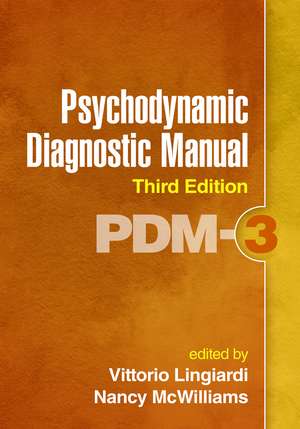
Psychodynamic Diagnostic Manual, Third Edition: PDM-3
Editat de Vittorio Lingiardi, Nancy McWilliamsen Limba Engleză Hardback – 16 feb 2026
În ultimii ani, practica diagnosticului în sănătatea mentală a evoluat de la o simplă clasificare a simptomelor către o înțelegere profundă, dimensională, a funcționării umane. Remarcăm faptul că Psychodynamic Diagnostic Manual, Third Edition (PDM-3) se consolidează ca un instrument clinic indispensabil, oferind o alternativă sau un supliment necesar la sistemele descriptive precum DSM sau ICD. Această a treia ediție, coordonată de Vittorio Lingiardi și Nancy McWilliams, integrează progresele recente din neuroștiințe într-un cadru psihodinamic riguros, reușind să păstreze totodată un limbaj accesibil, lipsit de jargon.
Reținem restructurarea fundamentală a conținutului, care acum urmează fidel etapele dezvoltării umane. Cartea este organizată pe secțiuni ce parcurg viața de la prima copilărie la adolescență, vârsta adultă și bătrânețe, punând un accent inedit pe perioadele de tranziție. Față de Psychodynamic Diagnostic Manual, Second Edition, unde accentul era pus pe formularea de caz, PDM-3 extinde viziunea prin introducerea unor capitole despre experiențele psihologice care, deși nu se încadrează în patologii stricte, solicită intervenția terapeutului.
Comparativ cu Diagnosis and Treatment of Mental Disorders Across the Lifespan, care se concentrează pe aplicarea criteriilor DSM, PDM-3 oferă avantajul unei perspective multiaxiale ce evaluează capacitățile mentale și funcționarea personalității, nu doar simptomele. În contextul operei lui Vittorio Lingiardi, acest manual reprezintă punctul culminant al cercetării sale asupra relației dintre psihic și mediu (temă explorată în Mindscapes), oferind o structură empirică pentru ceea ce autorul numește peisaj mental. Este o resursă vastă, de peste 1000 de pagini, care transformă actul diagnostic dintr-o etichetare statică într-o hartă dinamică a pacientului.
Preț: 911.39 lei
Preț vechi: 959.35 lei
-5% Nou
Carte tipărită la comandă
Livrare economică 06-20 iunie
Specificații
ISBN-10: 1462558720
Pagini: 1058
Dimensiuni: 178 x 254 x 56 mm
Greutate: 2.16 kg
Ediția:3rd edition
Editura: Guilford Publications
Colecția Guilford Press
V-ar putea interesa
-
 Massachusetts General Hospital Comprehensive Clinical PsychiatryTheodore A. Stern-5%Preț: 1732.63 lei1823.82 lei
 -
 Massachusetts General Hospital Handbook of General Hospital PsychiatryTheodore A. Stern-28%Preț: 485.31 lei671.43 lei
 -
 Borderline Personality Disorder in Adolescents, 3rd EditionBlaise Aguirre-20%Preț: 122.37 lei152.04 lei
 -
 -5%Preț: 503.70 lei530.20 lei
 -
 Diagnosis and Treatment of Mental Disorders Across the LifespanStephanie M Woo-9%Preț: 701.85 lei771.27 lei
 -
 Child and Adolescent PsychiatryRobert Goodman-5%Preț: 402.86 lei424.06 lei
 -
 Child and Adolescent TherapyJeremy P. Shapiro-5%Preț: 960.05 lei1010.58 lei
 -
 Introduction to the Practice of Psychoanalytic PsychotherapyAlessandra LemmaPreț: 372.92 lei
 -
 Dsm-5-Tr in ActionSophia F Dziegielewski-19%Preț: 545.19 lei673.07 lei
 -
 -5%Preț: 287.88 lei303.03 lei
 -
 Psychodynamic Diagnostic Manual, Second Edition: PDM-2Vittorio Lingiardi-8%Preț: 625.16 lei679.52 lei
 -
 Treatment of Disorders in Childhood and Adolescence, Fourth EditionMitchell J. Prinstein-5%Preț: 876.05 lei922.15 lei
 -
 Preț: 337.76 lei
 -
 -5%Preț: 446.40 lei469.90 lei
 -
 Normal Child and Adolescent DevelopmentKaren J. Gilmore-19%Preț: 450.14 lei555.73 lei
 -
 Psychodynamic Psychiatry in Clinical PracticeGlen O. Gabbard-5%Preț: 875.65 lei921.73 lei
 -
 -5%Preț: 387.58 lei407.98 lei
 -
 Kaplan & Sadock’s Pocket Handbook of Clinical PsychiatrySamoon Ahmad M.D.-22%Preț: 547.66 lei701.26 lei
 -
 -23%Preț: 591.03 lei764.79 lei
De ce să citești această carte
Recomandăm PDM-3 oricărui psihoterapeut sau psihiatru care dorește să depășească limitele diagnosticului categorial. Cititorul câștigă o metodologie de evaluare nuanțată, bazată pe dovezi, care facilitează planuri de tratament personalizate. Este un instrument esențial pentru rezidenți și practicieni experimentați, oferind acces la scale de rating validate și exemple clinice bogate care ancorează teoria în realitatea cabinetului.
Despre autor
Vittorio Lingiardi este un distins psihiatru și psihanalist italian, recunoscut la nivel internațional pentru contribuțiile sale în psihologia dinamică. Profesor titular la Universitatea Sapienza din Roma, acesta a condus programe de specializare în psihologie clinică, îmbinând rigoarea academică cu practica de cabinet. Expertiza sa în diagnosticul psihodinamic este dublată de un interes profund pentru legătura dintre spațiul mental și mediul extern, temă reflectată în lucrările sale anterioare. În calitate de editor al seriei PDM, Lingiardi a reușit să unifice perspective clinice diverse într-un limbaj comun pentru specialiștii din întreaga lume.
Recenzii
“The PDM is far more useful in clinical practice than the DSM or ICD. Psychopathologies simply cannot be adequately conceptualized in purely nomothetic terms; to ignore the idiographic is to ignore the most essential feature of the mind--namely, that it is subjective. The inclusion of some neuropsychoanalytic constructs in this edition is a particularly welcome development.”--Mark Solms, PhD, Co-Chair, International Neuropsychoanalysis Society
“A landmark achievement. Fully revised, PDM-3 offers a comprehensive lifespan framework that captures the complexity of human functioning through a dimensional, person-centered lens. It integrates contemporary research--from neuroscience and outcome studies to cultural and developmental psychology--while remaining grounded in core psychodynamic traditions such as object relations, ego psychology, and relational theory. PDM-3 adds vital clinical nuance to classification by emphasizing subjective experience, developmental context, and therapeutic relevance, and by incorporating both nomothetic and idiographic perspectives. Ideal for graduate training in diagnosis and assessment, PDM-3 is clinically meaningful and empirically grounded, revitalizing psychodynamic assessment for today’s mental health landscape.”--Peter Lilliengren, PhD, Department of Psychology, Stockholm University, Sweden
“PDM-3 is an extraordinary collaborative achievement, with chapter editors and consultants who are among the most talented people in our profession. The volume champions psychodynamic thinking, including ego psychology, object relations, self psychology, and relational psychoanalysis. With sensitivity to developmental phases, culture, context, and diversity, PDM-3 makes diagnosis clinically meaningful beyond the narrow categories of the DSM, and includes dialogue with cognitive science and neuroscience. The third edition is easy to read, is organized chronologically beginning with infancy, and includes more recent empirical literature. This book is an invaluable resource for researchers as well as clinicians.”--Beatrice Beebe, PhD, Clinical Professor, Columbia University Medical Center, New York State Psychiatric Institute-The depth is impressive….Recommended. Upper-level undergraduates through professionals/practitioners. (on the second edition)--Choice Reviews, 11/1/2017Æ’Æ’No matter what your theoretical framework, this book and its ideas will work for you. Truly a mind-opening experience, and one which makes clinicians stop and think about their current therapeutic orientation. A must read for open-minded clinicians willing to go beyond the confines of the current diagnostic models. *****! (on the second edition)--Doody's Review Service, 7/28/2017
Descriere scurtă
New to This Edition
- Restructured to follow development chronologically.
- Conceptual refinements, updated assessment tools, and expanded case material.
- Chapters on the transition from infancy to childhood and from adolescence to adulthood.
- Chapters on psychological experiences throughout the lifespan that are not captured by a diagnosis, but may require clinical attention.
Supporting associations include the International Psychoanalytical Association, Division 39 of the American Psychological Association, the American Psychoanalytic Association, the International Association for Relational Psychoanalysis & Psychotherapy, the American Association for Psychoanalysis in Clinical Social Work, and other organizations.
PDM-2 won the American Board and Academy of Psychoanalysis Book Prize (Clinical Category)
Cuprins
I. Infancy and Early Childhood
1. Mental Health and Developmental Disorders in Infancy and Early Childhood--IEC 0–3, Anna Maria Speranza & Miriam Steele
2. From Infancy to Childhood, Anna Maria Speranza
II. Childhood
3. Profile of Mental Functioning in Childhood--MC Axis, Norka Malberg, Anna Maria Speranza, & Alexandro Fortunato
4. Levels of Emerging Personality Patterns and Difficulties in Childhood--PC Axis, Norka Malberg, Anna Maria Speranza, & Alexandro Fortunato
5. Child Symptom Patterns: The Subjective Experience--SC Axis, Anna Maria Speranza, Norka Malberg, & Alexandro Fortunato
6. Psychological Experiences That May Require Clinical Attention in Childhood, Anna Maria Speranza, Alexandro Fortunato, & Norka Malberg
III. Adolescence
7. Profile of Mental Functioning in Adolescents--MA Axis, Annalisa Tanzilli & Norka Malberg
8. Emerging Personality Styles and Disorders in Adolescence--PA Axis, Annalisa Tanzilli & Carla Sharp
9. Adolescent Symptom Patterns: The Subjective Experience--SA Axis, Annalisa Tanzilli & Mario Speranza
10. Psychological Experiences That May Require Clinical Attention in Adolescence, Annalisa Tanzilli & Guido Giovanardi
11. Psychodynamic Diagnostic Assessment in the Early Adult Years, Annalisa Tanzilli
IV. Adulthood
12. Personality Styles and Disorders--P Axis, Nancy McWilliams & Jonathan Shedler
13. Profile of Mental Functioning--M Axis, Vittorio Lingiardi, Laura Muzi, & Robert F. Bornstein
14. Symptom Patterns: The Subjective Experience--S Axis, Emanuela Mundo,Laura Muzi, & Vittorio Lingiardi
15. Psychological Experiences That May Require Clinical Attention, Vittorio Lingiardi & Nancy McWilliams
V. Older Adults
16. When Does Later Life Begin?, Franco Del Corno & Daniel Plotkin
17. Profile of Mental Functioning in Older Adults--MOA Axis, Franco Del Corno & Daniel Plotkin
18. Personality Styles and Disorders in Older Adults--POA Axis, Franco Del Corno & Daniel Plotkin
19. Symptom Patterns in Older Adults: The Subjective Experience--SOA Axis, Franco Del Corno & Daniel Plotkin
20. Psychological Experiences That May Require Clinical Attention in Older Adults, Franco Del Corno & Daniel Plotkin
VI. Assessment Using PDM-3
21. Assessment within the PDM-3 Framework: The Psychodiagnostic Charts (PDCs), Vittorio Lingiardi & Nancy McWilliams
Index
Notă biografică
Nancy McWilliams, PhD, ABPP, is Visiting Professor Emerita at the Graduate School of Applied and Professional Psychology at Rutgers, The State University of New Jersey, and has a private practice in Lambertville, New Jersey. She is author or editor of acclaimed books, including Psychoanalytic Diagnosis, Second Edition, and has published widely in professional journals. Dr. McWilliams is a past president of the Society for Psychoanalysis and Psychoanalytic Psychology, Division 39 of the American Psychological Association (APA). She is the recipient of honors including the Gradiva Award from the National Association for the Advancement of Psychoanalysis, the Erikson Scholar Award from the Austen Riggs Center, the Goethe Scholarship Award from the Section on Psychoanalytic and Psychodynamic Psychology of the Canadian Psychological Association, the Rosalee Weiss Award from the Division of Independent Practitioners of the APA, the Laughlin Distinguished Teacher Award from the American Society of Psychoanalytic Physicians, the Hans H. Strupp Award from the Appalachian Psychoanalytic Society, and the International, Leadership, and Scholarship Awards from APA Division 39. She is an honorary member of the American Psychoanalytic Association, the Institute for Psychoanalytic Psychotherapy of Turin, Italy, and the Warsaw Scientific Association for Psychodynamic Psychotherapy. Dr. McWilliams’s writings have been translated into more than 20 languages.