
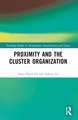
Proximity and the Cluster Organization: Routledge Studies in Management, Organizations and Society
Autor Anna Maria Lis, Adrian Lisen Limba Engleză Hardback – 5 apr 2023
However, proximity should not be perceived only in the geographical dimension. The similarity of knowledge systems (cognitive proximity), relationships based on trust (social proximity), organizational links (organizational proximity), and finally the similarity of institutional operating conditions (institutional proximity) enable and facilitate the development of cooperation relationships between business entities. Each of the above-mentioned threads deals separately with issues that have much in common, namely they can be treated as different dimensions of the same concept – proximity. Proximity provides a specific concretization of the features, processes and mechanisms underlying inter-organizational cooperation, and thus facilitates its understanding, increasing the possibility of its effective management.
The study provides new important elements to the current system of knowledge, filling in the cognitive and research gaps in the scientific literature on problems related to proximity development in cluster organizations. The new element includes a multidimensional concept of proximity explaining its role in the development of cooperative relationships in the cluster organizations. A strong point of the developed concept is its inductive-abductive origin and the use of grounded theory methodology, which is rare in the studies of cluster organizations. The developed concept has also significant practical advantages since it allows to consciously shape proximity in COs, thus contributing to the development of cooperation between cluster enterprises.
| Toate formatele și edițiile | Preț | Express |
|---|---|---|
| Paperback (1) | 335.51 lei 3-5 săpt. | +19.16 lei 4-10 zile |
| Taylor & Francis – 9 oct 2024 | 335.51 lei 3-5 săpt. | +19.16 lei 4-10 zile |
| Hardback (1) | 962.66 lei 6-8 săpt. | |
| Taylor & Francis – 5 apr 2023 | 962.66 lei 6-8 săpt. |
Din seria Routledge Studies in Management, Organizations and Society
-
 Preț: 352.04 lei
 -
 Preț: 352.04 lei
 -
 Preț: 367.78 lei
 -
 Preț: 297.52 lei
 -
 Preț: 335.51 lei
 -
 Preț: 356.32 lei
 -
 Preț: 319.14 lei
 -
 Preț: 334.42 lei
 -
 Preț: 312.56 lei
 -
 Preț: 404.30 lei
 - 18%
 Preț: 1122.95 lei
 - 18%
 Preț: 1063.81 lei
 - 15%
 Preț: 413.93 lei
 -
 Preț: 415.50 lei
 -
 Preț: 459.58 lei
 - 15%
 Preț: 429.48 lei
 - 18%
 Preț: 1011.94 lei
 - 18%
 Preț: 1120.50 lei
 - 18%
 Preț: 1117.64 lei
 - 18%
 Preț: 701.36 lei
 - 15%
 Preț: 559.71 lei
 - 18%
 Preț: 1332.95 lei
 - 18%
 Preț: 672.93 lei
 - 18%
 Preț: 1225.14 lei
 - 15%
 Preț: 413.13 lei
 - 15%
 Preț: 412.51 lei
 -
 Preț: 375.07 lei
 - 18%
 Preț: 1072.90 lei
 - 18%
 Preț: 860.89 lei
 - 18%
 Preț: 1066.21 lei
 - 34%
 Preț: 874.37 lei
 - 18%
 Preț: 1174.49 lei
 - 18%
 Preț: 1119.90 lei
 - 18%
 Preț: 1066.08 lei
 - 18%
 Preț: 1066.08 lei
 -
 Preț: 457.38 lei
 - 18%
 Preț: 1064.25 lei
 - 34%
 Preț: 787.19 lei
 -
 Preț: 468.10 lei
 - 18%
 Preț: 1225.31 lei
 - 18%
 Preț: 1068.05 lei
 - 31%
 Preț: 1245.62 lei
 - 18%
 Preț: 1173.58 lei
 - 18%
 Preț: 1059.99 lei
Preț: 962.66 lei
Preț vechi: 1173.97 lei
-18% Nou
Puncte Express: 1444
Preț estimativ în valută:
170.34€ • 200.02$ • 149.51£
170.34€ • 200.02$ • 149.51£
Carte tipărită la comandă
Livrare economică 27 ianuarie-10 februarie 26
Preluare comenzi: 021 569.72.76
Specificații
ISBN-13: 9781032046341
ISBN-10: 1032046341
Pagini: 238
Ilustrații: 24 Tables, black and white; 7 Line drawings, black and white; 7 Illustrations, black and white
Dimensiuni: 152 x 229 x 14 mm
Greutate: 0.49 kg
Ediția:1
Editura: Taylor & Francis
Colecția Routledge
Seria Routledge Studies in Management, Organizations and Society
Locul publicării:Oxford, United Kingdom
ISBN-10: 1032046341
Pagini: 238
Ilustrații: 24 Tables, black and white; 7 Line drawings, black and white; 7 Illustrations, black and white
Dimensiuni: 152 x 229 x 14 mm
Greutate: 0.49 kg
Ediția:1
Editura: Taylor & Francis
Colecția Routledge
Seria Routledge Studies in Management, Organizations and Society
Locul publicării:Oxford, United Kingdom
Public țintă
PostgraduateNotă biografică
Anna Maria Lis is a Faculty Member of the Department of Management and Economics at Gdańsk University of Technology, Poland.
Adrian Lis is a Faculty Member at Collegium Civitas in Warsaw, Poland.
Adrian Lis is a Faculty Member at Collegium Civitas in Warsaw, Poland.
Cuprins
Chapter 1. Introduction Chapter 2. Prior and contemporary theories on industrial clusters Chapter 3. Concept of proximity Chapter 4. Research methodology Chapter 5. The role of proximity in the development of cooperation in cluster organizations: the results of a qualitative research Chapter 6. The role of proximity in the development of cooperation in cluster organizations: the results of quantitative research Chapter 7. Application of the generated concept of proximity to selected cluster organizations in Europe Chapter 8. Conclusions
Descriere
The study provides new important elements to the current system of knowledge, filling in the cognitive and research gaps in the scientific literature on problems related to proximity development in cluster organizations.