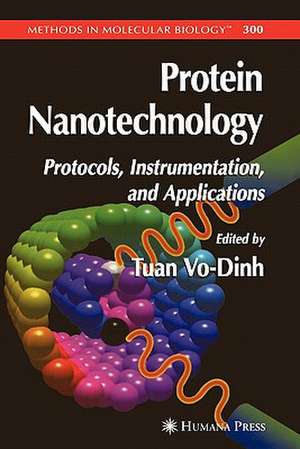
Protein Nanotechnology
Editat de Tuan Vo-Dinhen Limba Engleză Paperback – 10 noi 2010
| Toate formatele și edițiile | Preț | Express |
|---|---|---|
| Paperback (1) | 917.27 lei 6-8 săpt. | |
| Humana Press Inc. – 10 noi 2010 | 917.27 lei 6-8 săpt. | |
| Hardback (1) | 923.78 lei 6-8 săpt. | |
| Humana Press Inc. – 20 ian 2005 | 923.78 lei 6-8 săpt. |
Preț: 917.27 lei
Preț vechi: 1118.62 lei
-18%
Puncte Express: 1376
Preț estimativ în valută:
162.16€ • 189.83$ • 141.60£
162.16€ • 189.83$ • 141.60£
Carte tipărită la comandă
Livrare economică 06-20 martie
Preluare comenzi: 021 569.72.76
Specificații
ISBN-13: 9781617374838
ISBN-10: 1617374830
Pagini: 466
Ilustrații: XIV, 466 p. 195 illus.
Dimensiuni: 152 x 229 x 27 mm
Greutate: 0.7 kg
Ediția:2005 edition
Editura: Humana Press Inc.
Locul publicării:Totowa, NJ, United States
ISBN-10: 1617374830
Pagini: 466
Ilustrații: XIV, 466 p. 195 illus.
Dimensiuni: 152 x 229 x 27 mm
Greutate: 0.7 kg
Ediția:2005 edition
Editura: Humana Press Inc.
Locul publicării:Totowa, NJ, United States
V-ar putea interesa
-
 Schaum's Outline of Biochemistry, Third EditionPhilip Kuchel-17%Preț: 205.07 lei248.02 lei
 -
 Essential Ion Channel MethodsP. Michael Conn-5%Preț: 637.83 lei671.39 lei
 -
 The Machinery of LifeDavid S. GoodsellPreț: 202.67 lei
 -
 Real-time PCRM Dorak-15%Preț: 570.18 lei670.81 lei
 -
 -11%Preț: 565.99 lei635.94 lei
 -
 Fundamentals of Biochemical CalculationsKrish MoorthyPreț: 447.63 lei
 -
 Chemistry for the Life SciencesRaul Sutton-8%Preț: 407.71 lei443.17 lei
 -
 Bioelectronic Vision: Retina Models, Evaluation Metrics and System DesignJOAO CARLOS MARTINS-18%Preț: 676.27 lei824.72 lei
Public țintă
ResearchCuprins
Protein Nanotechnology.- Kinetics and Mechanisms of Protein Crystallization at the Molecular Level.- Nanostructured Systems for Biological Materials.- Nanomaterials of Drug Delivery Systems for Tissue Regeneration.- Nanotechnology With S-Layer Proteins.- Folding of ?-Structured Fibrous Proteins and Self-Assembling Peptides.- Application of NMR Methods to Identify Detection Reagents for Use in Development of Robust Nanosensors.- Studying 3D Subdomains of Proteins at the Nanometer Scale Using Fluorescence Spectroscopy.- Carbon Nanotubes and Nanowires for Biological Sensing.- Carbon Nanotube Systems to Communicate With Enzymes.- Molecularly Imprinted Polymers for Biomolecular Recognition.- Plasmonics-Based Nanostructures for Surface-Enhanced Raman Scattering Bioanalysis.- Bacterial Virus ?29 DNA-Packaging Motor and Its Potential Applications in Gene Therapy and Nanotechnology.- Construction of Ordered Protein Arrays.- Bioengineering and Characterization of DNA-Protein Assemblies Floating on Supported Membranes.- Nanosystems for Biosensing.- Optical Nanosensors for Detecting Proteins and Biomarkers in Individual Living Cells.- Nanoelectrodes Integrated in Atomic Force Microscopy Cantilevers for Imaging of In Situ Enzyme Activity.- Protein Amyloidose Misfolding.- Near-Field Scanning Optical Microscopy for Bioanalysis at Nanometer Resolution.
Textul de pe ultima copertă
Rapidly emerging at the intersection of nanotechnology, materials science, and molecular biology, the field of nanobiotechnology promises to elucidate many life processes at the molecular-level previously invisible to human inquiry, and thereby dramatically to transform diagnostics, therapy, and drug discovery in this postgenomic world. In Protein Nanotechnology: Protocols, Instrumentation, and Applications, leading experts in nanobiotechnology comprehensively review the most recent advances in instrumentation and methodology, as well as their applications in genomics and proteomics. The authors provide a wide variety of techniques and methods for dealing with protein functions and structures at the nanoscale level, including nanostructured systems, nanomaterials, carbon nanotubes and nanowires, optical nanosensors, and nanoelectrodes. Among the highlights are techniques for the in vivo tracking of biochemical processes using fluorescent molecular probes and nanosensors, and the exploration of biochemical processes and submicroscopic structures of living cells at unprecedented resolutions using near-field optics. Also discussed is the development of nanocarrier methodology for the targeted delivery of drugs whose shells are conjugated with antibodies for targeting specific antigens. The protocols follow the successful Methods in Molecular Biology™ series format, each offering step-by-step laboratory instructions, an introduction outlining the principle behind the technique, lists of the necessary equipment and reagents, and tips on troubleshooting and avoiding known pitfalls.
Comprehensive and authoritative, Protein Nanotechnology: Protocols, Instrumentation, and Applications provides investigators a wide variety of readily reproducible techniques and methods for exploring both protein functions and structures at the nanoscale level and their powerful new biological and medical applications.
Comprehensive and authoritative, Protein Nanotechnology: Protocols, Instrumentation, and Applications provides investigators a wide variety of readily reproducible techniques and methods for exploring both protein functions and structures at the nanoscale level and their powerful new biological and medical applications.
Caracteristici
Includes supplementary material: sn.pub/extras