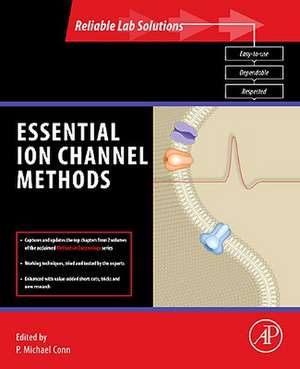
Essential Ion Channel Methods: Reliable Lab Solutions
Editat de P. Michael Connen Limba Engleză Paperback – 21 iul 2010
Ne-a atras atenția, în primul rând, rigoarea grafică a acestui volum: ilustrațiile tehnice și schemele de proces nu sunt simple anexe, ci piloni ai instrucțiunilor de laborator. Essential Ion Channel Methods, editat de P. Michael Conn, funcționează ca un manual de precizie clinică, oferind protocoale replicate și optimizate pentru studiul canalelor ionice, esențiale în menținerea homeostaziei celulare. Volumul reprezintă o sinteză actualizată a materialelor din prestigioasa serie Methods in Enzymology, fiind conceput pentru a permite cercetătorilor să adapteze metodele de studiu la sisteme biologice diverse.
Structura cărții urmărește o progresie logică a fluxului de lucru în cercetare. Începând cu asamblarea canalelor ionice, textul trece prin identificarea proteinelor asociate prin sistemul yeast two-hybrid, ajungând la nucleul dur al electrofiziologiei. Remarcăm detalierea tehnicilor de patch clamp pentru canalul clorură CFTR și pentru neuronii de C. elegans, precum și analiza proprietăților de permeație. Ultima secțiune se concentrează pe sistemele de exprimare recombinantă, utilizând vectori adenovirali sau baculovirusuri, oferind soluții practice pentru manipularea genelor în sistemul nervos.
Această lucrare este un manual de referință comparabil cu Ion Channels de Nikita Gamper, dar se distinge prin ancorarea în sursele clasice Methods in Enzymology, oferind acel „know-how” specific laboratoarelor de elită (tips and tricks). În contextul operei sale, P. Michael Conn continuă aici direcția metodologică stabilită în Techniques in Confocal Microscopy, mutând focusul de la vizualizarea microscopică spre funcționalitatea moleculară și electrofiziologică, menținând același standard de claritate care definește și Conn's Translational Neuroscience.
Preț: 637.83 lei
Preț vechi: 671.39 lei
-5%
Carte tipărită la comandă
Livrare economică 23 mai-06 iunie
Specificații
ISBN-10: 0123822041
Pagini: 632
Dimensiuni: 191 x 235 x 23 mm
Greutate: 1.04 kg
Editura: ELSEVIER SCIENCE
Seria Reliable Lab Solutions
V-ar putea interesa
-
 Essentials of Modern NeuroscienceFranklin Amthor-32%Preț: 599.67 lei888.26 lei
 -
 The Spark of Life: Electricity in the Human BodyFrances Ashcroft-5%Preț: 71.96 lei75.75 lei
 -
 Cellular Physiology and Neurophysiology: Mosby Physiology SeriesMordecai P. Blaustein-31%Preț: 222.13 lei322.62 lei
 -
 -28%Preț: 1405.68 lei1958.27 lei
 -
 Neuromuscular and Electrodiagnostic Medicine Board ReviewThananan Thammongkolchai-27%Preț: 508.26 lei700.84 lei
 -
 Neurologic ChannelopathiesMichael G. Hanna-24%Preț: 1348.06 lei1771.27 lei
 -
 Oh's Intensive Care ManualJonathan M. Handy-23%Preț: 742.08 lei963.74 leiRecomandat
 -
 Kern's Cardiac Catheterization HandbookPaul Sorajja-29%Preț: 370.61 lei519.46 leiRecomandat
 -
 Anesthesia SecretsBrian M. Keech-5%Preț: 292.34 lei307.73 leiRecomandat
 -
 Cellular and Molecular ImmunologyAbul K. Abbas-30%Preț: 475.59 lei677.09 leiRecomandat
 -
 Clinical ChemistryWilliam J. Marshall-30%Preț: 338.05 lei486.17 leiRecomandat
 -
 Structural Biology of Membrane ProteinsReinhard Grisshammer-14%Preț: 1087.87 lei1264.96 lei
 -
 Methods in Cardiovascular and Lymphatic BiologyEvangelia Papadimitriou-5%Preț: 1348.25 lei1419.21 lei
 -
 -9%Preț: 584.98 lei642.83 lei
 -
 Integrins and Ion Channels: Molecular Complexes and SignalingAndrea Becchetti-5%Preț: 1044.07 lei1099.01 lei
 -
 Herpes Simplex VirusRussell J. Diefenbach-5%Preț: 1237.77 lei1302.92 lei
 -
 Ionotropic Glutamate Receptor TechnologiesGabriela K. Popescu-15%Preț: 633.67 lei745.49 lei
 -
 -18%Preț: 948.31 lei1156.48 lei
 -
 -9%Preț: 856.07 lei940.73 lei
 -
 -24%Preț: 1273.82 lei1676.09 lei
Public țintă
Researchers in and students of biochemistry, molecular and cell biology, developmental biology, and genetics.De ce să citești această carte
Recomandăm această resursă cercetătorilor în biochimie și biologie celulară care au nevoie de protocoale verificate pentru studiul canalelor ionice. Cititorul câștigă acces la tehnici complexe, precum patch clamp și sisteme de exprimare virală, explicate pas cu pas de pionieri ai domeniului. Este un instrument esențial pentru oricine dorește să replice experimente de electrofiziologie cu o rată ridicată de succes, beneficiind de actualizările unor metode consacrate.
Despre autor
P. Michael Conn este profesor și director al Laboratorului de Neuroendocrinologie la Universitatea Rockefeller, fiind o figură proeminentă în cercetarea biomedicală. Expertiza sa vastă se reflectă într-o bibliografie impresionantă, care include lucrări de referință precum Conn's Translational Neuroscience și Animal Models for the Study of Human Disease. Activitatea sa ca editor pentru seria Reliable Lab Solutions de la ELSEVIER SCIENCE demonstrează angajamentul său pentru standardizarea și diseminarea metodologiilor de laborator de înaltă precizie, facilitând progresul în neuroștiințe și genetică.
Descriere scurtă
As part of theReliable Lab Solutionsseries,Essential Ion Channel Methodsbrings together chapters from volumes 293 and 294 ofMethods in Enzymology. The chapters have been selected by the editor and updated, when possible, by their original authors to include new research and references. The result is a set of chapters which make use of graphics, comparisons to other methods, and provide tricks and approaches that make it possible to adapt methods to other systems. Methods are presented in a fashion that allows their replication by individuals new to the field, yet providing valuable information for seasoned investigators.
- Highlights top downloaded and cited chapters, authored by pioneers in the field and enhanced with graphics and easy to follow methods
- Loaded with detailed protocols developed and used by leaders in the field
- Refines, organizes and updates popular methods from one of our top selling series,Methods in Enzymology
Cuprins
PART II - Genetics 2. Identification of Ion Channel-Associated Proteins Using the Yeast Two-Hybrid System Martin Niethammer and Morgan Sheng
PART III - Electrophysiology 3. Patch Clamp Studies of the Cystic Fibrosis Transmembrane Conductance Regulator Chloride Channel John W. Hanrahan, Zie Kone , Ceri J. Mathews,Jiexin Luo, Yanlin Jia and Paul Lindsell
4. Tight-Seal Whole-cell Patch Clamping of C. elegans Neurons S.R. Lockery and M.B. Goodman
5. Gating Currents Enrico Stefani and Francisco Bezanilla
6. Determining Ion Channel Permeation Properties Ted Begenisich
PART IV - Expression Systems 7. Expression of Ligand-Gated Ion Channels Using Using Semliki Forest Virus and Baculovirus Kathryn Radford and Gary Buell
8. Recombinant Adenovirus-Mediated Expression in Nervous System of Genes Coding for Ion Channels and Other Molecules Involved in Synaptic Function Markus U. Ehrengruber, Markus Lanzrein, Youfeng Xu, Mark C. Jasek, David B. Kantor, Erin M. Schuman, Henry A. Lester, and Norman Davidson
9. Transient Expression of Heteromeric Ion Channels Alison L. Eertmoed, Yolanda F. Vallejo, and William N. Green
PART V - Model Simulations 10. Computer Simulations and Modeling of Ion Channels Michael E. Green
PART VI. Physical 11. Fluorescence Techniques for Measuring Ion Channel Activity Gönül Velicelebi, Kenneth A. Stauderman, Mark A. Varney, Michael Akong, Stephen D. Hess, and Edwin C. Johnson
12. Ligand Binding Methods for Analysis of Ion Channel Structure and Function Steen E. Pedersen, Monica M. Lurtz, and Rao V. L. Papineni
13. Three-dimensional structure of membrane proteins determined by two-dimensional crystallization, electron cryomicroscopy, and image analysis Mark Yeager, Vinzenz M. Unger, Alok K. Mitra
14. Voltage Clamp Biosensors for Capillary Electrophoresis Owe Orwar, Kent Jardemark, Cecilia Farre, Ingemar Jacobson, Alexander Moscho, Jason B. Shear, Harvey A. Fishman, Sheri J. Lillard, Richard N. Zare
15. Ion Channels As Tools to Monitor Lipid Bilayer-Membrane Protein Interactions: Gramicidin Channels As Molecular Force O. S. Andersen, C. Nielsen, A. M. Maer, J. A. Lundbæk, M. Goulian, and R. E. Koeppe I
PART VII. Purification and Reconstitution 16. Purification and Reconstitution of the Epithelial Chloride Channel Cystic Fibrosis Transmembrane Conductance Regulator Mohabir Ramjeesingh, Elizabeth Garani, Kevin Galley, Canhui Li, Yanchun Wang, Christine E. Bear
17. Reconstitution of Native and Cloned Channels into Planar Bilayers I. Favre, Y.-M. Sun, and E. Moczydlowski
PART VIII. Second Messengers and Biochemical Approaches 18. Protein Phosphorylation of Ligand-Gated Ion Channels Andrew l. Mammen, Sunjeev Kamboj, and Richard L. Huganir
19. Analysis of Ion Channel Associated Proteins Michael Wyszynski and Morgan Sheng
20. Secondary Messenger Regulation of Ion Channels/Plant Patch Clamping Sarah M. Assmann and Lisa Romano
PART IX. Special Channels 21. ATP-Sensitive Potassium Channels Joseph Bryan, M. Schwanstecher, C. Schwanstecher, F. Chudziak, U. Panten, J.P. Clement IV, G. Gonzalez, and L. Aguilar-Bryan
22. Simplified Fast Pressure-Clamp Technique for Studying Mechanically-Gated Channels Don W. McBride, Jr. and Owen P. Hamill
23. Purification and Heterologous Expression of Inhibitory Glycine Receptors Bodo Laube and Heinrich Betz
24. Functional Analyses of Aquaporin Water Channel Proteins Peter Agre, John C. Mathai, Barbara L. Smith, and Gregory M. Preston
PART X. Toxins and Other Membrane Active Compounds 25. Conus Peptides as Probes for Ion Channels J. Michael McIntosh, Baldomero M. Olivera, and Lourdes J. Cruz
26. Scorpion Toxins as Tools for Studying Potassium Channels Maria Garcia, Markus Hanner, Hans-Günther Knaus, Robert Slaughter, Gregory J. Kaczorowski
27. The Use of Planar Lipid Bilayer Membranes for Rapid Screening of Membrane Active Compounds Bruce L. Kagan, Tajb A. Mirzabekov, Antoly Y. Silberstein
28. Antibodies to Ion Channels Angela Vincent, Ian Hart, Ashwin Pinto, and F. Anne Stephenson