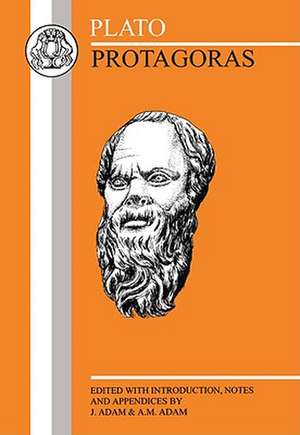
Protagoras: Greek Texts
Autor Plato Adela Marion Adam, James Adamen Limba Engleză Paperback – 31 aug 2001
Din seria Greek Texts
- 21%
 Preț: 264.52 lei
 - 26%
 Preț: 176.99 lei
 - 17%
 Preț: 163.77 lei
 - 16%
 Preț: 158.12 lei
 - 17%
 Preț: 185.65 lei
 - 18%
 Preț: 160.58 lei
 - 16%
 Preț: 215.96 lei
 - 16%
 Preț: 214.71 lei
 - 23%
 Preț: 153.59 lei
 - 16%
 Preț: 182.24 lei
 - 24%
 Preț: 262.39 lei
 - 16%
 Preț: 164.61 lei
 - 17%
 Preț: 154.36 lei
 - 9%
 Preț: 155.20 lei
 - 17%
 Preț: 212.21 lei
 -
 Preț: 162.30 lei
 - 17%
 Preț: 163.34 lei
 - 17%
 Preț: 212.40 lei
 - 17%
 Preț: 156.07 lei
 - 22%
 Preț: 154.56 lei
 - 17%
 Preț: 163.77 lei
 - 11%
 Preț: 213.56 lei
 - 16%
 Preț: 215.66 lei
 - 23%
 Preț: 152.82 lei
 - 16%
 Preț: 215.77 lei
 - 10%
 Preț: 216.16 lei
 - 10%
 Preț: 176.16 lei
 -
 Preț: 155.89 lei
Preț: 177.70 lei
Preț vechi: 213.54 lei
-17%
Puncte Express: 267
Carte tipărită la comandă
Livrare economică 26 noiembrie-10 decembrie
Livrare prin curier în România Termenul estimat este afișat lângă disponibilitate.
Transport gratuit de la 400.00 lei Plată online sau ramburs, în funcție de opțiunile comenzii.
Retur gratuit în 14 zile Comandă securizată și suport în română.
Specificații
ISBN-13: 9780862920258
ISBN-10: 0862920256
Pagini: 266
Dimensiuni: 124 x 202 x 18 mm
Greutate: 0.27 kg
Editura: Bloomsbury Publishing
Colecția Bristol Classical Press
Seria Greek Texts
Locul publicării:London, United Kingdom
ISBN-10: 0862920256
Pagini: 266
Dimensiuni: 124 x 202 x 18 mm
Greutate: 0.27 kg
Editura: Bloomsbury Publishing
Colecția Bristol Classical Press
Seria Greek Texts
Locul publicării:London, United Kingdom
V-ar putea interesa
-
 Behavior in Public PlacesErving Goffman-41%Preț: 75.07 lei127.96 lei
 -
 The Secret Diaries of Miss Miranda CheeverJulia QuinnPreț: 53.65 lei
 -
 Just Like HeavenJulia QuinnPreț: 62.93 lei
 -
 The Sum of All KissesJulia QuinnPreț: 57.88 lei
 -
 Because of Miss BridgertonJulia QuinnPreț: 57.69 lei
 -
 The Other Miss BridgertonJulia QuinnPreț: 58.57 lei
 -
 The Wit and Wisdom of BridgertonJulia QuinnPreț: 103.90 lei
 -
 Of Human FreedomEpictetus-21%Preț: 44.70 lei56.30 lei
 -
 If I Stay CollectionGayle FormanPreț: 158.84 lei
 -
 How to Be a StoicRobert Dobbin-20%Preț: 44.80 lei56.35 lei
 -
 A Night Like ThisJulia Quinn-25%Preț: 54.48 lei72.76 lei
 -
 The Secrets of Sir Richard KenworthyJulia Quinn-25%Preț: 59.50 lei79.76 lei
 -
 What Happens In LondonJulia Quinn-25%Preț: 49.08 lei65.50 lei
 -
 -26%Preț: 53.28 lei71.81 lei
 -
 -25%Preț: 49.42 lei65.72 lei
 -
 -25%Preț: 59.71 lei79.90 lei
 -
 -25%Preț: 54.41 lei72.72 lei
 -
 Preț: 79.65 lei
 -
 -26%Preț: 59.27 lei79.65 lei
 -
 The Lady Most Likely: A Novel in Three PartsJulia Quinn-26%Preț: 59.31 lei79.66 lei
 -
 The Lady Most Willing: A Novel in Three PartsJulia Quinn-26%Preț: 57.89 lei78.55 lei
 -
 Preț: 255.86 lei
 -
 EnchiridionEpictetus-20%Preț: 22.92 lei28.48 lei
 -
 Emotional Intelligence: Why It Can Matter More Than IQDaniel Goleman-25%Preț: 43.33 lei58.05 lei
 -
 -25%Preț: 60.57 lei80.42 lei
 -
 Ten Things I Love About YouJulia Quinn-25%Preț: 60.27 lei80.23 lei
 -
 Elon MuskAshlee VancePreț: 71.47 lei
 -
 HeroesStephen Fry-17%Preț: 67.68 lei81.10 lei
 -
 Preț: 49.00 lei
Notă biografică
Plato was an ancient Greek philosopher born in Athens during the Classical period in Ancient Greece. In Athens, Plato founded the Academy, a philosophical school where he taught the philosophical doctrines that would later become known as Platonism. Plato (or Platon) was a pen name derived, apparently, from the nickname given to him by his wrestling coach - allegedly a reference to his physical broadness. According to Alexander of Miletus quoted by Diogenes of Sinope his actual name was Aristocles, son of Ariston, of the deme Collytus (Collytus being a district of Athens).Plato was an innovator of the written dialogue and dialectic forms in philosophy. He raised problems for what later became all the major areas of both theoretical philosophy and practical philosophy. His most famous contribution is the Theory of forms, which has been interpreted as advancing a solution to what is now known as the problem of universals. He is also the namesake of Platonic love and the Platonic solids.His own most decisive philosophical influences are usually thought to have been, along with Socrates, the pre-Socratics Pythagoras, Heraclitus, and Parmenides, although few of his predecessors' works remain extant and much of what we know about these figures today derives from Plato himself.[a]Along with his teacher, Socrates, and his student, Aristotle, Plato is a central figure in the history of philosophy.[b] Unlike the work of nearly all of his contemporaries, Plato's entire body of work is believed to have survived intact for over 2,400 years.[6] Although their popularity has fluctuated, Plato's works have consistently been read and studied. Through Neoplatonism Plato also greatly influenced both Christian and Islamic philosophy (through e.g. Al-Farabi). In modern times, Alfred North Whitehead famously said: "the safest general characterization of the European philosophical tradition is that it consists of a series of footnotes to Plato.
Recenzii
`lucid, penetrating and philosophically interesting'M.C. Stokes, University of Durham
`excellent'W. Charlton, University of Edinburgh
`excellent'W. Charlton, University of Edinburgh