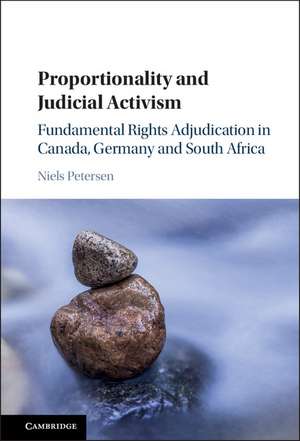
Proportionality and Judicial Activism
Autor Niels Petersenen Limba Engleză Hardback – 10 feb 2017
Preț: 754.99 lei
Preț vechi: 877.89 lei
-14%
Puncte Express: 1132
Carte tipărită la comandă
Livrare economică 07-21 decembrie
Livrare prin curier în România Termenul estimat este afișat lângă disponibilitate.
Transport gratuit pentru acest produs Plată online sau ramburs, în funcție de opțiunile comenzii.
Retur gratuit în 14 zile Comandă securizată și suport în română.
Specificații
ISBN-13: 9781107177987
ISBN-10: 1107177987
Pagini: 260
Ilustrații: 1 b/w illus.
Dimensiuni: 157 x 235 x 19 mm
Greutate: 0.53 kg
Editura: Cambridge University Press
Locul publicării:New York, United States
ISBN-10: 1107177987
Pagini: 260
Ilustrații: 1 b/w illus.
Dimensiuni: 157 x 235 x 19 mm
Greutate: 0.53 kg
Editura: Cambridge University Press
Locul publicării:New York, United States
V-ar putea interesa
-
 -29%Preț: 353.17 lei499.20 lei
 -
 Judging StatutesRobert Katzmann-19%Preț: 311.03 lei386.26 lei
 -
 The Manual on International Courts and TribunalsRuth Mackenzie-31%Preț: 1002.79 lei1452.49 lei
 -
 International ProsecutorsLuc Reydams-29%Preț: 1136.90 lei1607.16 lei
 -
 The English Legal ProcessTerence Ingman-22%Preț: 395.38 lei504.33 lei
 -
 -16%Preț: 332.77 lei396.10 lei
 -
 -12%Preț: 375.76 lei426.72 lei
 -
 Disorder in the CourtCharles M. SevillaPreț: 82.42 lei
 -
 Reflections on JudgingRichard Allen PosnerPreț: 297.75 lei
 -
 The Judge in a DemocracyAharon BarakPreț: 271.26 lei
 -
 The Steps to the Supreme CourtPeter IronsPreț: 141.20 lei
 -
 The NineJeffrey ToobinPreț: 130.56 lei
 -
 -27%Preț: 66.81 lei91.71 lei
Cuprins
Introduction; 1. Judicial review and the correction of political market failures; 2. The normative debate on balancing; 3. Balancing and judicial legitimacy; 4. Proportionality as a doctrinal construction; 5. The avoidance of balancing; 6. Rationalising balancing; Conclusion: proportionality and the review of legislative rationality.
Recenzii
'Niels Peterson's Proportionality and Judicial Activism is a very timely and accomplished book. It is an important addition to the now quite considerable literature on proportionality, and it would benefit anyone interested in this omnipresent doctrine, especially in the three jurisdictions it covers - Germany, Canada, and South Africa. The book is not too long, and extremely readable - two non-negligible advantages for any reader - and Peterson has a rare capacity of simplifying intricate analytical moves and theoretical constructs without losing accuracy, a talent he also applies to the many cases he reviews in the book. The book is also innovative and ambitious, making it a very interesting and enriching read.' Iddo Porat, International Journal of Constitutional Law
Descriere
This book uses empirical analysis to show that courts refrain from using the proportionality test as a means of judicial activism.