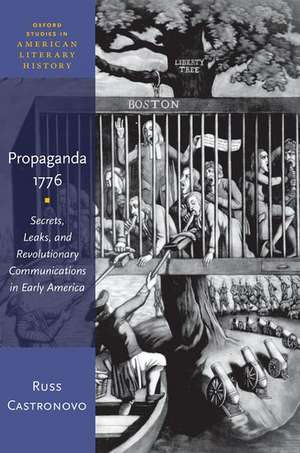
Propaganda 1776: Secrets, Leaks, and Revolutionary Communications in Early America: Oxford Studies in American Literary History
Autor Russ Castronovoen Limba Engleză Paperback – 17 ian 2019
Prin volumul Propaganda 1776, Russ Castronovo aduce o perspectivă proaspătă și necesară asupra mitologiei fondatoare americane, propunând o recalibrare a modului în care înțelegem comunicarea politică în zorii democrației. Notăm cu interes teza centrală a autorului: succesul Revoluției nu s-a datorat exclusiv adevărurilor „de la sine înțelese” din Declarația de Independență, ci mai degrabă unei infrastructuri complexe de propagandă, zvonuri și scurgeri de informații care au catalizat opinia publică. Remarcăm modul în care Castronovo extinde cadrul propus de Propaganda Wars of the American Revolution de George Goodwin, adăugând o dimensiune critică asupra „cineticii” textelor; el nu se limitează la conținutul mesajelor, ci analizează viteza și rețelele de distribuție ca elemente revoluționare în sine. În contextul operei sale anterioare, precum The Oxford Handbook of Nineteenth-Century American Literature, această lucrare continuă efortul de a chestiona coordonatele viziunii critice asupra istoriei literare, mutând accentul de pe autoritatea textului oficial pe dinamismul mediilor efemere precum foile volante sau scrisorile interceptate. Suntem de părere că rigoarea cu care sunt examinate activitățile unor figuri precum Ben Franklin sau Tom Paine oferă o imagine mult mai nuanțată a „consimțământului popular”, prezentându-l nu ca pe un produs al rațiunii pure, ci ca pe rezultatul unei manipulări strategice a informației. Structura narativă este una densă, academică, dar extrem de relevantă pentru curriculumul de istorie și studii literare, reușind să demonstreze că legătura dintre propagandă și democrație este mult mai veche și mai intrinsecă decât am fi tentați să credem.
Din seria Oxford Studies in American Literary History
- 27%
 Preț: 578.38 lei
 - 32%
 Preț: 643.43 lei
 - 32%
 Preț: 544.91 lei
 - 19%
 Preț: 633.70 lei
 - 33%
 Preț: 545.74 lei
 - 30%
 Preț: 499.48 lei
 - 21%
 Preț: 196.13 lei
 - 33%
 Preț: 544.36 lei
 - 33%
 Preț: 573.03 lei
 - 33%
 Preț: 571.11 lei
 - 30%
 Preț: 518.11 lei
 - 30%
 Preț: 493.82 lei
 - 32%
 Preț: 536.52 lei
 - 30%
 Preț: 499.79 lei
 - 32%
 Preț: 561.06 lei
 - 21%
 Preț: 194.92 lei
 - 17%
 Preț: 298.08 lei
 - 30%
 Preț: 432.76 lei
 - 29%
 Preț: 709.36 lei
 - 32%
 Preț: 574.39 lei
 - 32%
 Preț: 598.01 lei
 - 33%
 Preț: 563.75 lei
 - 19%
 Preț: 621.43 lei
 - 19%
 Preț: 621.16 lei
 - 24%
 Preț: 248.62 lei
 - 31%
 Preț: 608.87 lei
 - 18%
 Preț: 215.10 lei
 - 31%
 Preț: 667.09 lei
 - 19%
 Preț: 283.22 lei
 - 14%
 Preț: 556.15 lei
 - 28%
 Preț: 538.16 lei
 - 14%
 Preț: 597.24 lei
 -
 Preț: 322.08 lei
 - 28%
 Preț: 352.28 lei
 - 31%
 Preț: 622.71 lei
 - 31%
 Preț: 534.64 lei
 - 31%
 Preț: 546.95 lei
 - 32%
 Preț: 648.48 lei
 - 31%
 Preț: 594.28 lei
 - 20%
 Preț: 302.85 lei
 - 32%
 Preț: 528.27 lei
 - 21%
 Preț: 295.02 lei
 - 31%
 Preț: 530.89 lei
 - 9%
 Preț: 545.91 lei
 - 31%
 Preț: 564.93 lei
 - 34%
 Preț: 590.61 lei
Preț: 201.80 lei
Preț vechi: 274.56 lei
-27%
Carte tipărită la comandă
Livrare economică 19-25 noiembrie
Specificații
ISBN-10: 019067749X
Pagini: 258
Ilustrații: 12 illus.
Dimensiuni: 155 x 234 x 15 mm
Greutate: 0.43 kg
Editura: Oxford University Press
Colecția OUP USA
Seria Oxford Studies in American Literary History
Locul publicării:New York, United States
V-ar putea interesa
-
 Integrated Mental Health Services: Modern Community PsychiatryWilliam R. Breakey-28%Preț: 459.55 lei635.77 lei
 -
 -15%Preț: 146.63 lei173.32 lei
 -
 A Historical Guide to the U.S. GovernmentGeorge Thomas Kurian-31%Preț: 701.44 lei1020.31 lei
 -
 Monteverde: Ecology and Conservation of a Tropical Cloud ForestNalini M. Nadkarni-27%Preț: 552.37 lei760.77 lei
 -
 -13%Preț: 278.17 lei320.37 lei
 -
 Eros and Greek AthleticsThomas F. Scanlon-21%Preț: 430.32 lei543.90 lei
 -
 The Oxford Handbook of Nineteenth-Century American LiteratureRuss Castronovo-29%Preț: 365.99 lei514.76 lei
 -
 The Oxford Handbook of Propaganda StudiesJonathan Auerbach-36%Preț: 1049.88 lei1632.50 lei
 -
 Fantasy Film Post 9/11F. Pheasant-KellyPreț: 399.68 lei
 -
 Mysticism, Myth and Celtic IdentityMarion GibsonPreț: 468.59 lei
 -
 -8%Preț: 428.17 lei465.40 lei
 -
 South Asians and the shaping of Britain, 1870-1950Ruvani RanasinhaPreț: 218.30 lei
 -
 Public relations and the making of modern BritainScott Anthony-40%Preț: 139.09 lei230.69 lei
 -
 Preț: 323.12 lei
 -
 World HeritageAmareswar Galla-19%Preț: 324.58 lei402.57 lei
 -
 Preț: 321.83 lei
 -
 Old New MediaPaul GrosswilerPreț: 390.40 lei
 -
 -8%Preț: 600.60 lei652.82 lei
 -
 The Progressive Virus: Why You Can't Permit It to Go ForwardAnthony NapoleonPreț: 132.18 lei
 -
 -19%Preț: 610.42 lei753.60 lei
De ce să citești această carte
Recomandăm această carte cititorilor interesați de istoria politică și de mecanismele comunicării de masă. Russ Castronovo demonstrează cum „fake news-ul” și scurgerile de informații nu sunt invenții moderne, ci unelte fundamentale care au făcut posibilă nașterea Statelor Unite. Este o lectură esențială pentru a înțelege cum circulația informației, indiferent de acuratețea ei, poate răsturna regimuri și construi noi identități naționale.
Despre autor
Russ Castronovo este un distins specialist în studii literare americane, recunoscut pentru capacitatea sa de a intersecta analiza textului cu istoria politică și socială. Activitatea sa academică este marcată de coordonarea unor volume de referință precum The Oxford Handbook of Nineteenth-Century American Literature și The New Nineteenth-Century American Literary Studies, unde a explorat noi metodologii de investigare a culturii americane. Prin Propaganda 1776, Castronovo își consolidează autoritatea în cadrul Oxford Studies in American Literary History, oferind o cercetare minuțioasă asupra modului în care materialele tipărite au modelat conștiința politică în perioada modernă timpurie.
Descriere
Recenzii
Burke was also a shrewd political operative, who reframed issues and changed positions depending on the exigencies of the moment. It is this tactical aspect of political life-the qualities that make sports analogy often seem so apt-that comes through most clearly in Castronovo's treatment of propaganda. This focus distinguishes his approach from that of Chomsky, who critiques the mainstream news media as state-sanctioned disseminators of misinformation and propaganda froma stance of philosophical certainty. In the political writings of the Revolutionary era, Castronovo sees something more fluid and multifaceted at work, with imaginative and even playful elements being central. At its best, this book celebrates the arts of politics.
Neo-whig historians attacked progressive historians who debunked patriot 'propaganda' by telling us that American revolutionaries were true believers, if ideological, and radical in ways we can embrace without much reservation. Too often this has devolved into another version of American exceptionalism. Russ Castronovo has another take on their political talents: he finds a creative resistance to power in the modes of dissemination as much as their message. The radicalism of the Revolution is back up for grabs in this fascinating corrective.
In this fresh, provocative look at the revolutionary era, Russ Castronovo challenges our knee-jerk assumptions about propaganda and enhances our understanding of early American politics.... Castronovo encourages a deeper appreciation for revolutionary propaganda as a way to make sense of American democracy and its fractures.... Castronovo's bold reconceptualization offers plenty of tools for rethinking this crucial-and misunderstood-phenomenon.
Castronovo deftly-even audaciously-shuttles his way back and forth across the last three centuries to uncover the democratic work of propaganda operative at the nation's founding and continuing to this day. Understanding propaganda as a lateral and volatile form of 'communications in motion,' Castronovo especially challenges our ideas about Revolutionary-era texts, redefining what they meant by recovering how they moved. Propaganda 1776 will be of great interest to scholars of U.S. literary, communications, media and political history.
Propaganda 1776 is an elegantly written, compellingly conceptualized book. A provocative read from page to page, it makes an original argument about the American Revolution by reviving and revivifying the concept of propaganda.
In Propaganda 1776, Russ Castronovo sets forth a bold new paradigm of early American letters