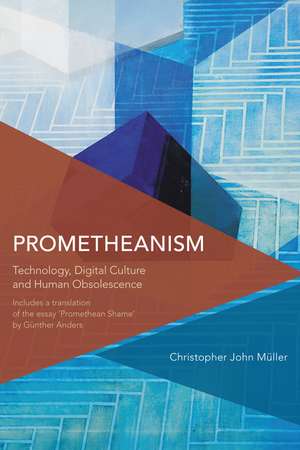
Prometheanism: Technology, Digital Culture and Human Obsolescence: Critical Perspectives on Theory, Culture and Politics
Autor Christopher John Mülleren Limba Engleză Hardback – 9 aug 2016
The book offers a comprehensive introduction to Anders's philosophy of technology with an annotated translation of his visionary essay 'On Promethean Shame', part of The Obsolescence of Human Beings 1 published in 1956.The essay analyses feelings of curtailment, obsolescence and solitude that become manifest whilst we interact with machines. When technological solutions begin to make humans look embarrassingly limited and flawed, new emotional vulnerabilities are exposed. These need to be thought, because our wavering confidence leaves us unprotected in an ever more (un)transparent, connected yet fractured world.
| Toate formatele și edițiile | Preț | Express |
|---|---|---|
| Paperback (1) | 239.67 lei 3-5 săpt. | +17.92 lei 6-12 zile |
| Bloomsbury Publishing – 29 iul 2016 | 239.67 lei 3-5 săpt. | +17.92 lei 6-12 zile |
| Hardback (1) | 644.61 lei 6-8 săpt. | |
| Bloomsbury Publishing – 9 aug 2016 | 644.61 lei 6-8 săpt. |
Din seria Critical Perspectives on Theory, Culture and Politics
-
 Preț: 239.67 lei
 - 22%
 Preț: 315.00 lei
 - 23%
 Preț: 312.25 lei
 - 26%
 Preț: 244.04 lei
 - 23%
 Preț: 326.05 lei
 - 13%
 Preț: 350.95 lei
 - 22%
 Preț: 327.23 lei
 - 18%
 Preț: 300.91 lei
 - 22%
 Preț: 313.13 lei
 - 22%
 Preț: 312.75 lei
 - 22%
 Preț: 299.44 lei
 - 22%
 Preț: 315.10 lei
 - 13%
 Preț: 299.63 lei
 - 31%
 Preț: 790.46 lei
 - 31%
 Preț: 789.61 lei
 - 20%
 Preț: 215.84 lei
 - 17%
 Preț: 246.21 lei
 - 25%
 Preț: 208.45 lei
 - 15%
 Preț: 305.11 lei
 - 34%
 Preț: 526.62 lei
Preț: 644.61 lei
Preț vechi: 974.10 lei
-34%
Puncte Express: 967
Preț estimativ în valută:
114.08€ • 133.33$ • 99.04£
114.08€ • 133.33$ • 99.04£
Carte tipărită la comandă
Livrare economică 19 februarie-05 martie
Preluare comenzi: 021 569.72.76
Specificații
ISBN-13: 9781783482382
ISBN-10: 1783482389
Pagini: 160
Dimensiuni: 160 x 235 x 19 mm
Greutate: 0.44 kg
Editura: Bloomsbury Publishing
Colecția Rowman & Littlefield Publishers
Seria Critical Perspectives on Theory, Culture and Politics
Locul publicării:New York, United States
ISBN-10: 1783482389
Pagini: 160
Dimensiuni: 160 x 235 x 19 mm
Greutate: 0.44 kg
Editura: Bloomsbury Publishing
Colecția Rowman & Littlefield Publishers
Seria Critical Perspectives on Theory, Culture and Politics
Locul publicării:New York, United States
V-ar putea interesa
-
 Libertarian Free Will: Contemporary DebatesDavid Palmer-14%Preț: 675.05 lei784.94 lei
 -
 On InequalityHarry G. FrankfurtPreț: 89.72 lei
 -
 A Companion to WittgensteinHans-Johann Glock-9%Preț: 1191.88 lei1309.77 lei
 -
 On Resistance: A Philosophy of DefianceHoward Caygill-41%Preț: 93.10 lei158.81 lei
 -
 In Praise of MathematicsAlain BadiouPreț: 139.94 lei
 -
 BlackAlain BadiouPreț: 100.59 lei
 -
 Foams – Spheres Volume III: Plural SpherologyPeter Sloterdijk-16%Preț: 222.70 lei266.41 lei
 -
 Agamben and Indifference: A Critical OverviewWilliam Watkin-22%Preț: 323.55 lei414.73 lei
 -
 Strangers Drowning: Voyages to the Brink of Moral ExtremityLarissa MacFarquhar-20%Preț: 60.62 lei75.78 lei
 -
 Beckett/Philosophy: A CollectionDavid Tucker-15%Preț: 227.13 lei267.07 lei
Cuprins
Acknowledgments/ Introduction: Thinking Finitude, Digital Technology and Human Obsolescence with Günther Anders / Part I: On Promethean Shame/ Preface to the Translation of 'On Promethean Shame'/"On Promethean Shame" (by Günther Anders)/ PART II: Utopia Inverted - Günther Anders in the Digital Age/1. Better than Human: Promethean Shame and the (Trans)humanist Project/2. The Punishment of Prometheus/Part III: Anaesthetic Lives: Joyful Surrender to Painful Obsolescence/3. The Unsalaried Masses: Working toward a 'World without Us'/ 4. Invisible Monsters: Your Smartphone is an Atom Bomb/ Bibliography/Index
Recenzii
Although Günther Anders (1902-1992) is considered one of the most important philosophers of technology and although he spent many years exiled in the US, he received scant attention within the English-speaking world itself. Christopher John Müller's comprehensive and sophisticated presentation and his nuanced translation of Anders' crucial writing "On Promethean Shame" should hopefully change this. It demonstrates vividly the significance of Anders as a shrewd and original thinker who was able to anticipate a number of recent societal and technological developments. Müller's book is crucial reading for anyone wishing to gain a better understanding of the workings of our technology-driven world.
Who was Günther Anders? In this brilliant book, Christopher Müller not only reconstructs Anders's crucial place in the history of modern philosophy of technology but shows that Anders still has much to say to us about our own postmodern technological condition. This book is essential reading for anyone interested in critical theory, philosophy of technology and the history of 20th century thought more widely.
Building upon (and exceeding) Heidegger on technology, Günther Anders diagnosed the "obsolescence of humanity." In the posthuman, transhuman era, the Anthropocene dominates obscenity. Departing from Jean-Luc Nancy's analysis of our technology 'fetish,' Christopher Müller's Prometheanism examines our bodily relation to technology, noting our naked vulnerability, including a cultural critique of the technologies of our lives, our finitude and "Promethean Shame."
Modernity aims at placing mankind in the position of being the divine maker of the world while at the same time condemning human beings to see themselves as out of date. German philosopher Günther Anders remains one of the best thinkers of this tragic paradox. It is a shame that his work is almost unknown in the English-speaking world. Christopher Müller's admirable book will no doubt fill this blatant gap.
Around Anders's 'On Promethean Shame', Müller [describes] the way in which contemporary technology both enhances our perception and obscures our vision, increases our capacity to control while at the same time giving rise to what Gilles Deleuze called a society of control, itself now running out of control. As an attempt at thinking these limits, and at taking thinking to the limit, Müller's step back to Anders's finite thinking promises to provide resources for a new thinking in and of the Anthropocene.
This is a very important book, and hopefully it will lead to a higher profile for [Günther] Anders's provocative and essential thought. We owe Christopher Müller a debt of intellectual gratitude.
Who was Günther Anders? In this brilliant book, Christopher Müller not only reconstructs Anders's crucial place in the history of modern philosophy of technology but shows that Anders still has much to say to us about our own postmodern technological condition. This book is essential reading for anyone interested in critical theory, philosophy of technology and the history of 20th century thought more widely.
Building upon (and exceeding) Heidegger on technology, Günther Anders diagnosed the "obsolescence of humanity." In the posthuman, transhuman era, the Anthropocene dominates obscenity. Departing from Jean-Luc Nancy's analysis of our technology 'fetish,' Christopher Müller's Prometheanism examines our bodily relation to technology, noting our naked vulnerability, including a cultural critique of the technologies of our lives, our finitude and "Promethean Shame."
Modernity aims at placing mankind in the position of being the divine maker of the world while at the same time condemning human beings to see themselves as out of date. German philosopher Günther Anders remains one of the best thinkers of this tragic paradox. It is a shame that his work is almost unknown in the English-speaking world. Christopher Müller's admirable book will no doubt fill this blatant gap.
Around Anders's 'On Promethean Shame', Müller [describes] the way in which contemporary technology both enhances our perception and obscures our vision, increases our capacity to control while at the same time giving rise to what Gilles Deleuze called a society of control, itself now running out of control. As an attempt at thinking these limits, and at taking thinking to the limit, Müller's step back to Anders's finite thinking promises to provide resources for a new thinking in and of the Anthropocene.
This is a very important book, and hopefully it will lead to a higher profile for [Günther] Anders's provocative and essential thought. We owe Christopher Müller a debt of intellectual gratitude.