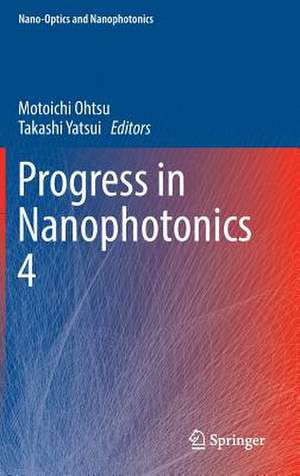
Progress in Nanophotonics 4
Editat de Motoichi Ohtsu, Takashi Yatsuien Limba Engleză Hardback – 23 feb 2017
Preț: 400.16 lei
Puncte Express: 600
Carte tipărită la comandă
Livrare economică 30 noiembrie-14 decembrie
Livrare prin curier în România Termenul estimat este afișat lângă disponibilitate.
Transport gratuit pentru acest produs Plată online sau ramburs, în funcție de opțiunile comenzii.
Retur gratuit în 14 zile Comandă securizată și suport în română.
Specificații
ISBN-13: 9783319490120
ISBN-10: 3319490125
Pagini: 160
Ilustrații: XIII, 146 p. 91 illus., 26 illus. in color.
Dimensiuni: 160 x 241 x 15 mm
Greutate: 0.36 kg
Ediția:1st edition 2017
Editura: Springer
Locul publicării:Cham, Switzerland
ISBN-10: 3319490125
Pagini: 160
Ilustrații: XIII, 146 p. 91 illus., 26 illus. in color.
Dimensiuni: 160 x 241 x 15 mm
Greutate: 0.36 kg
Ediția:1st edition 2017
Editura: Springer
Locul publicării:Cham, Switzerland
V-ar putea interesa
-
 Concepts in Organic ElectronicsStephen R. Forrest-9%Preț: 352.46 lei386.06 lei
 -
 Semiconductor Physics: Principles, Theory and NanoscaleSandip Tiwari-22%Preț: 663.36 lei850.62 lei
 -
 Semiconductor NanophotonicsPrasanta Kumar Basu-23%Preț: 592.77 lei766.26 lei
 -
 -20%Preț: 400.58 lei502.69 lei
 -
 Introduction to NanophotonicsHenri Benisty-8%Preț: 374.16 lei406.76 lei
 -
 Optical Properties of SolidsMark Fox-10%Preț: 342.00 lei379.52 lei
 -
 -11%Preț: 668.13 lei750.70 lei
 -
 Quantum & Nano Technologies for PhotovoltaicsLoucas Tsakalakos-9%Preț: 670.37 lei736.67 lei
 -
 Applied NanophotonicsSergey V Gaponenko-11%Preț: 641.90 lei721.23 lei
 -
 Fundamentals of Photonics, Third Edition, 2V SetBahaa E. A. Saleh-23%Preț: 1219.19 lei1583.36 lei
 -
 Nonlinear PhotonicsJia-Ming Liu-19%Preț: 720.08 lei888.99 lei
 -
 -23%Preț: 1262.27 lei1639.31 lei
 -
 Advances in Microelectronics & PhotonicsSatyabrata Jit-26%Preț: 1557.95 lei2116.25 lei
 -
 Progress in Nanophotonics 7Takashi Yatsui-18%Preț: 779.45 lei950.55 lei
 -
 Strong Light-Matter Interactions in Extreme Plasmonic and Mie-Resonant SystemsP. Elli Stamatopoulou-18%Preț: 1149.24 lei1401.51 lei
 -
 Advances in Photonics and ElectronicsAavishkar Katti-18%Preț: 1270.38 lei1549.25 lei
 -
 Preț: 411.30 lei
 -
 -14%Preț: 925.04 lei1075.63 lei
 -
 Advances in Photonics Integrated Circuits, LASER and ApplicationsVarun Raghunathan-18%Preț: 1601.51 lei1953.06 lei
Cuprins
Progress in dressed photon technology and the future.- Nonequilibrium statistical mechanical models for photon breeding processes assisted by dressed-photon-phonons.- Nearfield-assisted chemical reactions and its applications.- Nanophotonics-based self-optimization for macro-optical applications.- Ultraflexible organic electronics and photonics.
Notă biografică
Motoichi Ohtsu was professor at the Tokyo Institute of Technology, Graduate School of Interdisciplinary Science and Engineering, from 1991 to 2004. He has been Director at the Nanophotonics Research Center of the University of Tokyo since 2008. In addition, he has been a professor at the Department of Electronics Engineering, Graduate School of Engineering, of the University of Tokyo since 2004.
Prof. Takashi Yatsui got the Dr. degree in electronics engineering from Tokyo Inst. Tech. in 2000. He was employed as a researcher at Japan Science and Technology Agency (2000‐2008), and as associate professor at Univ. Tokyo since 2008. For his excellent research he got awards from the JSAP (2000), Tejima Doctoral Dissertation Award (2001), the Gottfried Wagener Prize (2011), Osaka University Kondo Prize (2012), Erlangen Innovation Award Optical Technologies (2012), The Ichimura Prize in Science for Distinguished Achievement (2016).
Textul de pe ultima copertă
This book presents the recent progress in the field of nanophotonics. It contains review-like chapters focusing on various but mutually related topics in nanophotonics written by the world’s leading scientists. Following the elaboration of the idea of nanophotonics, much theoretical and experimental work has been carried out, and several novel photonic devices, high-resolution fabrication, highly efficient energy conversion, and novel information processing have been developed in these years. Novel theoretical modelsdescribing the nanometric light-matter interaction, nonequilibrium statistical mechanical models for photon breeding processes and near-field‐assisted chemical reactions as well as light‐matter interaction are also explained in this book. It describes dressed photon technology and its applications, including implementation of nanophotonic devices and systems, fabrication methods and performance characteristics of ultrathin, ultraflexible organic light‐emitting diodes, organic solar cells and organic transistors.
Caracteristici
Reviews recent progress in optical nanotechnology Covers a wide range of topics from basic studies to applications Written by the leading researchers in the field