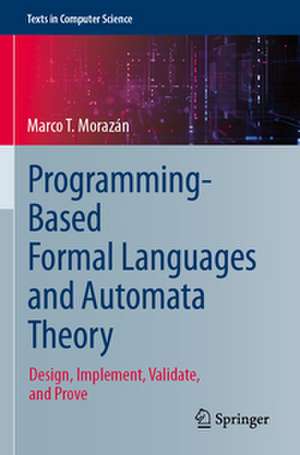
Programming-Based Formal Languages and Automata Theory: Texts in Computer Science
Autor Marco T. Morazánen Limba Engleză Paperback – 20 dec 2024
Descoperim în Programming-Based Formal Languages and Automata Theory o schimbare de paradigmă în predarea informaticii teoretice: tranziția de la demonstrația matematică abstractă la implementarea funcțională. Un proiect central care ilustrează această viziune este utilizarea expresiilor regulate nu doar ca notații formale, ci ca baze pentru scrierea unor programe care generează activ cuvinte într-un limbaj dat. Această abordare transformă conceptele de mașini finite și gramatici din obiecte statice în instrumente de programare dinamice. Remarcăm o structură riguroasă, organizată în patru părți fundamentale ce reflectă ierarhia Chomsky. Marco T. Morazán ghidează cititorul de la fundamentele programării în FSM (Finite State Machines) și seturi infinite, către studiul aprofundat al automatelor pushdown și, în final, către complexitatea mașinilor Turing. Pe linia practică a lucrării Automata Theory and Formal Languages de Pallavi Vijay Chavan, dar cu un focus distinct pe transformarea demonstrațiilor constructive în cod, volumul de față elimină bariera dintre teorie și aplicație. Considerăm că această lucrare reprezintă apogeul metodologiei autorului, observată anterior în Animated Program Design și Animated Problem Solving. Dacă în acele volume accentul cădea pe designul sistematic, aici Marco T. Morazán aplică aceleași principii de rafinare iterativă asupra automatelor și limbajelor formale. Textul nu se rezumă la a prezenta modele de calcul, ci analizează echivalența dintre gramaticile dependente de context și mașinile Turing, culminând cu o introducere esențială în teoria complexității pentru a evalua dacă o soluție teoretică este sustenabilă în practică.
Din seria Texts in Computer Science
- 20%
 Preț: 330.09 lei
 - 20%
 Preț: 501.92 lei
 - 17%
 Preț: 396.70 lei
 - 20%
 Preț: 496.15 lei
 - 20%
 Preț: 445.89 lei
 - 20%
 Preț: 417.78 lei
 - 13%
 Preț: 442.58 lei
 - 15%
 Preț: 720.22 lei
 - 20%
 Preț: 484.25 lei
 - 20%
 Preț: 342.08 lei
 - 20%
 Preț: 693.33 lei
 - 20%
 Preț: 400.45 lei
 - 20%
 Preț: 344.40 lei
 - 20%
 Preț: 592.76 lei
 -
 Preț: 491.23 lei
 - 20%
 Preț: 379.48 lei
 - 15%
 Preț: 756.39 lei
 - 20%
 Preț: 373.23 lei
 - 20%
 Preț: 382.69 lei
 - 20%
 Preț: 310.74 lei
 - 20%
 Preț: 735.08 lei
 - 20%
 Preț: 671.21 lei
 - 20%
 Preț: 640.40 lei
 - 23%
 Preț: 795.37 lei
 - 20%
 Preț: 546.95 lei
 - 25%
 Preț: 322.31 lei
 - 20%
 Preț: 571.17 lei
 - 20%
 Preț: 589.70 lei
 - 20%
 Preț: 338.01 lei
 - 20%
 Preț: 359.44 lei
 - 20%
 Preț: 492.01 lei
 - 20%
 Preț: 583.46 lei
 - 30%
 Preț: 391.47 lei
 -
 Preț: 415.60 lei
 - 20%
 Preț: 514.49 lei
 - 20%
 Preț: 346.44 lei
 - 20%
 Preț: 750.96 lei
 - 20%
 Preț: 359.75 lei
 - 20%
 Preț: 320.19 lei
Preț: 423.13 lei
Preț vechi: 528.92 lei
-20%
Carte tipărită la comandă
Livrare economică 28 noiembrie-04 decembrie
Specificații
ISBN-10: 3031439759
Pagini: 548
Dimensiuni: 155 x 235 x 30 mm
Greutate: 0.82 kg
Editura: Springer
Colecția Texts in Computer Science
Seria Texts in Computer Science
V-ar putea interesa
-
 -20%Preț: 209.98 lei262.47 lei
 -
 Automata TheoryJavier Esparza-23%Preț: 511.80 lei660.96 lei
 -
 -20%Preț: 574.25 lei717.80 lei
 -
 Programming Language PragmaticsMichael Scott-40%Preț: 488.30 lei808.04 lei
 -
 Programming ChallengesSteven S Skiena-20%Preț: 484.25 lei605.31 lei
 -
 Computer Architecture: A Quantitative ApproachJohn L. Hennessy-39%Preț: 534.37 lei882.55 lei
 -
 Sipser, M: Introduction to the Theory of ComputationMichael (Massachusetts Institute of Technology) Sipser-25%Preț: 599.79 lei801.72 lei
 -
 -40%Preț: 585.39 lei982.85 lei
 -
 CompilersAlfred V. Aho-20%Preț: 637.81 lei797.26 lei
 -
 C++ How to Program, Global EditionPaul Deitel-20%Preț: 496.44 lei620.55 lei
 -
 Coding For Dummies, All New EditionPaul McFedries-20%Preț: 116.94 lei146.18 lei
 -
 Click, Connect, Compute: Computer Science EssentialsDr Dharini Balasubramaniam-37%Preț: 52.05 lei82.18 lei
 -
 Strange Code: Esoteric Languages That Make Programming Fun AgainRonald T. Kneusel-35%Preț: 253.15 lei391.61 lei
 -
 -35%Preț: 289.47 lei444.24 lei
 -
 Math for ProgrammingRonald T. Kneusel-35%Preț: 244.36 lei373.43 lei
 -
 -36%Preț: 236.32 lei367.47 lei
 -
 -20%Preț: 322.61 lei403.26 lei
 -
 Theory of ComputationK. R. Chowdhary-20%Preț: 760.06 lei950.08 lei
De ce să citești această carte
Pentru studenții și programatorii care doresc să înțeleagă fundamentele calculului prin practică, nu doar prin teoreme. Cartea oferă o metodologie clară de a transforma conceptele abstracte de automate și gramatici în programe funcționale, oferind un avantaj competitiv în domenii precum designul compilatoarelor sau procesarea limbajului natural. Este resursa ideală pentru a trece de la „ce este calculabil” la „cum programăm acest calcul”.
Despre autor
Marco T. Morazán este un autor și profesor recunoscut pentru abordările sale pedagogice inovatoare în domeniul informaticii, publicând frecvent în seria Texts in Computer Science a editurii Springer. Expertiza sa acoperă designul de programe, rezolvarea sistematică a problemelor și limbajele funcționale, fiind implicat activ în comunitatea IFL (Implementation and Application of Functional Languages). Lucrările sale se disting prin utilizarea „rețetelor de design” și a metodelor formale pentru a ghida studenții de la enunțul unei probleme la soluții programate și testate riguros, adaptând rigoarea teoretică la nevoile ingineriei software moderne.