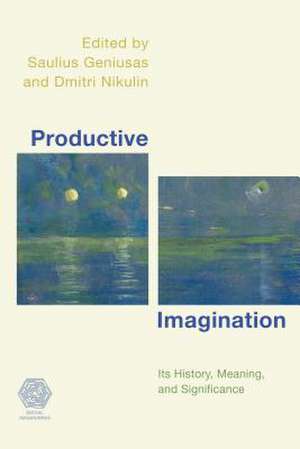
Productive Imagination: Its History, Meaning and Significance: Social Imaginaries
Editat de Saulius Geniusas, Dmitri Nikulinen Limba Engleză Hardback – 30 mai 2018


Preț: 727.59 lei
Preț vechi: 1147.52 lei
-37%
Puncte Express: 1091
Carte tipărită la comandă
Livrare economică 30 noiembrie-14 decembrie
Livrare prin curier în România Termenul estimat este afișat lângă disponibilitate.
Transport gratuit pentru acest produs Plată online sau ramburs, în funcție de opțiunile comenzii.
Retur gratuit în 14 zile Comandă securizată și suport în română.
Specificații
ISBN-13: 9781786604309
ISBN-10: 1786604302
Pagini: 208
Dimensiuni: 161 x 229 x 23 mm
Greutate: 0.48 kg
Editura: Bloomsbury Publishing
Colecția Rowman & Littlefield
Seria Social Imaginaries
Locul publicării:New York, United States
ISBN-10: 1786604302
Pagini: 208
Dimensiuni: 161 x 229 x 23 mm
Greutate: 0.48 kg
Editura: Bloomsbury Publishing
Colecția Rowman & Littlefield
Seria Social Imaginaries
Locul publicării:New York, United States
Cuprins
Editors' Introduction / 1. What is Productive Imagination? Dmitri Nikulin / 2. Productive and Practical Imagination: What Does Productive Imagination Produce? Alfredo Ferrarin / 3. Fantasy as Productive Imagination According to Friedrich Schlegel and Novalis or the Creativity of What is Human, Laura S. Carugati / 4. The Productive Imagination in Hegel and Classical German Philosophy, Angelica Nuzzo / 5. Dilthey's Typifying Imagination, Rudolf A. Makkreel / 6. Imagination of Stupidity: Jules de Gaultier, Flaubert and Le Bovarysme, Nicolas de Warren / 7. Productive Imagination and the Cassirer-Heidegger Disputation, Saulius Geniusas / 8. The Deeper Significance of Ricoeur's Philosophy of Productive Imagination: The Role of Figuration, George H. Taylor / Index
Recenzii
This welcome volume explores the conceptual history of productive imagination by focusing on the development of the concept from its prefiguration in antiquity to its modern articulation in and after Kant. Special attention is paid to the romantic, phenomenological and hermeneutical traditions, with the main reference authors being F. Schlegel, Novalis, Dilthey and Ricoeur, as well as Cassirer and Heidegger.
[This volume] offers a valuable combination of introductory guidance and original theses. It contains helpful clarifications of how philosophical concepts develop through inter-philosophical dialogue but also in conversation with the arts. It likewise opens avenues for exploring the grand, metaphysical question of human creativity in history. If we approach it aware of its deliberate focus on the Kantian and continental tradition, we will see that its chapters develop a coherent "conceptual history" of a core moment in philosophy.
[This volume] offers a valuable combination of introductory guidance and original theses. It contains helpful clarifications of how philosophical concepts develop through inter-philosophical dialogue but also in conversation with the arts. It likewise opens avenues for exploring the grand, metaphysical question of human creativity in history. If we approach it aware of its deliberate focus on the Kantian and continental tradition, we will see that its chapters develop a coherent "conceptual history" of a core moment in philosophy.