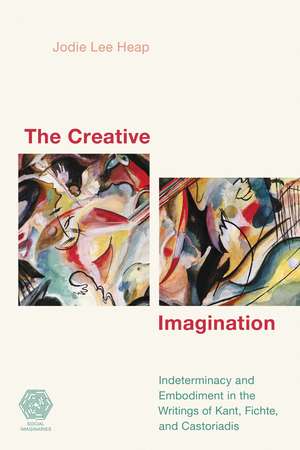
The Creative Imagination: Indeterminacy and Embodiment in the Writings of Kant, Fichte, and Castoriadis: Social Imaginaries
Autor Jodie Lee Heapen Limba Engleză Hardback – 17 iun 2021


Preț: 634.81 lei
Preț vechi: 959.36 lei
-34%
Puncte Express: 952
Carte tipărită la comandă
Livrare economică 30 noiembrie-14 decembrie
Livrare prin curier în România Termenul estimat este afișat lângă disponibilitate.
Transport gratuit pentru acest produs Plată online sau ramburs, în funcție de opțiunile comenzii.
Retur gratuit în 14 zile Comandă securizată și suport în română.
Specificații
ISBN-13: 9781538144268
ISBN-10: 1538144263
Pagini: 260
Dimensiuni: 163 x 227 x 26 mm
Greutate: 0.58 kg
Editura: Bloomsbury Publishing
Colecția Rowman & Littlefield
Seria Social Imaginaries
Locul publicării:New York, United States
ISBN-10: 1538144263
Pagini: 260
Dimensiuni: 163 x 227 x 26 mm
Greutate: 0.58 kg
Editura: Bloomsbury Publishing
Colecția Rowman & Littlefield
Seria Social Imaginaries
Locul publicării:New York, United States
Cuprins
Foreword / John Rundell
Preface: The Indeterminacy of Human Creation.
First Movement: The Unknown Seed of Indeterminacy in the Writings of Immanuel Kant.
Chapter One: The Unknown Seed of Indeterminacy.
Chapter Two: The Productive Imagination - A Power of Synthesis A Priori.
Chapter Three: The Productive Imagination - A Power of Representing.
Chapter Four: The Productive Imagination - A Determinate Power of Exhibition.
Chapter Five: The Productive Imagination - An Indeterminate Power of Exhibition.
Chapter Six: The Productive Imagination - The Act of Creation.
Second Movement: The Absolutely Incomprehensible Seed of Indeterminacy in the Writings of Johann Gottlieb Fichte.
Chapter Seven: The Absolutely Incomprehensible Seed of Indeterminacy.
Chapter Eight: The Absolutely Creative Imagination.
Chapter Nine: The Creative Imagination.
Third Movement: The Radical Seed of Indeterminacy in the Writings of Cornelius Castoriadis.
Chapter Ten: The Radical Seed of Indeterminacy.
Chapter Eleven: The Radical Imagination.
Chapter Twelve: The Radical Imaginary.
Chapter Thirteen: The Creative Imaginary.
Chapter Fourteen: The Creative Imagination.
Fourth Movement: The Embodied Seed of Indeterminacy.
Preface: The Indeterminacy of Human Creation.
First Movement: The Unknown Seed of Indeterminacy in the Writings of Immanuel Kant.
Chapter One: The Unknown Seed of Indeterminacy.
Chapter Two: The Productive Imagination - A Power of Synthesis A Priori.
Chapter Three: The Productive Imagination - A Power of Representing.
Chapter Four: The Productive Imagination - A Determinate Power of Exhibition.
Chapter Five: The Productive Imagination - An Indeterminate Power of Exhibition.
Chapter Six: The Productive Imagination - The Act of Creation.
Second Movement: The Absolutely Incomprehensible Seed of Indeterminacy in the Writings of Johann Gottlieb Fichte.
Chapter Seven: The Absolutely Incomprehensible Seed of Indeterminacy.
Chapter Eight: The Absolutely Creative Imagination.
Chapter Nine: The Creative Imagination.
Third Movement: The Radical Seed of Indeterminacy in the Writings of Cornelius Castoriadis.
Chapter Ten: The Radical Seed of Indeterminacy.
Chapter Eleven: The Radical Imagination.
Chapter Twelve: The Radical Imaginary.
Chapter Thirteen: The Creative Imaginary.
Chapter Fourteen: The Creative Imagination.
Fourth Movement: The Embodied Seed of Indeterminacy.
Recenzii
Elegantly written and illuminating, Jodie Lee Heap's The Creative Imagination explores the way that the imagination is treated in the monumental philosophical works of Kant, Fichte and Castoriadis. As she does this, Heap probes and dissects with great insight the many sides of the imagination: productive, creative, synthetic, antithetical, introspective, social, intuitive, spontaneous, determinate, formative and figurative.
Heap proposes a new way of theorising creative imagination. Through engagement with Kant, Fichte, and Castoriadis, she explores the enabling and disabling powers of indeterminacy embedded in subjects and collectives. This is a fascinating study that breaks new ground by returning anew to western philosophy's original inspiration: to think in and through the indeterminate.
Through a forensic examination of the work of Kant, Fichte and Castoriadis, Jodie Lee Heap reconstructs the concept of a creative imagination that is both free and embodied, reminding us that indeterminacy and determination must be thought together, that the indeterminate being is always this indeterminate being, and that, if indeterminacy transcends boundaries, it is not, thereby, untethered.
Jodie Lee Heap's well writtenand brilliantly researched book is the first proper account of Cornelius Castoriadis's development of the creative imagination from Enlightenment philosophy, in particular Kant's schematism and Fichte's idealist focus on the incomprehensible. Itraises a political question of how to creatively work on the limits, systemic constraints, ruptures, anomies and paradoxes of determinacy, that any critical thinker needs to ask today.
Heap proposes a new way of theorising creative imagination. Through engagement with Kant, Fichte, and Castoriadis, she explores the enabling and disabling powers of indeterminacy embedded in subjects and collectives. This is a fascinating study that breaks new ground by returning anew to western philosophy's original inspiration: to think in and through the indeterminate.
Through a forensic examination of the work of Kant, Fichte and Castoriadis, Jodie Lee Heap reconstructs the concept of a creative imagination that is both free and embodied, reminding us that indeterminacy and determination must be thought together, that the indeterminate being is always this indeterminate being, and that, if indeterminacy transcends boundaries, it is not, thereby, untethered.
Jodie Lee Heap's well writtenand brilliantly researched book is the first proper account of Cornelius Castoriadis's development of the creative imagination from Enlightenment philosophy, in particular Kant's schematism and Fichte's idealist focus on the incomprehensible. Itraises a political question of how to creatively work on the limits, systemic constraints, ruptures, anomies and paradoxes of determinacy, that any critical thinker needs to ask today.