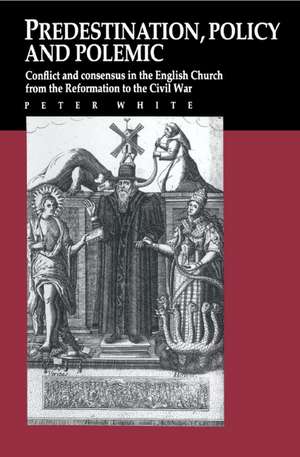
Predestination, Policy and Polemic
Autor Peter Whiteen Limba Engleză Hardback – 27 sep 2007
Preț: 761.39 lei
Preț vechi: 885.34 lei
-14%
Puncte Express: 1142
Carte tipărită la comandă
Livrare economică 28 noiembrie-12 decembrie
Livrare prin curier în România Termenul estimat este afișat lângă disponibilitate.
Transport gratuit pentru acest produs Plată online sau ramburs, în funcție de opțiunile comenzii.
Retur gratuit în 14 zile Comandă securizată și suport în română.
Specificații
ISBN-13: 9780521394338
ISBN-10: 0521394333
Pagini: 352
Dimensiuni: 157 x 235 x 25 mm
Greutate: 0.72 kg
Ediția:New.
Editura: Cambridge University Press
Locul publicării:Cambridge, United Kingdom
ISBN-10: 0521394333
Pagini: 352
Dimensiuni: 157 x 235 x 25 mm
Greutate: 0.72 kg
Ediția:New.
Editura: Cambridge University Press
Locul publicării:Cambridge, United Kingdom
V-ar putea interesa
-
 -26%Preț: 941.34 lei1279.20 lei
 -
 Catholic Identity and the Revolt of the Netherlands, 1520-1635Judith Pollmann-31%Preț: 915.43 lei1331.67 lei
 -
 Heaven in the American ImaginationGary Scott Smith-22%Preț: 341.99 lei438.42 lei
 -
 -13%Preț: 277.23 lei319.88 lei
 -
 The Philokalia and the Inner LifeChristopher C H CookPreț: 404.69 lei
 -
 Saint and NationErin Kathleen RowePreț: 313.35 lei
 -
 A New History of Early ChristianityCharles FreemanPreț: 116.75 lei
 -
 Sacred ViolenceBrent D. ShawPreț: 419.49 lei
 -
 Preț: 392.68 lei
 -
 Preț: 246.21 lei
 -
 With the JocksPeter WhitePreț: 137.54 lei
 -
 La ConquistadoraJaima ChevalierPreț: 95.27 lei
 -
 -11%Preț: 619.17 lei695.69 lei
 -
 The New Knighthood (Canto Classics)Malcolm BarberPreț: 160.04 lei
 -
 Christian Responses to Roman Art and ArchitectureLaura Salah NasrallahPreț: 452.10 lei
 -
 Rituals of SpontaneityLori BranchPreț: 282.94 lei
 -
 Voices of GnosticismMiguel ConnerPreț: 135.06 lei
Cuprins
Preface; Acknowledgements; 1. The polemics of predestination: William Prynne and Peter Heylyn; 2. The theology of predestination: Beza and Arminius; 3. Early English Protestantism; 4. The Elizabethan church settlement; 5. Elizabeth's church: the limits of consensus; 6. The Cambridge controversies of the 1590s; 7. Richard Hooker; 8. The early Jacobean church; 9. The Synod of Dort; 10. Policy and polemic, 1619–1623; 11. A gag for the Gospel? Richard Montagu and Protestant orthodoxy; 12. Arminianism and the court, 1625–1629; 13. Thomas Jackson; 14. Neile and Laud on predestination; 15. The personal rule, 1629–1640; Select bibliography; Index.
Recenzii
"...White takes the reader through an erudite, understandable, and thorough discussion of the various positions taken on the doctrine of predestination in all of its various nuances. Practically everything you ever wanted to know about predestination as it was discussed, particularly in England, between 1500 and 1640 is illuminated by the author....truly brilliant exposition of a complex theological subkect....His care and thoroughness are breathtaking. His writing is provocative fruitful dialogue. Old theses have been challenged and new discussions will begin. White has stirred the waters and must be reckoned with by anyone seeking to get into the territory of theological discourse during the Tudor and Stuart periods of English history....White's book is a "keeper," and it needs to be consumed and digested." Sixteenth Century Journal
"White has given us a pioneering, scholarly, and admirable study of the academic polemics of predestinarianism." American Historical Review
"...this is a useful and significant study, one which students of the English Reformed tradition must not take lightly." Sixteenth Century Journal
"Peter White's first book, appearing shortly before his retirement, is an important contribution to the writing of English church history for the period it covers." Daniel W. Doerksen, Sixteenth Century News
"...historiographically subtle....a fine book that will be a point of departure for future work in this field." Michael G. Finlayson, Journal of Modern History
"White has done an impressive work in reading the Latin works of sixteenth- and seventeenth-century theologians and in analyzing them." John LaRocca, Church History
"This is a landmark study in industrial relations and will be required reading for anyone interested in the causes of strikes in modern industrial societies." Lowell J. Satre, The Historian
"White has given us a pioneering, scholarly, and admirable study of the academic polemics of predestinarianism." American Historical Review
"...this is a useful and significant study, one which students of the English Reformed tradition must not take lightly." Sixteenth Century Journal
"Peter White's first book, appearing shortly before his retirement, is an important contribution to the writing of English church history for the period it covers." Daniel W. Doerksen, Sixteenth Century News
"...historiographically subtle....a fine book that will be a point of departure for future work in this field." Michael G. Finlayson, Journal of Modern History
"White has done an impressive work in reading the Latin works of sixteenth- and seventeenth-century theologians and in analyzing them." John LaRocca, Church History
"This is a landmark study in industrial relations and will be required reading for anyone interested in the causes of strikes in modern industrial societies." Lowell J. Satre, The Historian
Descriere
Arguing against sharp polarities, White denies the existence of any sharply-defined 'Calvinist consensus' into which 'Arminianism' made fateful inroads.