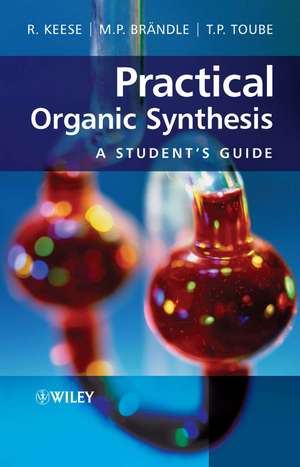
Practical Organic Synthesis
Autor Keese, Brandle, Toubeen Limba Engleză Hardback – 6 iun 2006
Preț: 829.86 lei
Preț vechi: 1136.80 lei
-27%
Puncte Express: 1245
Carte tipărită la comandă
Livrare economică 28 noiembrie-12 decembrie
Livrare prin curier în România Termenul estimat este afișat lângă disponibilitate.
Transport gratuit pentru acest produs Plată online sau ramburs, în funcție de opțiunile comenzii.
Retur gratuit în 14 zile Comandă securizată și suport în română.
Specificații
ISBN-13: 9780470029657
ISBN-10: 047002965X
Pagini: 208
Dimensiuni: 157 x 235 x 17 mm
Greutate: 0.48 kg
Ediția:New.
Editura: Wiley
Locul publicării:Chichester, United Kingdom
ISBN-10: 047002965X
Pagini: 208
Dimensiuni: 157 x 235 x 17 mm
Greutate: 0.48 kg
Ediția:New.
Editura: Wiley
Locul publicării:Chichester, United Kingdom
V-ar putea interesa
-
 -9%Preț: 1575.84 lei1731.70 lei
 -
 Transition Metal HydridesA. Dedieu-9%Preț: 1902.60 lei2090.76 lei
 -
 Flour Confectionery ManufactureC a Street-9%Preț: 1782.11 lei1958.36 lei
 -
 Risk Chemical Process IndustryStone & Webster-9%Preț: 1284.33 lei1411.34 lei
 -
 Handbook Of US Colorants 3eMarmion-9%Preț: 2494.41 lei2741.11 lei
 -
 Methods Biochem Analysis V35Suelter-9%Preț: 2672.10 lei2936.38 lei
 -
 Introduction to Stereochemistry and Conformational AnalysisEusebio Juaristi-9%Preț: 1581.49 lei1737.90 lei
 -
 Bubble Column ReactionsWolf-Dieter Deckwer-9%Preț: 13257.91 lei14569.13 lei
 -
 Potentiometric Water Analysis 2eMidgley-9%Preț: 3437.15 lei3777.09 lei
 -
 Biofilms in BioelectrochemicalBeyenal-9%Preț: 947.84 lei1041.58 lei
 -
 Hydrogen Exchange Mass Spectrometry of ProteinsDavid D Weis-9%Preț: 821.18 lei902.40 lei
 -
 -9%Preț: 989.84 lei1087.74 lei
 -
 -23%Preț: 998.15 lei1296.29 lei
 -
 Bioanalysis of PharmaceuticalsSteen Honore HansenPreț: 481.00 lei
 -
 -9%Preț: 1138.89 lei1251.54 lei
 -
 -9%Preț: 996.19 lei1094.72 lei
 -
 Physikalische Chemie Fur Chem–Techn Ass.F BerglerPreț: 416.88 lei
Public țintă
Introductory text for undergraduate, beginners and laboratory assistants in practical organic chemistry. A guide for advanced students and researchers working in organic synthesis.Notă biografică
Reinhart Keese is the author of Practical Organic Synthesis: A Student's Guide, published by Wiley.
Martin P. Brändle is the author of Practical Organic Synthesis: A Student's Guide, published by Wiley.
Trevor P. Toube is the author of Practical Organic Synthesis: A Student's Guide, published by Wiley.
Martin P. Brändle is the author of Practical Organic Synthesis: A Student's Guide, published by Wiley.
Trevor P. Toube is the author of Practical Organic Synthesis: A Student's Guide, published by Wiley.
Cuprins
Preface. Chapter 1 Accident Prevention and First Aid..
1.1 Safety.
1.2 First Aid.
Chapter 2 Environmentally Responsible Handling of Chemicals and Solvents.
2.1 Dangerous and Poisonous Material.
2.2 Regulations.
2.3 Maximum Concentration Limits.
Chapter 3. Crystallisation.
Chapter 4. Distillation.
Chapter 5. Chromatographic Methods.
5.1 Principles.
5.2 Thin-Layer Chromatography.
5.3 Column Chromatography.
5.4 Flash Chromatography.
5.5 HPLC.
Chapter 6. Extraction and Work-Up.
Chapter 7. Structure Determination Using Spectroscopic Methods.
Chapter 8. Searching the Chemical Literature.
8.1 The Mountain of Information.
8.2 On-Line Databases.
8.3 Reviews.
8.4 Monographs and Handbooks.
8.5 Collections of Data.
Chapter 9. Laboratory Notebooks.
Chapter 10. Writing a Report.
Chapter 11. Example of a Laboratory Report.
Chapter 12 Hints on the Synthesis of Organic Compounds.
12.1 The Route to Success.
12.2 Handling Water and Oxygen Sensitive Substances.
12.3 Working at Low Temperatures.
12.4 Synthesis and Analysis of Optically Active Compounds.
12.5 Synthesis of Isotopically Labelled Compounds.
Chapter 13. Disposal and Destruction of Dangerous Materials.
13.1 Classification of Waste Material.
13.2 Environmentally Acceptable Substances for Treating Dangerous Materials in the Laboratory.
13.3 Special Instructions for the Destruction of the Main Classes of Dangerous Substances.
13.4 Deactivation of Unknown Laboratory Chemicals.
13.5 Waste Disposal.
Chapter 14. Purification and Drying of Solvents.
14.1 Some Drying Agents.
14.2 Solvents.
Chapter 15.EU R and S Phrases.
Index.
1.1 Safety.
1.2 First Aid.
Chapter 2 Environmentally Responsible Handling of Chemicals and Solvents.
2.1 Dangerous and Poisonous Material.
2.2 Regulations.
2.3 Maximum Concentration Limits.
Chapter 3. Crystallisation.
Chapter 4. Distillation.
Chapter 5. Chromatographic Methods.
5.1 Principles.
5.2 Thin-Layer Chromatography.
5.3 Column Chromatography.
5.4 Flash Chromatography.
5.5 HPLC.
Chapter 6. Extraction and Work-Up.
Chapter 7. Structure Determination Using Spectroscopic Methods.
Chapter 8. Searching the Chemical Literature.
8.1 The Mountain of Information.
8.2 On-Line Databases.
8.3 Reviews.
8.4 Monographs and Handbooks.
8.5 Collections of Data.
Chapter 9. Laboratory Notebooks.
Chapter 10. Writing a Report.
Chapter 11. Example of a Laboratory Report.
Chapter 12 Hints on the Synthesis of Organic Compounds.
12.1 The Route to Success.
12.2 Handling Water and Oxygen Sensitive Substances.
12.3 Working at Low Temperatures.
12.4 Synthesis and Analysis of Optically Active Compounds.
12.5 Synthesis of Isotopically Labelled Compounds.
Chapter 13. Disposal and Destruction of Dangerous Materials.
13.1 Classification of Waste Material.
13.2 Environmentally Acceptable Substances for Treating Dangerous Materials in the Laboratory.
13.3 Special Instructions for the Destruction of the Main Classes of Dangerous Substances.
13.4 Deactivation of Unknown Laboratory Chemicals.
13.5 Waste Disposal.
Chapter 14. Purification and Drying of Solvents.
14.1 Some Drying Agents.
14.2 Solvents.
Chapter 15.EU R and S Phrases.
Index.
Descriere
Practical Organic Synthesis provides a concise, useful guide to good laboratory practice in the organic chemistry lab with hints and tips on successful organic synthesis. Topics discussed include safety in the laboratory, crystallization, distillation, writing a report, and much more.