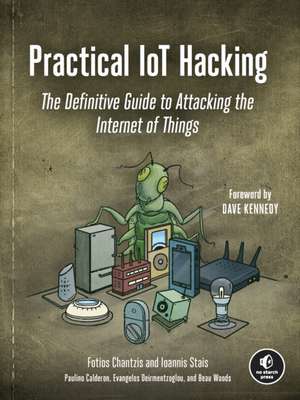
Practical IoT Hacking: The Definitive Guide to Attacking the Internet of Things
Autor Fotios Chantzis, Evangel Deirme, Ioannis Staisen Limba Engleză Paperback – 9 apr 2021
Considerăm că expertiza colectivă a autorilor Fotios Chantzis, Evangel Deirme și Ioannis Stais transformă acest volum dintr-un simplu manual într-o resursă critică pentru securitatea cibernetică modernă. Bazându-se pe cercetări practice de teren, aceștia oferă o perspectivă tehnică riguroasă asupra vulnerabilităților care afectează ecosistemul Internet of Things, de la dispozitive medicale la sisteme de automatizare industrială. Dacă The IoT Hacker's Handbook v-a oferit cadrul teoretic și o introducere în arhitectura dispozitivelor, Practical IoT Hacking oferă instrumentele practice și codul sursă necesar pentru a executa teste de penetrare complexe.
Ne-a atras atenția structura extrem de aplicată: volumul nu se limitează la teorie, ci ghidează cititorul prin procesul de interceptare a traficului radio, analiză de firmware și exploatare a interfețelor hardware fizice. Suntem de părere că abordarea metodologică, ce începe cu modelarea amenințărilor (threat modeling), este esențială pentru orice specialist care dorește să înțeleagă nu doar „cum”, ci și „unde” sunt punctele critice ale unui sistem. Capitolele dedicate protocoalelor precum LoRaWAN, MQTT sau BLE sunt însoțite de exemple de cod personalizat, permițând reproducerea atacurilor într-un mediu controlat. De la bypass-ul autentificării pe microcontrollere STM32 până la manipularea sistemelor de alarmă wireless, textul acoperă întreg spectrul de atac, oferind o claritate tehnică remarcabilă pentru un domeniu atât de fragmentat.
Preț: 287.78 lei
Preț vechi: 443.61 lei
-35%
Carte disponibilă
Livrare economică 06-17 noiembrie
Livrare express 22-28 octombrie pentru 120.19 lei
Specificații
ISBN-10: 1718500904
Pagini: 464
Dimensiuni: 178 x 235 x 32 mm
Greutate: 0.91 kg
Editura: Penguin Random House Group
Colecția No Starch Press
Locul publicării:United States
V-ar putea interesa
-
 Refactoring: Improving the Design of Existing CodeMartin Fowler-20%Preț: 373.37 lei466.71 lei
 -
 Database Design for Mere MortalsMichael J Hernandez-20%Preț: 290.85 lei363.57 lei
 -
 Deep LearningIan Goodfellow-21%Preț: 684.46 lei865.01 lei
 -
 The Code BookSimon SinghPreț: 117.88 lei
 -
 The Code BookSimon SinghPreț: 75.02 lei
 -
 Artificial Intelligence EnginesJames V. Stone-20%Preț: 197.12 lei246.41 lei
 -
 Machine Learning Design PatternsValliappa Lakshmanan-20%Preț: 328.72 lei410.90 lei
 -
 Practical Linear Algebra for Data ScienceMike X Cohen-8%Preț: 404.38 lei439.55 lei
 -
 Mathematics for Machine LearningMarc Peter Deisenroth-20%Preț: 321.21 lei401.51 lei
 -
 Cybersecurity Risk ManagementCynthia Brumfield-20%Preț: 601.03 lei751.29 lei
 -
 Mathematical Aspects of Deep LearningPhilipp Grohs-20%Preț: 542.51 lei678.14 lei
 -
 The Iot Hacker's HandbookAditya Gupta-20%Preț: 271.79 lei339.74 lei
 -
 -36%Preț: 188.12 lei295.22 lei
 -
 Serious Cryptography: A Practical Introduction to Modern EncryptionJean-Philippe Aumasson-36%Preț: 244.93 lei385.48 lei
 -
 The Hardware Hacking Handbook: Breaking Embedded Security with Hardware AttacksJasper van Woudenberg-35%Preț: 280.52 lei429.78 lei
 -
 Deep Learning for Vision SystemsMohamed Elgendy-20%Preț: 348.66 lei435.83 lei
 -
 -36%Preț: 299.83 lei465.21 lei
 -
 -30%Preț: 251.42 lei357.00 lei
 -
 Hands-On Design Patterns with C++Fedor G. Pikus-20%Preț: 293.48 lei366.86 lei
 -
 Expert Python Programming - Fourth EditionMichal Jaworski-20%Preț: 302.02 lei377.52 lei
 -
 Hands-On Mathematics for Deep LearningJay Dawani-20%Preț: 242.93 lei303.66 lei
 -
 Modern Computer Vision with PyTorchV Kishore Ayyadevara-20%Preț: 379.33 lei474.16 lei
 -
 Machine LearningPaul WilmottPreț: 134.74 lei
De ce să citești această carte
Recomandăm această carte profesioniștilor în securitate și administratorilor IT care au nevoie de competențe practice în auditarea dispozitivelor conectate. Veți câștiga capacitatea de a identifica defecte de proiectare în hardware și protocoale de rețea, utilizând echipamente cu costuri reduse. Este un ghid esențial pentru a trece de la securitatea software tradițională la complexitatea mediului IoT.
Descriere
The definitive guide to hacking the world of the Internet of Things (IoT) -- Internet connected devices such as medical devices, home assistants, smart home appliances and more.
Geared towards security researchers, IT teams, and penetration testers, application testers, developers, and IT administrators, this book teaches readers how to get started with hacking Internet connected devices. Readers dig deep into technical (and related legal) issues, as they learn what kinds of devices to use as hacking tools and which make the best targets. The authors, all experts in the field, cover the kinds of vulnerabilities found in IoT devices, explain how to exploit their network protocols, and how to leverage security flaws and certain hardware interfaces found in the physical devices themselves.
The book begins with threat modeling and a security testing methodology, then covers how to attack hardware interfaces such as UART, IᄇC, SPI, JTAG / SWD and IoT network protocols like UPnP, WS-Discovery, mDNS, DNS-SD, RTSP / RTCP / RTP, LoRa / LoRaWAN, Wi-Fi / Wi-Fi Direct, RFID / NFC, BLE, MQTT, CDP and DICOM. Examples throughout offer custom code designed to demonstrate specific vulnerabilities and tools to help readers reproduce the attacks. Practical IoT Hacking is full of practical exercises and hands-on examples taken from the authors' own research that teach readers things like how to bypass the authentication of an STM32F103 device (black pill) through SWD; reverse firmware; exploit zero-configuration networking; use low-cost equipment to capture LoRa network traffic; analyze IoT companion mobile apps, take over and remotely control an Android based treadmill, jam wireless devices such as home alarm systems, hijack Bluetooth Low Energy connections and how to circumvent modern RFID and NFC enabled smart door locks.