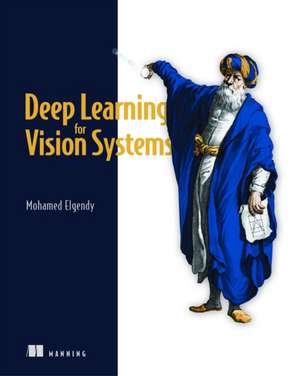
Deep Learning for Vision Systems
Autor Mohamed Elgendyen Limba Engleză Paperback – 10 noi 2020
Ceea ce diferențiază Deep Learning for Vision Systems de documentația oficială a bibliotecilor de profil este modul în care transformă conceptele matematice abstracte în intuiție vizuală aplicabilă. În timp ce documentația se concentrează pe sintaxa API-urilor, această lucrare publicată de Manning Publications explică mecanismele interne ale rețelelor neuronale convoluționale (CNN) folosind doar algebra de liceu, eliminând barierele de intrare pentru dezvoltatorii care nu au un doctorat în matematică. Subliniem abordarea tehnică și extrem de practică a lui Mohamed Elgendy, care ghidează cititorul prin proiecte reale de clasificare a imaginilor și recunoaștere facială. Apreciem structura progresivă a cărții: pornește de la fundamentele Deep Learning, trece prin arhitecturi complexe precum YOLO și SSD pentru detecția obiectelor și culminează cu modele generative (GANs) și stilizare neuronală. Dacă Computer Vision Using Deep Learning de Vaibhav Verdhan v-a oferit cadrul teoretic necesar înțelegerii domeniului, această carte oferă instrumentele practice și studiile de caz necesare pentru a construi sisteme scalabile în lumea reală. Deși autorul este cunoscut și pentru Business Analysis For Beginners, unde pune accent pe identificarea problemelor organizaționale, în Deep Learning for Vision Systems își folosește expertiza dobândită la Amazon și Twilio pentru a trece de la analiză la execuție tehnică pură. Credem că este o resursă esențială pentru a înțelege cum mașinile „învață” să interpreteze mediul înconjurător, oferind un echilibru între claritatea conceptuală și rigoarea implementării codului.
Preț: 349.18 lei
Preț vechi: 436.49 lei
-20%
Carte disponibilă
Livrare economică 11-25 noiembrie
Livrare express 28 octombrie-03 noiembrie pentru 50.18 lei
Specificații
ISBN-10: 1617296198
Pagini: 480
Ilustrații: Illustrations, unspecified
Dimensiuni: 189 x 233 x 27 mm
Greutate: 0.84 kg
Editura: Manning Publications
V-ar putea interesa
-
 Refactoring: Improving the Design of Existing CodeMartin Fowler-20%Preț: 373.37 lei466.71 lei
 -
 Database Design for Mere MortalsMichael J Hernandez-20%Preț: 300.69 lei375.86 lei
 -
 Deep LearningIan Goodfellow-21%Preț: 684.46 lei865.01 lei
 -
 The Code BookSimon SinghPreț: 117.88 lei
 -
 Artificial Intelligence EnginesJames V. Stone-20%Preț: 197.12 lei246.41 lei
 -
 Machine Learning Design PatternsValliappa Lakshmanan-20%Preț: 326.93 lei408.66 lei
 -
 Practical Linear Algebra for Data ScienceMike X Cohen-8%Preț: 418.10 lei454.46 lei
 -
 Mathematics for Machine LearningMarc Peter Deisenroth-20%Preț: 321.51 lei401.89 lei
 -
 Cybersecurity Risk ManagementCynthia Brumfield-20%Preț: 617.00 lei771.25 lei
 -
 Mathematical Aspects of Deep LearningPhilipp Grohs-20%Preț: 542.51 lei678.14 lei
 -
 Business Analysis For BeginnersMohamed ElgendyPreț: 145.58 lei
 -
 -36%Preț: 192.66 lei300.29 lei
 -
 Serious Cryptography: A Practical Introduction to Modern EncryptionJean-Philippe Aumasson-36%Preț: 250.84 lei390.78 lei
 -
 The Hardware Hacking Handbook: Breaking Embedded Security with Hardware AttacksJasper van Woudenberg-35%Preț: 280.69 lei429.78 lei
 -
 -36%Preț: 299.83 lei465.21 lei
 -
 -35%Preț: 287.78 lei443.61 lei
 -
 -20%Preț: 251.45 lei314.31 lei
 -
 Hands-On Design Patterns with C++Fedor G. Pikus-20%Preț: 293.48 lei366.86 lei
 -
 Expert Python Programming - Fourth EditionMichal Jaworski-20%Preț: 302.02 lei377.52 lei
 -
 Hands-On Mathematics for Deep LearningJay Dawani-20%Preț: 269.40 lei336.75 lei
 -
 Modern Computer Vision with PyTorchV Kishore Ayyadevara-20%Preț: 379.33 lei474.16 lei
 -
 Machine LearningPaul WilmottPreț: 134.74 lei
De ce să citești această carte
Recomandăm această carte programatorilor Python care doresc să treacă de la simple scripturi la sisteme complexe de inteligență artificială aplicată. Cititorul câștigă capacitatea de a implementa algoritmi de detecție a obiectelor și generare de imagini folosind tehnici de ultimă oră. Este un ghid practic care transformă teoria matematică în soluții software gata de producție, esențial pentru oricine vrea să lucreze în domeniul vehiculelor autonome sau al securității biometrice.
Despre autor
Mohamed Elgendy este o figură proeminentă în industria inteligenței artificiale, ocupând în prezent funcția de VP of Engineering la Rakuten. Expertiza sa vastă a fost consolidată prin construirea și gestionarea unor produse AI complexe la giganți tehnologici precum Amazon și Twilio. Această experiență practică la nivel enterprise se reflectă în stilul său pedagogic, care prioritizează eficiența și scalabilitatea codului. Deși a scris și despre analiza de business, Elgendy se concentrează aici pe aplicațiile vizuale ale Deep Learning, oferind cititorilor o perspectivă rară din interiorul industriei tech de vârf.
Descriere scurtă
Computer vision is central to many leading-edge innovations, including self-driving cars, drones, augmented reality, facial recognition, and much, much more. Amazing new computer vision applications are developed every day, thanks to rapid advances in AI and deep learning (DL). Deep Learning for Vision Systems teaches you the concepts and tools for building intelligent, scalable computer vision systems that can identify and react to objects in images, videos, and real life. With author Mohamed Elgendy's expert instruction and illustration of real-world projects, you'll finally grok state-of-the-art deep learning techniques, so you can build, contribute to, and lead in the exciting realm of computer vision! Purchase of the print book includes a free eBook in PDF, Kindle, and ePub formats from Manning Publications. About the technology
How much has computer vision advanced? One ride in a Tesla is the only answer you'll need. Deep learning techniques have led to exciting breakthroughs in facial recognition, interactive simulations, and medical imaging, but nothing beats seeing a car respond to real-world stimuli while speeding down the highway. About the book
How does the computer learn to understand what it sees? Deep Learning for Vision Systems answers that by applying deep learning to computer vision. Using only high school algebra, this book illuminates the concepts behind visual intuition. You'll understand how to use deep learning architectures to build vision system applications for image generation and facial recognition. What's inside Image classification and object detection
Advanced deep learning architectures
Transfer learning and generative adversarial networks
DeepDream and neural style transfer
Visual embeddings and image search About the reader
For intermediate Python programmers. About the author
Mohamed Elgendy is the VP of Engineering at Rakuten. A seasoned AI expert, he has previously built and managed AI products at Amazon and Twilio. Table of Contents PART 1 - DEEP LEARNING FOUNDATION 1 Welcome to computer vision 2 Deep learning and neural networks 3 Convolutional neural networks 4 Structuring DL projects and hyperparameter tuning PART 2 - IMAGE CLASSIFICATION AND DETECTION 5 Advanced CNN architectures 6 Transfer learning 7 Object detection with R-CNN, SSD, and YOLO PART 3 - GENERATIVE MODELS AND VISUAL EMBEDDINGS 8 Generative adversarial networks (GANs) 9 DeepDream and neural style transfer 10 Visual embeddings