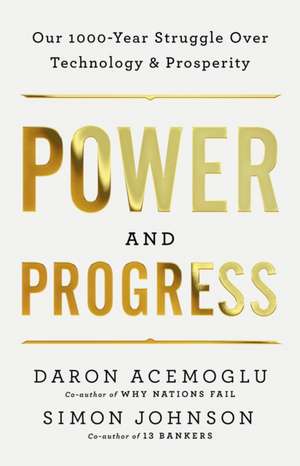
Power and Progress
Autor Daron Acemoglu, Simon Johnsonen Limba Engleză Hardback – 16 mai 2023
Dacă Technology Trap de Carl Benedikt Frey v-a oferit cadrul teoretic pentru a înțelege cum automatizarea polarizează societatea, Power and Progress oferă instrumentele practice și viziunea politică necesară pentru a redirecționa inovația către prosperitate comună. Observăm că autorii Daron Acemoglu și Simon Johnson, recent distinși cu Premiul Nobel pentru Economie, refuză determinismul tehnologic care domină discursul actual. Notăm cu interes cum aceștia demontează mitul conform căruia orice avans tehnologic aduce automat beneficii maselor, demonstrând, prin analize istorice ce acoperă un mileniu, că bogăția generată tinde să fie capturată de elite dacă nu există mecanisme de control social. Descoperim aici o perspectivă riguroasă asupra modului în care alegerile noastre colective pot transforma inteligența artificială dintr-un instrument de supraveghere și înlocuire a forței de muncă într-unul care să sporească productivitatea umană. În contextul operei lor anterioare, Power and Progress continuă explorarea instituțiilor începută în Why Nations Fail și analizează crizele financiare abordate de Johnson în 13 Bankers, dar mută accentul pe tehnologie ca factor de putere. Stilul este autoritar, fundamentat pe date economice solide, însă textul rămâne accesibil, fiind un manifest pentru o societate mai echitabilă în fața schimbărilor digitale radicale.
Preț: 193.62 lei
Carte disponibilă
Livrare economică 03-17 noiembrie
Specificații
ISBN-10: 1541702530
Pagini: 560
Dimensiuni: 170 x 244 x 47 mm
Greutate: 0.82 kg
Editura: PublicAffairs
V-ar putea interesa
-
 The New Geography of InnovationMehran GulPreț: 123.61 lei
 -
 A World Without WorkDaniel Susskind-30%Preț: 65.23 lei93.54 lei
 -
 People, Power, and ProfitsJoseph Stiglitz-30%Preț: 65.59 lei93.82 lei
 -
 GrowthDaniel SusskindPreț: 93.52 lei
 -
 Preț: 115.12 lei
 -
 Preț: 178.75 lei
 -
 Capital in the Twenty-First CenturyThomas PikettyPreț: 163.01 lei
 -
 The Technology Trap - Capital, Labor, and Power in the Age of AutomationCarl Benedikt FreyPreț: 219.37 lei
 -
 Technology TrapCarl Benedikt FreyPreț: 123.98 lei
 -
 Preț: 309.50 lei
 -
 -25%Preț: 82.44 lei109.57 lei
 -
 Power and TechnologyJan Van DijkPreț: 165.67 lei
 -
 The Republic of InnovationAndrea Lorenzo CapusselaPreț: 140.60 lei
 -
 The Progress TrapBen CobleyPreț: 165.76 lei
 -
 -26%Preț: 59.23 lei79.68 lei
 -
 How Silicon Valley Unleashed Techno-feudalismCédric DurandPreț: 99.37 lei
 -
 -17%Preț: 78.48 lei94.71 lei
 -
 -19%Preț: 98.15 lei120.78 lei
 -
 Nature, Culture, and InequalityThomas PikettyPreț: 92.03 lei
 -
 Empire of AIKaren HaoPreț: 145.19 lei
De ce să citești această carte
Veți învăța că viitorul muncii nu este dictat de algoritmi, ci de decizii politice. Cartea se adresează profesioniștilor, decidenților și studenților la economie care doresc să înțeleagă mecanismele prin care tehnologia poate fi modelată pentru a reduce inegalitatea. Este o lectură esențială pentru a înțelege de ce actuala traiectorie a inteligenței artificiale amenință democrația și ce măsuri concrete pot fi luate pentru a schimba acest parcurs.
Despre autor
Daron Acemoglu și Simon Johnson sunt profesori la MIT și laureați ai Premiului Nobel pentru Economie în 2024. Daron Acemoglu este recunoscut la nivel mondial pentru cercetările sale privind originile istorice ale prosperității și efectele tehnologiei asupra ocupării forței de muncă, fiind laureat al Medaliei John Bates Clark. Simon Johnson aduce o experiență vastă în gestionarea crizelor economice globale, servind anterior ca economist-șef al Fondului Monetar Internațional. Expertiza lor combinată oferă o autoritate de neegalat în analiza intersecției dintre putere, instituții și inovație tehnologică.
Descriere
WINNERS OF THE 2024 NOBEL PRIZE FOR ECONOMICS
LONGLISTED FOR THE BAILLIE GIFFORD PRIZE
LONGLISTED FOR THE FINANCIAL TIMES AND SCHRODERS BUSINESS BOOK OF THE YEAR
SHORTLISTED FOR THE LIONEL GELBER PRIZE
A FINANCIAL TIMES TECHNOLOGY BOOK OF THE YEAR
UPDATED WITH A NEW PREFACE
'The blueprint we need for the challenges ahead' Shoshana Zuboff
'If you are not already an addict of Daron Acemoglu and Simon Johnson's previous books, Power and Progress is guaranteed to make you one' Jared Diamond
'A breathtaking tour of the history and future of technology' Abhijit Banerjee and Esther Duflo
A bold new interpretation of why technology benefits the elites - and how we must reshape the path of innovation to create true shared prosperity.
A thousand years of history make one thing clear: progress is not automatic but depends on the choices we make. Much of the wealth generated by agricultural advances during the Middle Ages was captured by the Church while the peasants starved. The first hundred years of industrialization delivered stagnant incomes for workers, while making a few people rich. Throughout the world today, digital technologies and artificial intelligence increase inequality and undermine democracy. It doesn't have to be this way.
Power and Progress demonstrates that the path of technology was once - and can again be - brought under control. With their breakthrough economic theory and manifesto for a better society, Acemoglu and Johnson provide the vision to reshape how we innovate so we can create real prosperity for all.
Daron Acemoglu and Simon Johnson were awarded the Nobel Prize in Economic Sciences on 14 October 2024.
Recenzii
In this brilliant, sweeping review of technological change past and present, Acemoglu and Johnson mean to grab us by the shoulders and shake us awake before today's winner-take-all technologies impose more violence on global society and the democratic prospect. This vital book is a necessary antidote to the poisonous rhetoric of tech inevitability . . . Power and Progress is the blueprint we need for the challenges ahead
One powerful thread runs through this breathtaking tour of the history and future of technology, from the Neolithic agricultural revolution to the ascent of artificial intelligence: Technology is not destiny, nothing is pre-ordained . . . In this age of relentless automation and seemingly unstoppable consolidation of power and wealth, Power and Progress is an essential reminder that we can, and must, take back control
A sweeping history of more than a thousand years of technical change . . . An important book that is long overdue
A book you must read: compelling, beautifully written, and tightly argued, it addresses a crucially important problem with powerful solutions
Acemoglu and Johnson would like a word with the mighty tech lords before they turn over the entire world economy to artificial intelligence. The lesson of economic history is technological advances such as AI won't automatically lead to broad-based prosperity-they may end up benefiting only a wealthy elite . . . it's a bracing wake-up call for the rest of us
This singular book elevated my understanding of the present confluence of society, economics, and technology. Here we have a synthesis of history and analysis coupled with specific ideas about how the future can be improved. It pulls no punches but also inspires optimism
The technology of artificial intelligence is moving fast and likely to accelerate. This powerful book shows we now need to make some careful choices to really share the benefits and reduce unintended, adverse consequences. Technology is too important to leave to the billionaires. Everyone everywhere should read Acemoglu and Johnson - and try to get a seat at the decision-making table
A remarkable analysis of the current drama of technology evolution versus human dignity . . . Acemoglu and Johnson offer a fresh vision of how this drama unfolds by highlighting human capabilities and social skills. They are deeply informed, masters at synthesis, and passionate about shaping a better future where innovation supports equality
Will the AI revolution increase the average worker's productivity while recusing their drudgery, or will it simply create more exploitative and heavily surveilled workplaces run by robotic overlords? That is the right question, and luckily Acemoglu and Johnson have set out to answer it, giving it profound historical context, combing through the economic incentives, and lighting a better path forward
Renowned MIT economists Daron Acemoglu and Simon Johnson explain in their important and lucid book how the transformation of work could make life even worse for most people, or, possibly, much better - depending on the political and social and technological choices we make starting now . . . With revealing, relevant stories from throughout economic history and sensible ideas for systemic reform, this is an essential guide for this crucial battle in the 'one-thousand-year struggle' between the powerful and everyone else
Two of the best economists alive today are taking a closer look at the economics of technological progress in history. Their findings are as surprising as they are disturbing. This beautifully written and richly documented book marks a new beginning in our thinking about the political economy of innovation
Technology is upending our world - automating jobs, deepening inequality, and creating tools of surveillance and misinformation that threaten democracy. But Acemoglu and Johnson show it doesn't have to be this way. The direction of technology is not, like the direction of the wind, a force of nature beyond human control. It's up to us. This humane and hopeful book shows how we can steer technology to promote the public good. Required reading for everyone who cares about the fate of democracy in a digital age
Here, from two of the greatest economists of our time, we have the definitive refutation of the techno-determinist story that has held us back from building a better future for the last four decades. With a bit of luck, we may look back at this as a turning point where we collectively once again took responsibility for defining the world we want technology to empower us to live in together
Faced with fresh upheaval, the authors make a positive case for how societies can maximise the benefits of our powerful new technologies to the advantage of all
A call to arms
Important and absorbing
An important new book
Acemoglu and Johnson would like a word with the mighty tech lords
before they turn over the entire world economy to artificial intelligence.
The lesson of economic history is technological advances such as AI
won't automatically lead to broad-based prosperity - they may end up
benefiting only a wealthy elite. Just as the innovations of the Gilded
Age of American industrialization had to be reined in by progressive
politics, so too, in our Coded Age, we need not only trade unions, civil
society, and trustbusters, but also legislative and regulatory reforms to
prevent the advent of a new panopticon of AI-enabled surveillance.
This book will not endear the authors to Microsoft executives, but it's a
bracing wake-up call for the rest of us
Decisions on how we manage this tension between risk and opportunity are ultimately political. In their remarkable book Power and Progress, economists Daron Acemoglu and Simon Johnson provide a compelling framework for thinking this through