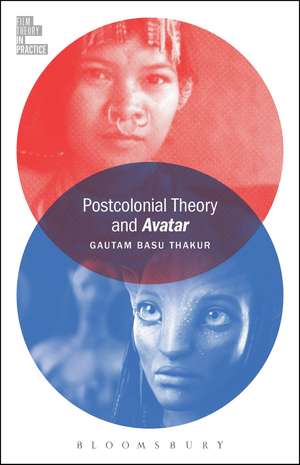
Postcolonial Theory and Avatar: Film Theory in Practice
Autor Gautam Basu Thakuren Limba Engleză Paperback – 17 dec 2015
Avatar is widely celebrated for its politically and culturally sensitive critique of the "West's" neocolonial wars and exploitation of the "global south" - an allegory for (neo)colonialism - and for highlighting the plight of tribal communities throughout the world (for instance, the case of the Dongriah Kondh tribe of India). At the same time, it has been also criticized for repeating the colonialist fantasy of saving natives doomed by imperialist aggression. Intervening in this debate over how to read the film, Basu Thakur focuses on issues of representations, discourse, subalternity, and subjectivity, all of which have been central to postcolonial theory and postcolonial analyses of culture. This history will help students and scholars who are eager to learn more about this important area of theory and bring the concepts of postcolonial theory into practice through a detailed interpretation of the film.
Din seria Film Theory in Practice
- 17%
 Preț: 129.60 lei
 - 10%
 Preț: 111.07 lei
 - 16%
 Preț: 167.08 lei
 - 20%
 Preț: 146.72 lei
 - 11%
 Preț: 166.46 lei
 - 21%
 Preț: 142.27 lei
 - 20%
 Preț: 145.73 lei
 - 21%
 Preț: 142.89 lei
 - 21%
 Preț: 145.42 lei
 - 22%
 Preț: 140.97 lei
 - 15%
 Preț: 146.23 lei
 - 28%
 Preț: 138.57 lei
 - 21%
 Preț: 121.62 lei
 - 21%
 Preț: 117.56 lei
 - 20%
 Preț: 113.15 lei
Preț: 163.07 lei
Preț vechi: 208.31 lei
-22%
Puncte Express: 245
Carte tipărită la comandă
Livrare economică 07-21 decembrie
Livrare prin curier în România Termenul estimat este afișat lângă disponibilitate.
Transport gratuit de la 400.00 lei Plată online sau ramburs, în funcție de opțiunile comenzii.
Retur gratuit în 14 zile Comandă securizată și suport în română.
Specificații
ISBN-13: 9781628925630
ISBN-10: 1628925639
Pagini: 206
Dimensiuni: 122 x 202 x 14 mm
Greutate: 0.23 kg
Editura: Bloomsbury Publishing
Colecția Bloomsbury Academic
Seria Film Theory in Practice
Locul publicării:New York, United States
ISBN-10: 1628925639
Pagini: 206
Dimensiuni: 122 x 202 x 14 mm
Greutate: 0.23 kg
Editura: Bloomsbury Publishing
Colecția Bloomsbury Academic
Seria Film Theory in Practice
Locul publicării:New York, United States
V-ar putea interesa
-
 Into The WoodsJohn Yorke-30%Preț: 65.03 lei93.43 lei
 -
 Seeing Fictions in Film: The Epistemology of MoviesGeorge M. Wilson-13%Preț: 355.47 lei406.78 lei
 -
 The Social Science of CinemaJames C. Kaufman-30%Preț: 650.07 lei926.53 lei
 -
 What Art IsArthur C. DantoPreț: 105.25 lei
 -
 French Cinema: A Student's GuidePhil Powrie-16%Preț: 243.11 lei287.83 lei
 -
 How to Write about Contemporary ArtGilda Williams-17%Preț: 102.54 lei123.50 lei
 -
 Seeing is BelievingPeter Biskind-27%Preț: 89.02 lei121.61 lei
 -
 Cinema IGilles Deleuze-48%Preț: 317.74 lei611.69 lei
 -
 Film Theory for BeginnersRichard Osborne-17%Preț: 61.05 lei73.47 lei
 -
 Preț: 258.96 lei
Cuprins
Introduction
Section 1: The Postcolonial Avatar: A Brief History of Postcolonial Theory
Section 2: Postcolonial Theory and Avatar, Or, Postcolonial Criticism in a Multicultural World
Conclusion
Appendices
- Further Reading
- Filmography
Section 1: The Postcolonial Avatar: A Brief History of Postcolonial Theory
Section 2: Postcolonial Theory and Avatar, Or, Postcolonial Criticism in a Multicultural World
Conclusion
Appendices
- Further Reading
- Filmography
Recenzii
Adopting a fresh perspective as well as inviting a sharp critical stance, the book is a pleasurable and excellent read.
What makes this book particularly compelling is the author's strong voice. Basu Thakur dismantles and revamps postcolonial scholarship with firm conviction, and his film analysis is driven by a desire to uncover what he sees as the truth behind Avatar's beguiling surface.
This erudite and brilliantly provocative book takes us on a familiar journey through the history of post-colonial theory in order to end up in a new place: a critique not of colonialism but instead of the new Eurocentric neo-liberal, globalized subject. Basu Thakur teases us by juxtaposing James Cameron's Avatar with Michael Haneke's Caché. Of these two, it is Caché that surprisingly ends up with the post-colonial laurels for expressing what it is to be 'truly imagined by other worlds,' whereas Avatar is dismissed for re-presenting the fantasy of otherness that supplements the West's on-going performance of its own politically correct, neo-liberal subjectivity. This book will outrage even as it informs, adding new fire to the criticism of what Basu Thakur calls 'the West's unending imaginative vacuity about otherness.'
Straightforwardly written, yet sufficiently critical, Basu Thakur stakes a claim for the resurrection of postcolonial theory as a critical praxis, one that can help us examine the veiled strategies of othering that lay not so much at the margins, but at the very heart of our global Western imagination.
Cogent and lucid, this book is an original contribution to postcolonial theory, and the reading of Avatar follows unexpected avenues toward a new understanding of one of the most popular films of recent decades.
What makes this book particularly compelling is the author's strong voice. Basu Thakur dismantles and revamps postcolonial scholarship with firm conviction, and his film analysis is driven by a desire to uncover what he sees as the truth behind Avatar's beguiling surface.
This erudite and brilliantly provocative book takes us on a familiar journey through the history of post-colonial theory in order to end up in a new place: a critique not of colonialism but instead of the new Eurocentric neo-liberal, globalized subject. Basu Thakur teases us by juxtaposing James Cameron's Avatar with Michael Haneke's Caché. Of these two, it is Caché that surprisingly ends up with the post-colonial laurels for expressing what it is to be 'truly imagined by other worlds,' whereas Avatar is dismissed for re-presenting the fantasy of otherness that supplements the West's on-going performance of its own politically correct, neo-liberal subjectivity. This book will outrage even as it informs, adding new fire to the criticism of what Basu Thakur calls 'the West's unending imaginative vacuity about otherness.'
Straightforwardly written, yet sufficiently critical, Basu Thakur stakes a claim for the resurrection of postcolonial theory as a critical praxis, one that can help us examine the veiled strategies of othering that lay not so much at the margins, but at the very heart of our global Western imagination.
Cogent and lucid, this book is an original contribution to postcolonial theory, and the reading of Avatar follows unexpected avenues toward a new understanding of one of the most popular films of recent decades.
Notă biografică
Gautam Basu Thakur is Assistant Professor of English at Boise State University, USA. He received his Ph.D. in Comparative Literature from the University of Illinois at Urbana-Champaign in 2010 and taught at the University of Mississippi before joining Boise State in 2011. His teaching and research interests include postcolonial literature and theory, transnational/world literature, critical theory with a particular focus on Freudian-Lacanian psychoanalysis, and nineteenth and twentieth-century British literature of the Empire.